Thank you for your suggestion. I am from Kagoshima, but I would like to hide the information of my prefecture. As I often criticize local governments as well as the central government, I think it would be more appropriate for me to conceal my regional information and reveal it case by case. I know that it is useless for the purpose of keeping it secret, but I'm afraid that too much emphasis on my regional information would make somebody feel uneasy.
So, I would like you to allow me to hide my regional symbol for some time.
To tell the truth, I was not concerned about symbols of prefectures in Japan. I was quite unaware that I represented a wrong prefecture's symbol.
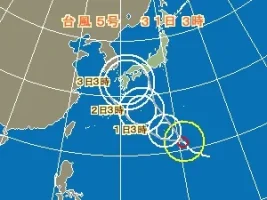
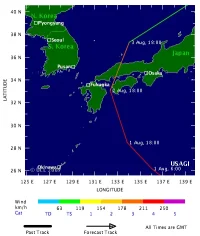
Few Japanese know that the typhoon No.4 is called as typhoon Man-yi in Asian countries. Even if they know any of it, they may think that it is natural for foreigners to call the typhoon in their ways.
They are awfully mistaken.
Since the end of WWII, Asian countries followed American navy rules about how to call typhoons. In Japan typhoons were also called by American women's names, such as Catherine and Ruth. At that time Americans had major responsibility for the observation of typhoons.
In 1951, Japan restored its virtual independence with San Francisco Peace Treaty. Japan restored its original way of naming typhoons by their yearly numbers though all the other Asian countries continued to follow the American system.
Then, Japan attempted to weaken American influence. But the attempt was almost conspiracy.
1. All the related nations including Japan and the US stop calling typhoons by the American names and agree to introduce the unified name table for the typhoon.
2. The unified name table includes all the languages of participating countries in a fair manner.
In 2000, a treaty for the unified typhoon name table was signed. I now remember that, at that time, I thought it was wonderful. For the first a few months, Japan used unified typhoon names as well as Japanese original typhoon names. But I wondered which way the Japanese government would take at the end.
The end soon came. A few months later, Japan gave up using the unified typhoon name. Since then I have not heard any unified typhoon name in the TV weather forecast program. It is a kind of betrayal.
Other Asian countries may not have known the betrayal. But, even if they knew, they couldn't be helped. The US had already given up their original typhoon naming system, expecting all the countries would use the unified system.
Japan ignores the unified system while other Asian countries use the unified name table that includes even Japanese names (See Note 1). This is none other than a betrayal.
That's nothing new. Japan abetted Asian countries to go to war against Western powers during WWII. But Japan's scale of robbery, carnage and rape against Asian countries was no comparison. Comfort women's case is just a tip of the iceberg.
Japan is walking the same path and I believe Japan is resolute for continuing it. This is the reform that Koizumi and Abe talk of. People may begin feeling that Japan smacks of conspiracy. Japan has had it.
--(Note 1)-- Japanese names that are used in the unified name table---
Japan ignores the unified system while other Asian countries use the unified name table that includes even Japanese names. This is none other than a betrayal. This is one example of the reason why Japan is hated by many Asians.
The table includes some Japanese words, such as Tenbin, Usagi, Kanmuri, Koppu, Tokage, Yagi, Kaziki, Kujira, Kompasu, Washi.
At that time, I was actually intimidated with an earthquake notice by a Japanese net stalker. Intimidation was nothing new. But an earthquake notice was an unusual one.
(1) Location near Kashiwazaki-Kariwa Nuclear Power Plant
One of the conspicuous figures related to the nuclear power plant is Toru Hasuike. He was born and brought up in this city. He is the leader of a group of Japanese relatives of people abducted by North Korea. In 1977, He entered the Tokyo Electric Power Company. In 1978, his brother, Kaoru Hasuike, was abducted by North Korean agent. In 2002, he was transferred to Japan Nuclear Fuel as a vice manager of the fuel production department. In 2006, he was promoted to the manager of the nuclear fuel cycle department.
North Korea announced that it shut down and sealed off its 5 nuclear facilities including those at Nyongbyon and that it allowed IAEA inspectors to examine them.
(3) Characteristic : A fire broke out at the nuclear power plant.
(4) Conspiracy theories
1. Japan was isolated and took a beating in the six-country negotiations. The earthquake symbolizes anger and intimidation against North Korea as well as menace to other countries.
2. Kashiwazaki-Kariwa Nuclear Power Plant has a lot of things with North Korea including abductees' issues and problems around Mangyongbong-92, a mixed passenger-cargo ferry running between Wonsan in North Korea and Niigata. This earthquake is particularly suspicious.
3. When 2007 Noto earthquake took place in March, the adjacent nuclear power plant had already shut down. There was a doubt that it might be a conspiracy.
Tis time, there is a possibility that the fire was intentionally set, that the extinction activities were conspicuously slow and that the news coverage was exaggerated.
I have to wonder how long the government intends to continue this funny series of conspiracy.
I have to agree with some of the other posters and say what a crock of cow dung, I have only seen a dribble of physical evidence. My suggestion you get back on your meds as soon as humanly possible. If you have so many preconceived notions why not just leave?
Because it's a signal to countries of its power, beauty and general good quality and desirability. Japan is saying to any country that might be watching, "Look at us! We are so powerful. We can afford to grow this gigantic ornamental tail. Come and follow me, countries!"
This is just what the Japanese prime minister is saying.
This attitude is almost the same as that of peacocks. It's original sentence is as follows.
Look at the most famous of wasteful traits -- the adult male peacock's tail. This huge, elaborate structure is no use for flying. In fact it hinders him, and makes it easier for predators to catch him. And he has to expend a significant amount of energy just growing the thing. So, in evolutionary terms, why do they do it? Because it's a signal to females of the species of his power, beauty and general good quality and desirability. The peacock is saying to any peahen who might be watching, "Look at me! I'm so powerful, I can afford to grow this gigantic ornamental tail. Come and get me girls!" (See Note 1)
------------------
Japan's conspiracy is so humongous, stupid and unimaginable that you can't believe it. I understand your objections. Although I am a very sceptical person, I couldn't realize Japan's conspiracy for many years. Some of my acquaintances claimed that there was conspiracy, I often failed to understand the whole perspective.
The following sentence is part of a Japantimes article.
There is another hypothesis. Some speculate that the real beneficiaries of Mr. Litvinenko's death are those who want to see Mr. Putin put on the defensive. (See Note 2)
I don't want to talk much about Litvinenko's case. But Japan has hated Mr. Putin. Japan tried to buy not Northern Territories (Kuril islands) but to buy the concession by the then Russian President Yeltsin about the territories' handover to Japan. The Japan's attempt seemed to be almost successful. But the next President Putin suddenly stopped the negotiation.
When Mr. Yeltsin died on April 23. Most countries sent the then leaders of them. But Japan ignored this opportunity. I can't find any articles about who represented Japan and attended the funeral.
Intolerable intervene in the internal affairs of Venezuela http://www.yomiuri.co.jp/world/news/20070725i211.htm
南米ベネズエラの松井靖夫駐カラカス日本大使が「日本人はチャベス大統領よりも社会主義者」と発言し、波紋を広げている。
ベネズエラ政府は24日、「受け入れがたい内政干渉だ」として抗議し、大使館側が釈明に追われている。
A remark of a Japanese diplomat caused controversy in Venezuela after he said that Japan was more socialistic than Hugo Chavez.
The maximum tax rate incl. income and local taxes is now 50%, but it used to be 93%!!! just about 30 years ago.
I don't know if Venezuelans would stay in their country with the hefty tax. And Chavez should know that Japan has long had her strict arms control policy.
====a Nobel laureate and 300 million yen robbery ====
One day, I happened to read a book written by Yasunari Kawabata, a Japanese Nobel laureate. But the book was desperately dull and I began to examine his history. His books were written before and during WWII.
When he made a speech at the Nobel Prize award ceremony in 1968, the title of his speech was "Beautiful Japan". At that time, this catch phrase was unusual. But this phrase is just what Prime Minister Shinzo Abe talks of (See Note 1).
I couldn't recognize why he was given the prize. But my story ended there.
Later, I watched a TV special program about the 300 million yen affair in 1968 (See Note 2). I suspected that the incident was a conspiracy. I examined the back ground of the affair. When I read the next morning's newspaper at a newspaper stack in a library, I found that the Nobel Prize was given to Mr. Kawabata on the same day. But I ignored the coincidence. I almost forgot these stories.
later again, as many suspicious things were around us, I tried to examine the relationship between the two cases. I soon found that the robbery was a conspiracy.
At the Nobel Prize award ceremony, laureates have to wear tailcoat. Mr. Kawabat tried to ignore this tradition by wearing Japanese formal kimono (See Note 3). Until the moment of the ceremony, it was unclear for Japan to be able to see him at the ceremony stage. It was a brinkmanship that the Japanese government often takes.
The Japanese government believed that Sweden would give up. But they also had to prepare for the worst, cancel of the prize. The Japanese government was concerned about the next morning's headline news. I believed that the 300 million yen robbery was a fabrication by the government. The reasons are as follows.
1. The robber pretended to be a policeman. It was easy for a policeman to pretend to be a robber pretending to be a real policeman.
2. The police could not arrest any suspects.
3. A son of a policeman who live near the robbery site killed himself with potassium cyanide. There were some reports that he was the true culprit. But it was also a red herring.
4. There are increasing number of cases in which it is unclear whether the arrested are really culprits or not.
5. This kind of conspiracy represents the Japanese government's attitude very well.
6. The mass media's coverage was unusual. There were such robberies too, but others were ignored.
7. Mr. Kawabata killed himself later, but the reason was unknown.
A surprising combination has emerged. I was stunned.
Bangladeshis have been poisoned with arsenic (See Note 1). At first, I couldn't understand the situation at all. But I began recognizing the whole perspective.
For about 30 years, Bangladeshis have been suffering from arsenic poisoning. It is a man-made disaster (See Note 2). I remember that Americans often told me not to eat fish in the river in the US. But now I think it is unnatural. Who poisoned fish? Is it a community's failure?
Then, I thought about the possibility of Japan's involvement with poisoning. For the past about 20 years, there was only one poisoning case in Japan: the mass poisoning of people celebrating a festival in the western town of Sonobe in July 25, 1998 (See Note 3). There was extensive media coverage on this case for quite a long period. I believe that all the Japanese still remember the case still now. The development of the event was extremely unusual and eerie. I checked the date when the poisoning occurred just for confirmation. Again, I was stunned.
On that very day, the impact of an unprecedented scale of flooding became decisive in Bangladeshi, particularly in Dhaka, the Bangladeshi capital. Two-thirds of the whole nation was flooded. At least 730 people were killed. The number of victims was more than 20 million (See Note 4). Rivers in Bangladeshi are so big that the scale and period is larger in general (See Note 5,6 ).
Since then until October, the extensive flooding continued to inundated Bangladeshi. During this period, The media report spree about the arsenic poisoning was unusual in Japan. The suspected woman, TV reporters, the police and juvenile gangs tried to harass and provoke each other. Most Japanese were fed up with watching such funny news day by day. The suspected woman splashed water against TV reporters several times. But the scene was televised again and again. Now I believe that the unusual behavior was just an insinuation to the Bangladeshi flooding (See Note 7,8).
This turmoil ended when she was arrested on October 4. In Bangladeshi, floods began to recede then.
The evidence of conspiracy
1. These periods were almost the same.
2. Both cases have a lot of things to do with arsenic.
3. The culprit was a woman. In Japan, Ms. Hayashi was arrested. In Bangladeshi, the then female prime minister Sheikh Hasina Wajed was arrested this month (See Note 9).
4. Ms. Hayashi insinuated floods by splashing water against TV reporters.
5. Curry was poisoned during a summer festival. Rice and curry was the staple diet in Bangladeshi. Curry poisoning was just an insinuation.
6. Weather terrorism and contamination terrorism was combined and seen in both countries (See Note 10).
7. In Japan, as usual, there was a variety of red herrings (See Note 11).
8. On August 15, 1985, The then Bangladeshi president was assassinated. Just on this day, Japanese prime minister paid an official visit to Yasukuni Shrine. It was the first official visit by the prime minister since the end of World War II. This day was the 40th anniversary of the end of World War II.
9. On August 13, 1985, there was a terrible aeroplane accident. But the cause and consequences were suspicious and eerie (See Note 12).
10. An Indian airplane was exploded in the air by terrorists on June 23, 1985. On that day, Japan held an 40th anniversary of the fall of Okinawa and the suicide of Lieutenant General Ushijima (See Note 13).
11. On August 19,2000, a Japanese prime minister visited Bangladeshi. He wasted his time visiting the place where the former Bangladeshi president was assassinated on August 15, 1985 (See Note 14).
I sincerely hope that this hypothesis is just a nightmare. But I am still afraid that they may be tips of ice bergs.
--(See Note 1)--
( I recently happened to read the article below. )
Millennium Development Goals
The eight commandments
Jul 5th 2007 | DHAKA, KOLKATA AND TIMBUKTU
From The Economist print edition
In 2000 the world set itself goals to cut poverty, disease and illiteracy. It will take more than aid to meet them.
Bangladesh's arsenic poisoning: who is to blame? Thirty years ago, Bangladeshi villages began pumping arsenic-laced water in a development project gone awry.
A communal pot of curry being served to residents of Sonobe district, Wakayama, was poisoned with at least 1000 grams of arsenic--enough to kill over 100 people, on July 25, 1998.
Two children and two adults quickly sickened and died after consuming the curry, and sixty-three others suffered from acute arsenic poisoning. The dead included the council president and vice president of Wakayama, as well as a 10-year old boy and a 16-year old girl.
Bangladesh floods: rich nations 'must share the blame'
Climate modellers are currently unable to make accurate predictions about such extreme events. But in the short term, they can already say that they are likely to become more frequent, even if not necessarily more severe.
For example, 'once-in-20-year' events, such as the current flood, could now occur every five years. This prediction is supported by the fact that the last flood of similar magnitude occurred not 20 years ago (as we might have expected without any global warming) but only six years ago, in 1998.
Of course, this does not prove conclusively that this flood is due to global warming. But the modelling work of climate scientists does suggest the frequency of such floods will be much greater in future than in the past. And that means that we need to be better prepared for such floods in future.
-------------
Why Bangladesh floods are so bad
BBC News
Recently it has been happening on a 10-year cycle. The last major floods were in 1998 and 1988.
Diarrheal Epidemics in Dhaka, Bangladesh, During Three Consecutive Floods: 1988, 1998, and 2004
An individual river's flood stage was defined by the Flood Forecasting Watch Center, Bangladesh. Using this definition, there were four flood-related diarrheal epidemics: September 6 to October 13, 1988; July 25 to October 13, 1998; July 20 to August 21, 2004; and September 16 to October 24, 2004 .
July 24: Prime Minister Sheikh Hasina Wajed requested government bureaucrats and non-government organizations to cooperate with the government at the disaster emergency committee.
July 25: Central Dhaka began to be flooded.
July 26: More than 10 million people suffered from the floods.
July 27: More than 100 people were killed.
August 22: The water height of the Padma river reached its record high 23.52 meters.
Every day I buy a 1.5 liter of Diet Coke from the local Nishitetsu store. This has been my routine for the last year or so. Yesterday there was none in stock... I gave them the benefit of the doubt. Today I went back as usual and AGAIN, none to be found! Therefore... after careful deliberation and conferring with my sources... I can only conclude there must indeed be conspiratorial forces at work to stifle my Gaijin palate. Oh the horror...
I wrote that the then Bangladeshi prime minister was Hasina and that Japan's female suspect poisoner was Hayashi Masumi(See Note 1). But these names rang a bell . Their pronunciations were very similar, particularly in Japanese.
Hasina Wajed
Hayashi Masumi
(Hayashi Masumi is called in English as Masumi Hayashi. In Japanese, they put the family name first and then his or her first name.)
That means Masumi Hayashi was ordered to commit the poisoning crime just because she was female and just because her name was similar to the then Bangladeshi prime minister.
In Japan there are quite a many people who engage in secret jobs. They are said to be 100 percent loyal to a special organization. There are many such people around me. They are sometimes three generations such as grandparents, parents and children.
For that reason, it is thought that they are guaranteed to be given special treatment after arrest.
-----(Note 1)--------------------------------
Japan's Conspiracy (20)
3. The culprit was a woman. In Japan, Ms. Hayashi was arrested. In Bangladeshi, the then female prime minister Sheikh Hasina Wajed was arrested this month (See Note 9).
In February, 2000, the suspect, Masumi Hayashi's house was set on fire, burnt down and demolished.
The site is now a garden park. To tell the truth, the site was auctioned off by the community. It seems that the community has arranged the site for gardening (See Note 1).
The progress of the case was very unusual. Hayashi resolutely refused to answer at the court. And, in the first trial, the judge solely expressed general comments that were apparently made for media coverage (See Note 2).
Suspicion
1. At the summer festival held by the community, 67 people were poisoned and taken to the hospital. Four people including the community leader died at the hospital. It is unusual that the community itself bought the site and enjoys gardening at the site.
2. Hayashi's house was a critical property for both the prosecutors and the accused with regard to the detected arsenic. They can't avoid being accused of destroying evidence.
-------(Note 1)---------------------------------
There was an article about the auction of Hayashi's house.
It is said that the community auctioned off the site.
Hasina Wajed
Hayashi Masumi
(Hayashi Masumi is called in English as Masumi Hayashi. In Japanese, they put the family name first and then his or her first name.)
Unfortunately, this story doesn't stop here. At today's news, a commentator talked about the 1998 Upper House election. Stories come one after another. I am a little tired of writing.
On July 12, 1998, the Liberal Democratic Party suffered a humiliating setback in the Upper House election. The then Prime Minister Ryutaro Hashimoto was forced into a corner. Current Prime Minister Shinzo Abe is in almost the same situation (See Note 1).
On July 25, 1998, there occurred a mass poisoning of people celebrating a festival in the western town of Sonobe. The impact of an unprecedented scale of flooding became decisive in Bangladeshi, particularly in Dhaka, the Bangladeshi capital. Two-thirds of the whole nation was flooded. At least 730 people were killed. The number of victims was more than 20 million.
On July 30, 1998 the then Prime Minister Ryutaro Hashimoto resigned. He continued to refuse to resign for some time. But the Japanese political circles and mass media were already running toward a political realignment (See Note 2).
The reason for the terrorism alarm
1. The circumstances around the current Upper House election are very similar to those around the Upper House election in 1998.
2. Past terrorism in Japan often occurred around a change of government. The timing would be more convenient for the government to evade its responsibility.
3. In the UK, the US and the Middle East, terrorism is most active from July through September.
4. So far, my prediction was often accurate. The devil seems to show off its strength (See Note 3).
5. I live in Kagoshima City. For the past week, Kagoshima City alone was hit by a heat wave with the temperature of 36 degrees Celsius. Considering the past typhoon disaster, I can't help thinking the unusual weather as part of weather terrorism (See Note 4).
6. I have nothing to do with any politicians. I hope that my suspicion will end up a nightmare.
This thread reminds me of a nonsensical phrase from a very old Japanese pop song or something (don't know the original)
ツ「窶嚢窶「テ免竹ニ湛ニ暖窶堋ェツ静披?堋「窶堙娯?堙?ツ、窶彭ツ信窶卩停?堋ェツ坂?壺?堋「窶堙娯?堙?ツ、窶堙昶?堙ア窶堙闇ス窶樞?堋ェヒ?ォ窶堋「窶堙娯?堙ヲツ」
(Post box being red or telephone pole being so high, they are all my fault!)
You can just replace "my fault" with "Japanese government's conspiracy"
Arsenic is known best as a deadly poison, although in small doses it does have medical benefits. BBC News Online looks at the workings of the chemical infamous for its deadly effects.
He is going to come back here and write that the government of Japan through the use of cloud seeding and other star wars related equipment created the typhoon to come and "attack" Japan, excuse me, him!
It reads like something one might expect from a tabloid.
This site uses cookies to help personalise content, tailor your experience and to keep you logged in if you register.
By continuing to use this site, you are consenting to our use of cookies.