Environment Worst drought in three decades strikes Japan

thomas

Unswerving cyclist
Admin
Joined
14 Mar 2002
Messages
21,050
Reaction score
18,903
Water shortages are deepening across Japan as rainfall drops to levels meteorologists characterise as a once-in-30-year low. Riverbeds are emerging in places that would normally be submerged, while reservoirs in several regions have slipped toward record lows. The prolonged dryness is also being linked to a renewed rise in influenza cases.


In Tokyo, parts of the Asakawa River, which runs through Hino and surrounding districts, have dried to the extent that sections of the riverbed can now be crossed on foot. Aerial images suggest the current has all but stalled. Rainfall has been scarce for roughly a month — especially along the Pacific coast — leaving much of the country unusually parched.

Residents report that winter often results in lower water levels, yet some note that they have never observed the river this depleted. The Ogouchi Dam reservoir in Okutama, frequently described as Tokyo's main water store, stood at 40.8% on 13 February, slipping below any level recorded since the start of the Heisei era. City officials are urging households to conserve water—a familiar appeal, though the timing feels more acute this year.

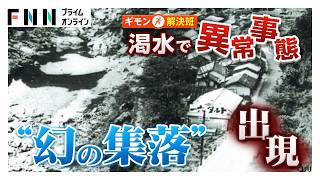
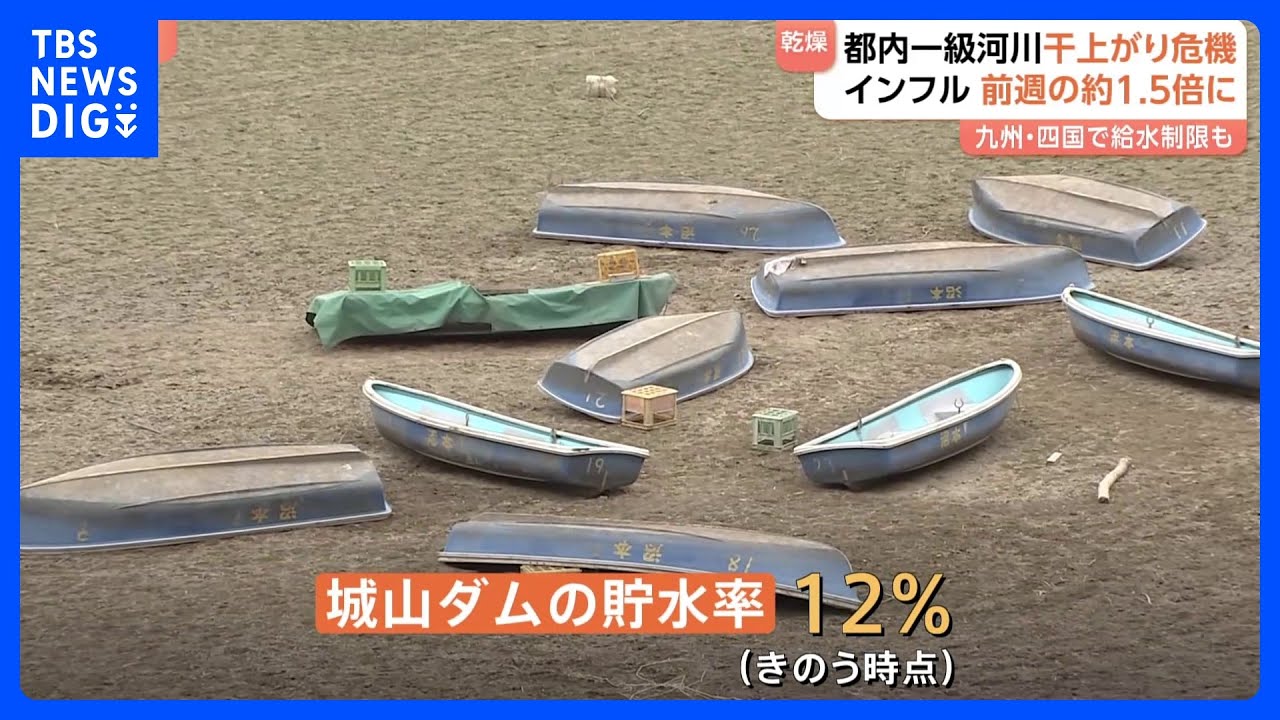
Neighbouring Kanagawa Prefecture is seeing similar conditions. At Lake Tsukui in Sagamihara, a well-known winter smelt fishing site, ground that is normally submerged now lies fully exposed. Stone steps assembled from piled rocks have surfaced in the mud, thought to be traces of a former settlement. One boat-rental operator reports that the business has been entirely closed since November because water levels have not recovered. Nearby, the Shiroyama Dam reservoir measured just 12% as of 16 February.
In western Japan, water supply restrictions have already begun. In Kochi City and 14 municipalities in Fukuoka Prefecture, authorities have started reducing water pressure to curb consumption. Kochi's restrictions mark the first in 28 years. Dry weather has also contributed to a rise in influenza cases. According to the health ministry, about 3,000 medical institutions nationwide reported an average of 43.34 influenza patients per facility in the week ending 8 February, roughly 1.5 times the previous week and the fifth consecutive weekly increase. A clinic director noted that viruses tend to remain airborne longer in dry conditions, increasing the likelihood of infection. The Japan Meteorological Agency expects below-average rainfall to continue for about another month. In central Tokyo on 16 February, temperatures reached levels typical of early April, only to swing back toward winter later that night. Snow was forecast for Tokyo's 23 wards, with possible accumulation depending on conditions.


The Asakawa, Lake Tsukui and the Shiroyama Reservoir are our usual bicycle turf. Shocking to see them with so little or no water at all!
 
Water shortages are deepening across Japan as rainfall drops to levels meteorologists characterise as a once-in-30-year low. Riverbeds are emerging in places that would normally be submerged, while reservoirs in several regions have slipped toward record lows. The prolonged dryness is also being linked to a renewed rise in influenza cases.


In Tokyo, parts of the Asakawa River, which runs through Hino and surrounding districts, have dried to the extent that sections of the riverbed can now be crossed on foot. Aerial images suggest the current has all but stalled. Rainfall has been scarce for roughly a month — especially along the Pacific coast — leaving much of the country unusually parched.

Residents report that winter often results in lower water levels, yet some note that they have never observed the river this depleted. The Ogouchi Dam reservoir in Okutama, frequently described as Tokyo's main water store, stood at 40.8% on 13 February, slipping below any level recorded since the start of the Heisei era. City officials are urging households to conserve water—a familiar appeal, though the timing feels more acute this year.

Neighbouring Kanagawa Prefecture is seeing similar conditions. At Lake Tsukui in Sagamihara, a well-known winter smelt fishing site, ground that is normally submerged now lies fully exposed. Stone steps assembled from piled rocks have surfaced in the mud, thought to be traces of a former settlement. One boat-rental operator reports that the business has been entirely closed since November because water levels have not recovered. Nearby, the Shiroyama Dam reservoir measured just 12% as of 16 February.


The Asakawa, Lake Tsukui and the Shiroyama Reservoir are our usual bicycle turf. Shocking to see them with so little or no water at all!


How's Tamagawa doing, Thomas?
 
Could it be related? Western US--Colorado and a couple few states west of there--are experiencing a drought. News reports of no snow, which is hurting a lot of ski areas. Same area, reservoirs along the colorado river are at (record?) lows. Various states thru which that river flows have been unable to agree on how to parcel out the river water. And Mexico, where it last passes thru, isn't really getting any (tho it's entitled to its share).

I've read that an el niño might be developing:

Tho that doesn't affect the wx and water levels now, or thru spring.
 
Could it be related? Western US--Colorado and a couple few states west of there--are experiencing a drought. News reports of no snow, which is hurting a lot of ski areas. Same area, reservoirs along the colorado river are at (record?) lows. Various states thru which that river flows have been unable to agree on how to parcel out the river water. And Mexico, where it last passes thru, isn't really getting any (tho it's entitled to its share).

I've read that an el niño might be developing:

Tho that doesn't affect the wx and water levels now, or thru spring.
The UK has been exceptionally wet recently. A few days ago, people in Aberdeen saw the sun for the first time in 21 days.
 
Hard to imagine a drought in rainy Japan. I remember a couple of years where the reservoirs that supply Tokyo had gotten to low levels, but they always seemed to rejuvenate after the winter snowfall.

California also came out of its years-long drought, and now the reservoirs are at 100% or more. We'd gotten to very low levels right when I moved here, and there were constant news stories about how bad the drought was, and that even a bit of rain wasn't going to help because the drought was so severe that we'd need several years of record rain to make a dent in the dire situation, and that the ground was so dry that any rain would just run off, and not soak into the ground and replenish the aquifers, etc...

And then we got some record rain, and then some more record rain, and then some more record-breaking rain. So we're out of the woods for now. Wishing the same for Japan and Colorado.
 
More on the drought:

Large parts of Japan, including the Kanto-Koshin and Tokai regions and the Pacific side of Kinki, are facing what the Japan Meteorological Agency describes as a once-in-30-year drought. Rainfall has been scarce for months. Vegetable crops have struggled to grow, and some areas have imposed nighttime water outages as reservoirs run low. At Takihata Dam in Kawachinagano, one of Osaka Prefecture's largest dams, the receding water has exposed the lakebed. Foundations of former houses and stretches of old road from a settlement submerged before the dam's construction have reappeared. An official overseeing the dam said parts of the remains have surfaced in the past, but it is unusual for the entire submerged area to be visible.

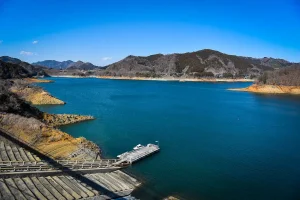
Lake Miyagase in February 2026

Lake Miyagase in February


As of 19 February, the dam's storage rate stood at 20.74%. Authorities have cut water intake by about 85% from normal levels, the toughest restriction since the dam was completed in 1981. The meteorological agency said precipitation has remained low since mid-November on the Pacific side of eastern and western Japan, and since early January on the Pacific side of northern Japan.

The impact on agricultural products has also begun to emerge. According to the farm ministry, open‑field vegetables such as cabbage and daikon radish, which had been more affordable thanks to last autumn's favourable weather, are now exhibiting delayed growth and are smaller.


This is what Lake Miyagase usually looks like:

Lake Miyagase

Travel  Lake Miyagase

Lake Miyagase (宮ヶ瀬湖 Miyagase-ko) is a water reservoir located in Kanagawa Prefecture, west of Machida and Atsugi and north of the Tanzawa Mountains. It is not only a human-made lake that provides Tokyo and Yokohama with drinking water but also a popular tourist destination for one-day trips from...
 
Exciting days for amateur historians: drought conditions have exposed previously submerged villages across Japan.

Record-low rainfall has uncovered parts of a village that sank beneath a riverbed more than 40 years ago in Niyodogawa, Kochi Prefecture. The site, long submerged, has reappeared as water levels fell. The shortage has also left stretches of the Shimanto River close to dry. The drop in flow is affecting ayu fishing and disrupting daily life in nearby communities.


In Niyodogawa, reporters walked through overgrown paths to find remnants of a settlement that had been submerged when a dam was built decades ago. The drop in water levels brought into view rooftops, terraces and other traces of homes once lost beneath the river. Residents who remember the village recalled childhood games played in the valley and visits to a local inn, describing a community that disappeared when the dam flooded the area more than four decades ago. The Odo Dam, one of Kochi's key water sources, recorded a storage rate of 0% for the first time since operations began, far below the typical 80% for this time of year. Although recent rainfall has pushed the level back up to around 17%, officials warn that the situation remains critical. With water levels unusually low, parts of the former Funato settlement—normally hidden beneath the reservoir—have also resurfaced. Foundations of homes, a bathhouse and the remains of a bridge that once connected the village can now be seen. Kataoka Kazuhiko, 74, whose family lived in the village before it was submerged, guided reporters through the exposed site. He pointed out where homes once stood and recalled passing through the area as a child, sometimes receiving a five-yen coin from a relative at a nearby inn. Only the framework of a terrace now remains where guests once gathered for tea and drinks.

 
I'm surprised there hasn't been a national announcement asking people to use water more sparingly. Japanese people tend to be cooperative in such situations (remember the 20-25% reduction in electricity use in the months after the 2011 disaster?), and it would reduce the pressure on wildlife and water supplies.
 
Could Japan, hypothetically, reach out to allies, the US, South Korea, and ask for bottled water to be imported for their citizens to drink, in lieu of using the natural water sources?
 
Could Japan, hypothetically, reach out to allies, the US, South Korea, and ask for bottled water to be imported for their citizens to drink, in lieu of using the natural water sources?
The amount of water that people drink is very small compared with the amount people use directly for washing and flushing and indirectly through the food and other products they consume. Such bottled water would be the proverbial drop in the ocean.
 
Back
Top Bottom