What's the origin of the Japanese people?

* I have found one updated research on Yayoi

The migrations in Yayoi period happened way before there was any nation-state in Korea peninsula.And now,the re-evaluations of carbon 14 had indicated the possibility that maybe Yayoi period began 500 years earlier than previously recognized ( BC 800 ).


It is noteworthy that this is the first time that NMJH has been awarded a Grant-in-Aid for Creative Scientific Research from the Ministry of Education, Culture, Sports, Science, and Technology for research on, "The Origin of the Farming in the Yayoi Period and East Asia: Establishment of High-Precision Chronology by Carbon 14 Age Analysis", the NMJH Centers of Excellence grant since 1997

" The Origin of the Farming in the Yayoi Period and East Asia: Establishment of High-Precision Chronology by Carbon 14 Age Analysis" (2004-2008) (General Organizer: NISHIMOTO Toyohiro)

NMJH has been conducting studies on the application of high-precision C14 dating techniques with the use of Accelerator Mass Spectrometry (AMS).This research was approved in order to confirm preliminary results that the Yayoi period had started in the 10th century BCE, or 500 years earlier than previous archaeological theories have proposed. At the end of 2003, NMJH established a research facility to create a framework for C14 dating experiments. With the award of the grant, the group decided to conduct nation-wide research on age determination, primarily of Yayoi period remains.

In the 2004 fiscal year, more than 2,000 samples of wood, seeds, and carbide residue on earthen vessels were extracted from 190 sites; among them, measurements were conducted on 500 samples. As a result, we speculate that irrigated rice cultivation of the Yayoi cultures first appeared in northern Kyushu approximately 930 BCE and that the "early Yayoi" period began around 800 BCE. We also tentatively concluded that "early Yayoi" culture appeared in the Chugoku and Kinai areas between 700 and 600 BCE, 100 to 200 years later than northern Kyushu. We are also beginning to get a clear picture of ocean reservoir effects and millet.

English Source: http://www.rekihaku.ac.jp/e_kenkyuu/report2004.html

Natl Museum of Japanese History: http://www.rekihaku.ac.jp/english/index.html
 
http://www.rekihaku.ac.jp/kenkyuu/news/index.htm

九州北部の弥生時代早期から弥生時代前期(年表参照)にかけての土器(夜臼Ⅱ式土器・板付Ⅰ式土器)に付着していた炭化物などの年代を、AMS法による炭素14年代測定法によって計測したところ、紀元前約900~800年ごろに集中する年代となった。

http://www.rekihaku.ac.jp/kenkyuu/news/hyou.htm

The above link chart indicates earlier Yayoi periods of northern Kyushu island in concurrent with Zhou Dynasty and Spring & Autumn of China.

http://en.wikipedia.org/wiki/Spring_and_Autumn

http://en.wikipedia.org/wiki/Wu_(state)

http://en.wikipedia.org/wiki/Eastern_Wu

* origin of Kimono ( 呉服 ) or Gofuku ( literally translated as "Costume of Wu" ).

http://www.wa-pedia.com/forum/showthread.php?t=35391
 
"¹l : ƒI[ƒXƒgƒƒlƒVƒAŒn'ÌŒÃ'ã"ú–{•"'°
Hayato : An Austronesian speaking tribe in southern Japan

http://ci.nii.ac.jp/naid/110000577490/en/

* Earliest ancient Chinese history chronicle identified black-teeth indigenous islanders populated present day southern foremost Japanese archipelago.
 
Origin of Japanese

Here are detailed percentages .... :cool:

You are repeating to use the chart of the same source, from 1998 NHK documentary based on professor horai's own independent seminary works.

You did not appreciate the copyright laws by not citing the original sources, and remember you are not quoting the academic sources, but treat commercial sources without giving names, creation date, and company name.

You are also ignoring my comments or warnings of misuse and violation of copyright laws on the publication dates of "original academic sources", so please excuse me to repeat my previous posts below.

Horai published a book in 1997, and results are mostly then-2 years old (listed below), meaning that the chart you give much credits are done on 1990-1995, ancient by the standard of genetic science.

Horai S., Hayasaka K., Kondo R., Tsugane K. and Takahata N.: Recent African origin of modern humans revealed by complete sequences of hominoid mito chondrial DNAs. Proc. Natl. Acad. Sci. USA, 92, 532-536, 1995.
Horai S.: Evolution and origins of man: clues from complete sequences of hominoid mitochondrial DNA. Southeast Asian J. Trop. Med. Publ. Health, 26(Suppl. 1), 146-154, 1995.
Horai S.: Origin of Homo sapiens inferred from the age of the common ancestral human mitochondrial DNA. In The origin and past of modern humans as viewed from DNA (S. Brenner and K. Hanihara, eds.), pp. 171-185, World Scientific, 1995.
1Horai S., Kondo R., Sonoda S. and Tajima K.: The first Americans: Different waves of migration to the New World inferred from mitochondrial DNA sequence polymorphisms. In Prehistoric dispersal of Mongoloids, (T. Akazawa and E. Szathmary, eds.), pp. 270-283, Oxford University Press, 1996.

A chart I quoted below is created in 2005, and 2006, and by the reputed western scholors, for that reason, I tend to believe them comparing to the Horai's studies based on outdated unreliable methodology, without an international team, and published 12 years ago.

What also bothers me is that your comments do not match the description of chart which is highly inappropriate.:okashii:

W-MAP.GIF


Dual origins of the Japanese: common ground for hunter-gatherer
and farmer Y chromosomes


Michael F. Hammer, Tatiana M. Karafet, Hwayong Park et al, 2006
japan1.jpg


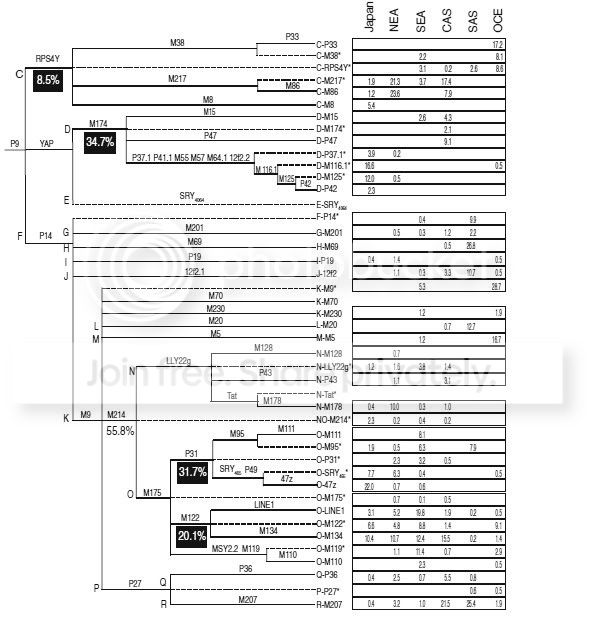
Below is the Hammer's results on the three major genetic lineages of Japanese people.

Haplogroup C (M130, M216)
High frequencies among the indigenous populations of Mongolia, the Russian Far East, Polynesia, Australia, and at moderate frequency in the Korean Peninsula, Manchuria, Japan and India.
*about 10% of Japanese population has Haplogroup C

Haplogroup D (M174)
High frequencies among the indigenous populations of Tibet, Japanese Archipelago (Ainu of Japan), Andaman Islands, Tajikistan
*about 35% of Japanese population has Haplogroup D

Haplogroup O (M175):
High frequencies among the indigenous populations of Austronesia, China (Sino-Tibetan, Han chinese of China), Tai, Cambodia, Vietnam, Hmong-Mien, Japan, Korean Peninsula
*about 50% of Japanese population has Haplogroup O

In case you are refering to Austronesian by Pacific Islanders, you may find the following guide as useful (from MacDonald, 2005).

Haplogroup K (M-9):
High frequencies among Melanesian, New Guinean, indigenous people of Fiji, Solomon Islands
*Japanese people is not known to have this haplogroup.

Haplogroup K is found at low to moderate frequencies (5%) in the indigenous population of South east Asia, Northern Han Chinese and Southern Han Chinese.
 
Origin of Japanese

"¹l : ƒI[ƒXƒgƒƒlƒVƒAŒn'ÌŒÃ'ã"ú–{•"'°
Hayato : An Austronesian speaking tribe in southern Japan
http://ci.nii.ac.jp/naid/110000577490/en/
* Earliest ancient Chinese history chronicle identified black-teeth indigenous islanders populated present day southern foremost Japanese archipelago.

The article is published in 1998, and did not link with updated results of genetic science. Before you post, please give a courtesy of citing publication years and at least an abstract of article.

You are also stating something not in the article. Please be cautious on the use of academic materials.

tokapi said:
Don't forget the view that Northeast Asians (Ainu) mixed with South East Asians ( Malayo-Polynesian speaking peoples) to form the Jomon People.

Your view is new to me, and to mainstream geneticist. Ainu is usually not grouped with Northeast Asian. South east asian is not an isolate gene stock, and known to share the Haplogroup O with all of East Asia, the dominant among East Asians including Southern Han Chinese, Northern Han Chinese.

For details of mainstream geneticist view of Japanese origin, please find the below, and I hope it useful to you.

Genetics
PNAS | August 28, 2001 | vol. 98 | no. 18 | 10244-10249

The Eurasian Heartland: A continental perspective on Y-chromosome diversity

R. Spencer Wellsa,b, Nadira Yuldashevaa,c, Ruslan Ruzibakievc, Peter A. Underhilld, Irina Evseevae, Jason Blue-Smithd, Li Jinf, Bing Suf, Ramasamy Pitchappang, Sadagopal Shanmugalakshmig, Karuppiah Balakrishnang, Mark Readh, Nathaniel M. Pearsoni, Tatiana Zerjalj, Matthew T. Websterk, Irakli Zholoshvilil, Elena Jamarjashvilil, Spartak Gambarovm, Behrouz Nikbinn, Ashur Dostievo, Ogonazar Aknazarovp, Pierre Zallouaq, Igor Tsoyr, Mikhail Kitaevs, Mirsaid Mirrakhimovs, Ashir Charievt, and Walter F. Bodmera,u

ABSTRACT
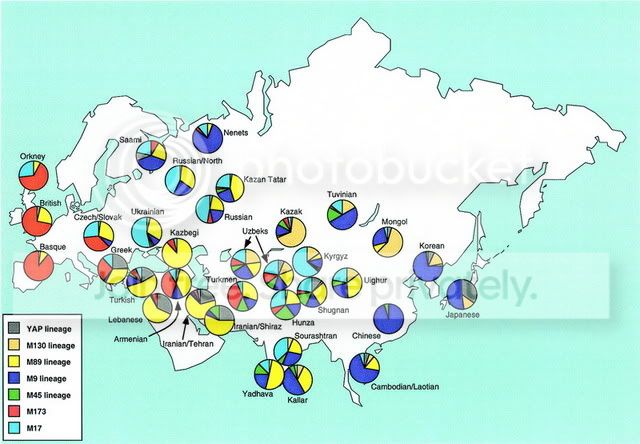
The nonrecombining portion of the human Y chromosome has proven to be a valuable tool for the study of population history. The maintenance of extended haplotypes characteristic of particular geographic regions, despite extensive admixture, allows complex demographic events to be deconstructed. In this study we report the frequencies of 23 Y-chromosome biallelic polymorphism haplotypes in 1,935 men from 49 Eurasian populations, with a particular focus on Central Asia. These haplotypes reveal traces of historical migrations, and provide an insight into the earliest patterns of settlement of anatomically modern humans on the Eurasian continent. Central Asia is revealed to be an important reservoir of genetic diversity, and the source of at least three major waves of migration leading into Europe, the Americas, and India. The genetic results are interpreted in the context of Eurasian linguistic patterns.

pq1713050001-1.jpg


Cranial Morphology
http://www.pnas.org/cgi/content/full/171305898v1

Anthropology
Old World sources of the first New World human inhabitants: A comparative craniofacial view

C. Loring Brace*,, A. Russell Nelson*,, Noriko Seguchi*, Hiroaki Oe˜, Leslie Sering*, Pan Qifeng÷, Li Yongyi, and Dashtseveg Tumen**
* Museum of Anthropology, University of Michigan, 1109 Geddes Avenue, Ann Arbor, MI 48109; Department of Anthropology, University of Wyoming, Laramie, WY 82071; ˜ Department of Statistics, University of Michigan, Ann Arbor, MI 48109; ÷ Institute of Archaeology, Chinese Academy of Social Sciences, 27 Wangfujing Dajie, Beijing 100710, China; Department of Anatomy, Chengdu College of Traditional Chinese Medicine, 13 Xing Lo Road, Chengdu, Sichuan, People's Republic of China; and ** Department of Anthropology, Mongolian Academy of Sciences, Ulaanbaatar-51, Mongolia

Communicated by Kent V. Flannery, University of Michigan, Ann Arbor, MI, June 18, 2001 (received for review January 2, 2001)

Abstract
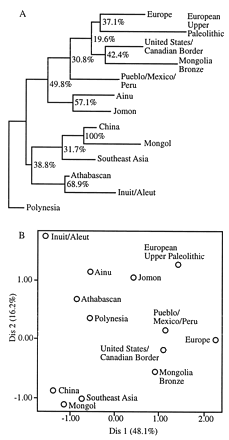
Human craniofacial data were used to assess the similarities and differences between recent and prehistoric Old World samples, and between these samples and a similar representation of samples from the New World. The data were analyzed by the neighbor-joining clustering procedure, assisted by bootstrapping and by canonical discriminant analysis score plots. The first entrants to the Western Hemisphere of maybe 15,000 years ago gave rise to the continuing native inhabitants south of the U.S.-Canadian border. These show no close association with any known mainland Asian population. Instead they show ties to the Ainu of Hokkaido and their Jomon predecessors in prehistoric Japan and to the Polynesians of remote Oceania. All of these also have ties to the Pleistocene and recent inhabitants of Europe and may represent an extension from a Late Pleistocene continuum of people across the northern fringe of the Old World. With roots in both the northwest and the northeast, these people can be described as Eurasian. The route of entry to the New World was at the northwestern edge. In contrast, the Inuit (Eskimo), the Aleut, and the Na-Dene speakers who had penetrated as far as the American Southwest within the last 1,000 years show more similarities to the mainland populations of East Asia. Although both the earlier and later arrivals in the New World show a mixture of traits characteristic of the northern edge of Old World occupation and the Chinese core of mainland Asia, the proportion of the latter is greater for the more recent entrants.

pq1713058004.gif


Fig. 4. A dendrogram based on the samples used to construct Fig. 3, plus a Bronze Age Mongolian group and four others from the Western Hemisphere. (A) The neighbor-joining method was used on 1,000 bootstrap samplings to generate the pattern displayed. (B) The relationships among the groups are also displayed by canonical discriminant function scores. The first discriminant function accounts for 48% of total variation, and the second accounts for 16%.

Japanese has multiple origins, and I can briefly categorize them into three categories.

(1) Yayoi (North East Asian) Japanese (Continental, Korean, Manchus, Mongols)

(2) Yayoi (South East Asian) Japanese (Continental, Han Chinese, Hmong, Vietnamese, Cambodian, Thais, Phillipinos)

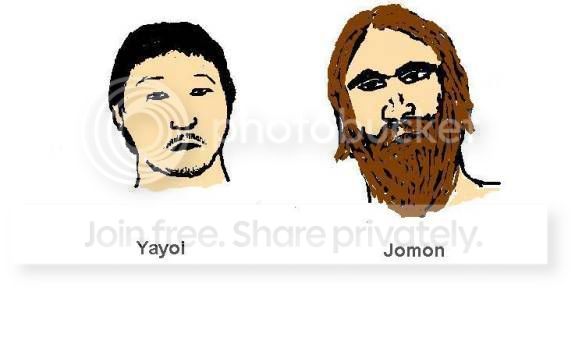
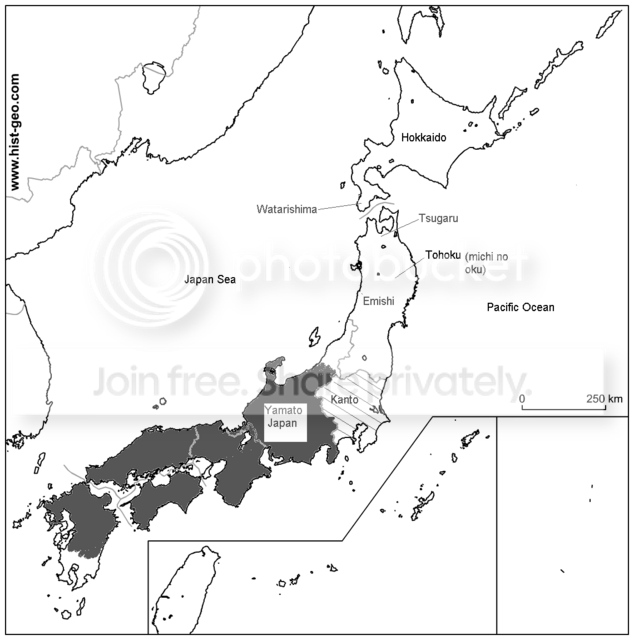
(3) Jomon Japanese (Emishi-tohoku, Ainu-hokkaido, Kumaso-kagoshima, Ryukyuan-okinawa, and people rooted in shikoku and kanto, and others who interbreds with Yayoi. Note: Ancient Japanese Knight's class', samurai , crania were known to be much common with Ainu.)

The Emishi: What Anthropology tells us
http://www.emishi-ezo.net/emishi_anthro.html

Who Were the Emishi?
http://www.isn.ne.jp/~suzutayu/MHJapan/WhosEmishi.html

The pictures below were from emshi-ezo.net.

image002.jpg

image001.png
 
Last edited:
Deja vu

On the similarity of materials to those posted on other forum

Please have a look at:

Japan's Yayoi period, updated research
http://www.chinahistoryforum.com/index.php?showtopic=21329

User dingy posted very similar materials like yours, tokapi although dingy was banned for his/her trolling, and for statement without courtesy of authors dingy quoted. dingy's use of obscure materials also worsened his/her reputation to effect his/her bans from the forum.

Anyway, I wanted to point this out to Tokapi because you, Tokapi, should know that you are either quoted, or quoting the similar materials on other forum.:blush:
 
Dual origins of the Japanese:

A set of 81 Y chromosome single nucleotide polymorphisms (SNPs) was used to trace the origins of Paleolithic and Neolithic components of the Japanese paternal gene pool, and to determine the relative contribution of Jomon and Yayoi Y chromosome lineages to modern Japanese. Our global sample consisted of >2,500 males from 39 Asian populations, including six populations sampled from across the Japanese archipelago.

a Southeast Asian origin of the ancestors of the Yayoi,contra previous models based on morphological and genetic evidence.

http://www.springerlink.com/content/p31g0300430k6215/

I would say any sample below 2,000, any sampling that does not strictly follow a well defined statistical method be kept at bay by calling them hypotheses.

The small sample size is enough to raise serious doubts about the reliability of the study; most genetic group studies conducted these days suffer from the same problem. Furthermore, the sampling method employed is not even defined.Often times academic studies are hampered by such fundamental flaws lending numerous theoretical and factual errors to creep in. Academic publishing has become more an issue of competition for suvival pushing otherwise good intuitions to deteriorate into sensational hypothesising that stops at just that. The temptation to manipulate data by "weeding out" unfavourable "stray occurences" to force statistics with superficial appeal are sometimes detected, but not always. The extent to which dishonest science has become fashionable is a problem that needs to be addressed before getting too serious about any particular study result.


Actually,in term of looks,Japanese and Korean look quite different. Majority modern day Koreans have broad face and big head whereas the Japanese typically have sharp narrow face and small head.Also,most Koreans are stocky build oppose to the Japanese are mostly smaller build.

Great disparity of these basic physical characteristics are sufficient to ' debunk ' any argument that Japanese and Koreans are more closely related than with other NE Asian group
 
The Japanese are more ' indigenous ' than you all previously believed.


Abstract:

Based on the frequencies of these two clades (my note - Y haplogroups D, O-P31 and O-M 122, which account for 86.9% of Japanese Y haplogroups), we estimate the Jomon contribution to modern Japanese to be 40.3%, with the highest frequency in the Ainu (75%) and Ryukyuans (60%). On the other hand, Yayoi Y chromosomes account for 51.9% of Japanese paternal lineages, with the highest contribution in Kyushu (62.3%) and lower contributions in Okinawa (37.8%) and northern Honshu (46.2%). Interestingly there is no evidence of Yayoi lineages in the Ainu.

...and...

In summary, our data suggest that Paleolithic male lineages entered Japan at least 12,000-20,000 years ago from Central Asia, and were isolated for thousands of years once land bridges between Japan and continental Asia disappeared at the end of the last glacial maximum (~12,000 years ago). More recently, Y chromosomes that originated in Southeast Asia expanded to Korea and Japan with the spread of wet rice agriculture. The ages and spatial patterns of haplogroups D and O in Japan are concordant with the hypothesis that Y chromosomes spread via a process of demic difussion during the Yayoi period (Sokal and Thomso, 1998). Each of the populations carrying these differentiated lineages made separate contributions to modern Japanese, both genetically and culturally. In contrast to previous models, we propose that the Yayoi Y chromosomes descend from prehistoric farmers that had their origins in Southeastern Asia, perhaps going back to the origin of agriculture in this region. This places the Yayoi in the context of other population expansions stimulated by the acquisition of agriculture, whereby farmer societies gained advantage over hunter-gatherer societies (Diamond and Bellwood, 2003). In this case, however the Jomon hunter gatherers may have held off the onslaught of farmers for thousands of years as a result of their highly succesful brand of subsistence.The data indicate, however, that Jomon genes survive in contemporary Japanese, possibly because their unique and varied culture complemented that of the immigrant famers.

From Michael F. Hammer et al. (2005)


Here is one academic research on ' dual origins ' of the Japanese.

A set of 81 Y chromosome single nucleotide polymorphisms (SNPs) was used to trace the origins of Paleolithic and Neolithic components of the Japanese paternal gene pool, and to determine the relative contribution of Jomon and Yayoi Y chromosome lineages to modern Japanese. Our global sample consisted of >2,500 males from 39 Asian populations, including six populations sampled from across the Japanese archipelago. Japanese populations were characterized by the presence of two major (D and O) and two minor (C and N) clades of Y chromosomes, each with several sub-lineages. Haplogroup D chromosomes were present at 34.7% and were distributed in a U-shaped pattern with the highest frequency in the northern Ainu and southern Ryukyuans. In contrast, haplogroup O lineages (51.8%) were distributed in an inverted U-shaped pattern with a maximum frequency on Kyushu. Coalescent analyses of Y chromosome short tandem repeat diversity indicated that haplogroups D and C began their expansions in Japan ~20,000 and ~12,000 years ago, respectively, while haplogroup O-47z began its expansion only ~4,000 years ago. We infer that these patterns result from separate and distinct genetic contributions from both the Jomon and the Yayoi cultures to modern Japanese, with varying levels of admixture between these two populations across the archipelago. The results also support the hypothesis of a Central Asian origin of Jomonese ancestors, and a Southeast Asian origin of the ancestors of the Yayoi, contra previous models based on morphological and genetic evidence.

http://www.springerlink.com/content/p31g0300430k6215/


* In geographic accuracy,SE Asia ( which has been false representative of Thailand Vietnam Burma Cambodia,these nations are nowhere near eastern part of Asia continent ) is China's coastal region of Jiangsu & Zhejiang provinces.
 
Last edited:
The Fallacy of Sinophobia

There is a major misconception that has been pushing certain Japanese and Korean scholars to find non-Chinese origin for them to feel safe, but the source of their fear was a phantom, a propagandist claim within their neo-Confucian factions that used sinocentrist rhetoric of their times to gain unfair advantage over liberalist ideas.

One needs not fight a Chinese enemy that does not exist. The great diversity of the origin and evolution of Chinese civilisation that has been gaining steady momentum should rid the need for pursuing a non-Chinese origin for there is no such thing as a single Chinese origin.

It is to point out the fact that many Japnaese and Korean sources blindedly followed the "Out-of-Lake Baikal/Mongol Hypothesis of Japanese/Korean Origin" which has become rather popular during the 1970's in the so-called Egami's "Horserider Theory of Japanese Origin.".But this theory has few supporters nowadays,as it has been heavily criticized from an archeological point of view.
 
Korean males don't carry DNA YAP+ that 50% of Japanese counterparts have.Ainu not even related to Korean populations ( past and present ),*Jomon contribution to modern Japanese to be 40.3%

Consider the *Yayoi Y chromosomes account for 51.9% of Japanese paternal lineages,which has a Southeast Asian origin established by *2005 academic source.How is Japanese ethnicity place in NE Asian racial group not more genetically related to continental SE Asian peoples ?!

Overall modern day Koreans don't have a definite ' SE Asian ' origin component in their gene pool as is the case for both Chinese & Japanese are of ' dual NE & SE Asian origins '.

* http://www.springerlink.com/content/p31g0300430k6215/

Final point,nearly 50% of immigrants via Korea peninsula in 4th or 5th century were actually Chinese ancestry,their familiy registries recorded in Japan's Shoban 諸蕃.

http://www.myj7000.jp-biz.net/clan/03/03.htm
 
...
One needs not fight a Chinese enemy that does not exist. The great diversity of the origin and evolution of Chinese civilisation that has been gaining steady momentum should rid the need for pursuing a non-Chinese origin for there is no such thing as a single Chinese origin.
...

So true. And probably patriotic Han Chinese people may claim the Qin and the Tang dynasty were the great dynasties by the Han Chinese, but it is really hard to define what was the Han-Chinese ruled dynasty.
 
According to genetic science, chinese are mostly composed of homogeneous people.

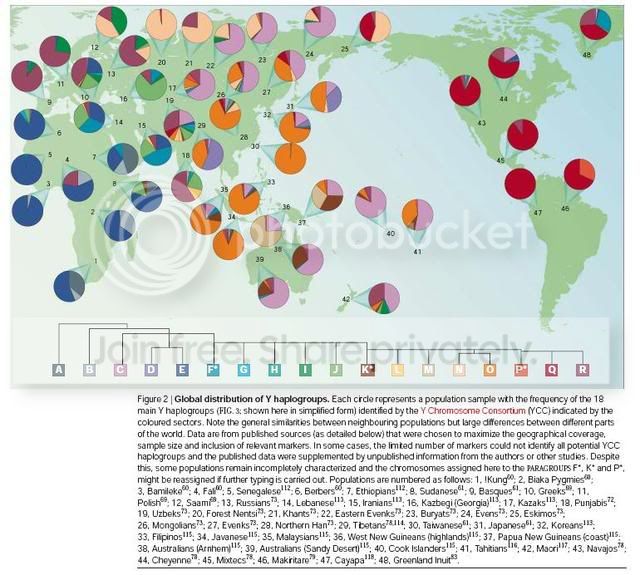
WorldYHaplo-1.jpg


(28) Chinese (Northern Han)
(31) Japanese
(32) Koreans
(33) Philipinos
(35) Malaysians

Majority of Northern Han Chinese shares a lineage with south east asian.
 
China is a wonderful diverse place same as America.


HGM2002 Poster Abstracts: 11. Genome Diversity
------------------------------------------------------------------

Study of Korean Male Origins

Sunghee Hong, Seong-Gene Lee, Yongsook Yoon, Kyuyoung Song
University of Ulsan College of Medicine, 388-1 Poongnap-dong, Songpa-ku, Seoul, Korea

Population studies of genetic markers such as HLA variation and mitochondrial DNA have been used to understand human origins, demographic and migration history. Recently, diversity on the nonrecombining portion of the Y chromosome (NRY) has been applied to the study of human history. Since NRY is passed from father to son without recombination, polymorphisms in this region are valuable for investigating male-mediated gene flow and for complementing maternally based studies of mtDNA. Haplotypes constructed from Y-chromosome markers were used to trace the paternal origins of Korean. By using 38 Y chromosome single nucleotide polymorphism markers, we analyzed the genetic structure of 195 Korean males. The Korean males were characterized by a diverse set of 4 haplogroups (Groups IV, V, VII, X) and 14 haplotypes that were also present in Chinese. The most frequent haplogroup in Korean was Group VII (82.6%). It was also the most frequent haplogroup in Chinese (95%) as well as in Japanese (45%). The frequencies of the haplogroups V, IV, and X were 15.4%, 1%, and 1%, respectively. The second most frequent haplogroup V in Korean was not present in Chinese, but its frequency was similar in Japanese.

http://hgm2002.hgu.mrc.ac.uk/Abstracts/Publish/WorkshopPosters/WorkshopPoster11/hgm0542.htm


* Professor Masao Oka on " Race,Ethnicity,Migration of Japan ",an archaeologist noted the Japanese people came from 5 population groups.

(1) north-eastern Asiatic Tungusic
(2) Austro-Asiatic
(3) Altaic group
(4) south-eastern Asiatic group of Austronesian origin
(5) ethnic group of Melanesian origin

http://books.google.com/books?id=_f...GMHZmU_&sig=c-Pdpbru408IkAJhg_rwv_IXXqo&hl=en
 
More about the research:
In recent years, more archaeological and genetic evidence have been found in both eastern China and western Japan to lend credibility to this argument. Between 1996 and 1999, a team led by Satoshi Yamaguchi, a researcher at Japan's National Science Museum, compared Yayoi remains found in Japan's Yamaguchi and Fukuoka prefectures with those from early Han Dynasty (202 BC-8) in China's coastal Jiangsu province, and found many similarities between the skulls and limbs of Yayoi people and the Jiangsu remains.[8] Two Jiangsu skulls showed spots where the front teeth had been pulled, a practice common in Japan in the Yayoi and preceding Jōmon period. The genetic samples from three of the 36 Jiangsu skeletons also matched part of the DNA base arrangements of samples from the Yayoi remains.
Surprisingly, Japanese also display the highest frequency of haplogroup O3a5, which is a Han Chinese and Sino-Tibetan specific O3 branch.
Xue et. al.
Japanese
Haplogroup O3a5 (O3e) 10/47= 23%
This frequency is about 5% higher than the frequency of O3a5 among Manchus, Koreans and other Northeast Asians.
For North Koreans, the frequency of O3a5 is lower than some Tungusic populations. Overall, the Koreanic haplogroup O3 were the least influenced by Sinitic populations.

Whereas pure haplogroup C3 (M217) was observed at a high frequency among Tungusic (20%) and Koreanic (16%) populations. The frequency of haplogroup C3 among Japanese was only 1%. This means Japanese origins were NOT from Siberia.

Haplogroup D was observed among Japanese (25%) and Tibetans (40%). Was also observed among Han Chinese, Mongolians and Koreans.

DNA sequence SNP study done by Japanese researchers in 2005.

Biggest contributor of DNA of each East Asian people is bolded
Korean DNA sequence is made up of:
40.6% Uniquely Korean
21.9% Chinese
1.6% Ainu
17.4% Okinawan
18.5% Unidentified

Japanese DNA sequence is made up of:
4.8% Uniquely Japanese
24.2% Korean
25.8% Chinese
8.1% Ainu
16.1% Okinawan
21% Unidentified

Chinese DNA sequence is made up of:
60.6% Uniquely Chinese
1.5% Japanese
10.6% Korean
1.5% Ainu
10.6% Okinawan
15.2% Unidentified

The biggest components in Japanese are Chinese, Korean, Okinawan.
It's a fact that Korean peninsula was not as isolated as Japanese islands. But, this meant one people could settle on the peninsula, but Japan became an island of migrants. This is maybe why Koreans have the least Japanese and Chinese components, whereas Japanese and Chinese have higher Japanese and Chinese components to their DNA.
 
More about the research:
In recent years, more archaeological and genetic evidence have been found in both eastern China and western Japan to lend credibility to this argument. Between 1996 and 1999, a team led by Satoshi Yamaguchi, a researcher at Japan's National Science Museum, compared Yayoi remains found in Japan's Yamaguchi and Fukuoka prefectures with those from early Han Dynasty (202 BC-8) in China's coastal Jiangsu province, and found many similarities between the skulls and limbs of Yayoi people and the Jiangsu remains.[8]
This is interesting. If you try Japanese cuisine and Huaiyang cuisine (http://en.wikipedia.org/wiki/Huaiyang_cuisine), you will find out that these two share a lot. Some of my Chinese friends even say that Shanghai dialect (Wu Dialect) sounds like Japanese :blush:.
 
Japanese/Koguryo Languages

A book which investigates the relationship between the Japanese and Koguryoic Languages:

Koguryo: The Language of Japan's Continental Relatives: An Introduction to the Historical-Comparative Study of the Japanese-Koguryoic Languages
 
A book which investigates the relationship between the Japanese and Koguryoic Languages:
Koguryo: The Language of Japan's Continental Relatives: An Introduction to the Historical-Comparative Study of the Japanese-Koguryoic Languages

Well,the relation between Japanese, Korean, and other Altaic languages has not been settled. It's hard to say which scholar's argument holds true.
 
Koguryoan/Japanese

Indeed, these are contested points. Nonetheless, a strong case for relationship with Koguryoan has been made here.
 
Indeed, these are contested points. Nonetheless, a strong case for relationship with Koguryoan has been made here.
Any scholar who asserts particular connection to proto-Japanese would say their theory is more convincing than others. A quick googling led to me the following article severely criticizing the book:
Unfortunately, Beckwithfs ambitious work is heavily flawed in many aspects, of
which I will provide only a few examples. First, I deplore the general opacity of his
methodology, since most of his reconstructions are his own, quite different from the
ones adopted in mainstream Chinese (Baxter 1992; Sagart 1999; Starostin 1989, 1998-
2003) and Japanese (Martin 1987) historical phonology, and it is unclear how they were
arrived at. His comparisons thus use reconstructions that are too often problematic,
sometimes simply incorrect, or, worse, just circular.
The review concluded,
In conclusion, Beckwithfs book is a valuable attempt to have a new look at the
Koguryo fragments, within the broader scale of a global ethnolinguistic study of
Ancient Eastern Asia. Nevertheless, its too many methodological shortcomings forbid
us to accept Beckwithfs reconstructions and conclusions, although it is quite clear that
some of the Koguryo place names indeed represent in all likelihood a language related
to Japanese that was once spoken in the center of the Korean peninsula.
http://hal.archives-ouvertes.fr/docs/00/19/41/11/PDF/review-Beckwith-Koguryo.pdf
 
Koguryoic relationship theory is quite old, I had made a valid quotation on another thread:

"The essence of my model is as follows. I contend that
the Jōmon culture (c. 10,000–300 BCE) on the Japanese
archipelago was the product of Ainu and Malayo-Polynesian
people, while the Yayoi culture (c. 300 BCE-300 CE) was the
product of Kaya (Karak) people from the southern Korean
peninsula together with Ainu and Malayo-Polynesian
aborigines. The proto-Japanese people, speaking proto-
Japanese language, were formed during the Yayoi period. I
contend that the Kaya dialect of the Korean language provided
the basic structure of the proto-Japanese language although
lexically (in loan words) and phonologically (in sound), the
influence of Ainu and Malayo-Polynesian languages was
substantial.
I also regard the early tomb culture (c. 300-375 CE)
as an extension of the Yayoi culture.
The late tomb culture (c. 375-675 CE) was, however,
brought about by the Yamato kingdom, the first unified state
on the Japanese islands that was newly established at the end
of the fourth century by the Paekche people from the Korean
peninsula. Syntactically (in patterns of word arrangement) and
morphologically (in systems of word formation), the similarity
between the Korean and Japanese languages was very much
strengthened. However, the lexical and phonological influence
of the Ainu and Malayo-Polynesian languages cast a long
shadow on the subsequent evolution of the Japanese language.

Therefore, by the early ninth century at the latest, due to ever
increasing lexical, semantic (in meaning) and phonological
differences, the people of the Korean peninsula and the people
of the Japanese islands could no longer directly communicate
with each other without interpreters."

My observation is that formation of Yamato coincide with the findings of early Kaya tombs and Kaya styled objects inside the tombs.
 
I
contend that the Kaya dialect of the Korean language provided
the basic structure of the proto-Japanese language although
lexically (in loan words) and phonologically (in sound), the
influence of Ainu and Malayo-Polynesian languages was
substantial.
Can you clarify the status of the proto-Japanese language? Was it a pidgin/creol or a second language spoken by the speakers of the Kaya dialect or by the speakers of the an Ainu or Malayo-Polynesian language?


Syntactically (in patterns of word arrangement) and
morphologically (in systems of word formation), the similarity
between the Korean and Japanese languages was very much
strengthened. However, the lexical and phonological influence
of the Ainu and Malayo-Polynesian languages cast a long
shadow on the subsequent evolution of the Japanese language.

Therefore, by the early ninth century at the latest, due to ever
increasing lexical, semantic (in meaning) and phonological
differences, the people of the Korean peninsula and the people
of the Japanese islands could no longer directly communicate
with each other without interpreters.
This sounds like the Ainu and Malayo-Polynesian languages were the substrata of the proto-Japanese language. So, are you saying the proto-Japanese language started as a second language spoken by the Ainu and Malayo-Polynesian people?
 
Can you clarify the status of the proto-Japanese language? Was it a pidgin/creol or a second language spoken by the speakers of the Kaya dialect or by the speakers of the an Ainu or Malayo-Polynesian language?


This sounds like the Ainu and Malayo-Polynesian languages were the substrata of the proto-Japanese language. So, are you saying the proto-Japanese language started as a second language spoken by the Ainu and Malayo-Polynesian people?


It was pretty much like the early Germanic migrants to UK who led a segregated life from natives and didn't mix (much) with them. Japanese commoners at that time didn't wear clothes, only nobles did.

http://news.bbc.co.uk/2/hi/science/nature/5192634.stm
 
Back
Top Bottom