Politics Why Koreans think Japan isn’t sorry

thomas

Unswerving cyclist
Admin
Joined
14 Mar 2002
Messages
21,050
Reaction score
18,903
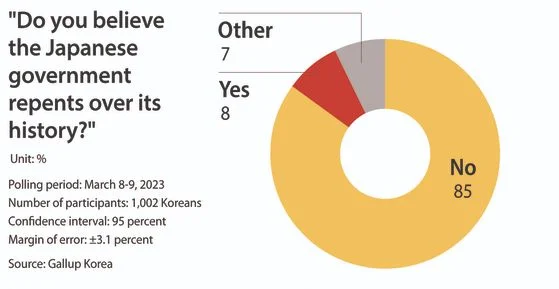
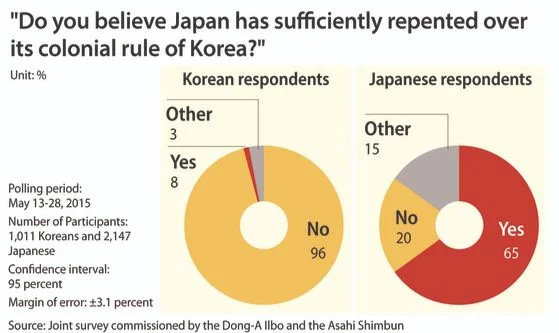
The JoongAng Daily on why many Koreans don't think Japan is sorry despite 63 official apologies from 1965, when South Korea and Japan normalised their diplomatic relations after the latter's 1910-45 colonial rule of Korea, to the latest apology by PM Kishida in May 2023. The bilateral agreement is to compensate Korean forced labourers and restore trade cooperation. However, Korean polls indicate that most Koreans do not trust Japan's repentance or its indirect compensation, and this, according to JoongAng Daily, could challenge a stable and friendly relationship between the two countries.
353de074-f3d1-403a-89a1-053c908cf43d.webp


b4cc73a2-688b-4836-9ece-f12043a41fc7.webp


What can Korea and Japan do in the future? One oft-mentioned model for lasting rapprochement between Korea and Japan is the Franco-German partnership after World War II. "If Japan issued an unequivocal apology, repeated it annually and jointly commemorated the past with Korea, relations between Japan and Korea could be as good as relations between Germany and France," said David, who noted that "political will" in Paris and Berlin made lasting reconciliation possible. Hosaka went further, arguing that Koreans could believe that their neighbour is genuinely sorry if Japan "substantiated its apologies with appropriate measures" akin to those adopted by postwar Germany, such as "educational reforms that ensure Japanese students are taught about Japanese invasions, as well as laws that punish acts that justify or glorify Japan's past wrongs." According to Nilsson-Wright, "there are encouraging attempts by Japan to show genuine contrition" in this vein, such as Kishida's visits in May to Seoul National Cemetery, where Korean independence fighters are buried, and later to the Korean atomic bombing victims' memorial in Hiroshima during the G-7 summit. But he cautioned that rising "emotional drivers" of domestic politics in both Korea and Japan would likely inhibit political will on both sides for more profound reconciliation or atonement.


I cannot believe the article neglected to mention the fact that Japanese High Court(s) have prevented former slave laborers from suing the companies which slaved them not only for their suffering, but even for their due wages.

When one's words do not match one's actions one is a liar. Japan's official actions consistenly prove all the statements of remorse to be utterly false.

The non-government groups that have sent financial compensation to Korea are to be praised. However, so much of that compensation was appropriated by the Korean government and not distributed to victims.

There is so very much that is absolutely wrong about every aspect of this topic and on both sides its enough to make you disgusted with both sides in general, but especially the Japanese side.

The whole debate probably could die if the Japanese government would just give Japanese students honest textbooks. But the government does not give a damn to educate the public on the truth....they just want a pro-Japan populace that is so pro-Japan it thinks the Japanese government can do no wrong.......since it "never did". Its all just politicians promoting themselves and that is why all the lies of omission. They are scum.

They keep complaining that is all in the past so Koreans should shut up. But its NOT in the past! The modern government is VERY active hiding the truth today! So the issue never dies!

There are scarcely any actual Korean victims left to be compensated, and their children's claim to the compensation is debatable. There are scarcely any actual Japanese villians left to apologize or offer compensation, and apologizing and compensating on behalf of others, even your own parents, is nice but essentially empty. So most of that, with the exception of Japanese companies and the government owing actual known wages, which should go to the families, are issues that died with the victims and the villains.

So Korea (gov and people) is right to be angry with the Japanese government for whitewashing textbooks and blocking wage litigation. Those two things absolutely stink and will reek forever unless Japan fixes them. Korea is right to be annoyed that Japanese people today are so ignorant of the misdeeds of Japanese in the past, annoyed I say, but not angry with....cause its not their fault their history class are whitewashed. But Korea is wrong to expect apologies from the descendants of the villians or financial compensation beyond due wages.

And one more point. There is only one body that actuallt represents Japan and that body is the Diet. The Diet has never issued any apology or statement of remorse or whatever, so saying "Japan apologized 63 times is utterly false. But, once again, it would be meaningless anyway even if they did.
 
I agree. Neither country comes out well with the current squabbling, especially when you compare it with how quickly relations normalised among countries in Europe after WWII or between Blacks and Whites in southern African countries after apartheid.

But, as you say, the onus is on Japan to acknowledge the dark side of its history (something my country also doesn't do very well). And Abe pushed the process of reconciliation a long way backwards.
 
Time I spent in korea: 19 months when in the army, mid '71 to early '73 (mostly seoul); peace corps volunteer, '74 to '76 (Inje, inner seorak-san); uni english teaching, calendar '84.

The resentment of japan--the need for apology (compensation/reparations) hadn't spun up, even by that last time. It was nowhere to be seen/felt. Japan hadn't become a bogeyman, and in '84 talk was, if anything, about the coming olympics ('88), and demonstrations (common, with loads of tear gas, at the uni front gate) were students demo-ing against the govt. Chun Doo-Whan was in power on up thru the olympics. So one oddity seems to be the relatively late emergence of the feelings towards japan.

And then there's the 'misuse' of the '65 treaty monies:
In January 2005, the South Korean government disclosed 1,200 pages of diplomatic documents that recorded the proceeding of the treaty. The documents, kept secret for 40 years, recorded that the Japanese government actually proposed to the South Korean government to directly compensate individual victims but it was the South Korean government which insisted that it would handle individual compensation to its citizens and then received the whole amount of grants on behalf of the victims.[10][11][12]

South Korean government demanded a total of 364 million dollars in compensation for the 1.03 million Koreans conscripted into the workforce and the military during the colonial period,[13] at a rate of 200 dollars per survivor, 1,650 dollars per death and 2,000 dollars per injured person.[14] South Korea agreed to demand no further compensation, either at the government or individual level, after receiving $800 million in grants and soft loans from Japan as compensation for its 1910–45 colonial rule in the treaty.[12]

Most of the funds from grants and loan were used for economic development,[15] particularly on establishing social infrastructures, founding POSCO, building Gyeongbu Expressway and the Soyang Dam with the technology transfer from Japanese companies.[16]

This treaty is now characterized as 'not a real apology', or some such. And the $800M in 1965 dollars that was directed to economic development (and not individual compensation) is equivalent to about $7.6 billion in 2023.

In the past I've mentioned the marked contrast between the views of japan in taiwan (also ruled by japan by about the same period that korea was) vs the recent views of japan in korea. Tho the parallels between the two countries are not complete, they are still plentiful, and it's strange how taiwan's view of japan can be so positive, while korea's is so negative.

Similarly, the Philippines (attacked by the japanese at the same time as pearl harbor**), Malaysia, Vietnam, the Dutch East Indies, and Burma. All of those places seem to have comparatively little animosity towards japan. Nor are they persistently calling for apologies, atonement, etc., and in those other countries there was actual fighting--war going on. Whereas korea was occupied without fighting back.

Tho there were protests and independence movements (March 1st is a biggie in korea), there may be some guilt that korea more or less submitted to japanese rule. There were probably as many koreans betting on the japanese, throwing their lot in with them (collaborators, in one way or another), as there were protestors. That's on the collective level. Then, there are generally three classes of war criminals. Class A are the highest level perpetrators--the generals and the leaders who directed everything. While you might think that class B and C did something less bad, these are the criminals who actually killed people (killing of prisoners, civilians, torture). Guess what--there were at least some koreans involved in war crimes against their own people, and if not war crimes, a far larger number of koreans worked in conjunction with and thus facilitated japan's occupation. These latter folks continued in power and privilege after korean liberation during Syngman Rhee's regime, and even thru the 70s (Pak Chung-hee, anyone?)

There is also the view in korea that japan benefited (unfairly) from the Korean war--that the war, which destroyed korea, was good business for japan (ah, those cunning japanese!). No doubt it did. War can be good business if you're not directly involved. On the other hand, if the US/UN had somehow not been able to use japan for a staging area, korea might be unified today, and south korea would have ceased to exist. And, regarding the division of korea after the war, it should be noted that russia proposed a similar division 50 years earlier:
Russia had pursued an expansionist policy east of the Urals, in Siberia and the Far East, since the reign of Ivan the Terrible in the 16th century.[5] Since the end of the First Sino-Japanese War in 1895, Japan had feared Russian encroachment would interfere with its plans to establish a sphere of influence in Korea and Manchuria.

Seeing Russia as a rival, Japan offered to recognize Russian dominance in Manchuria in exchange for recognition of the Korean Empire as being within the Japanese sphere of influence. Russia refused and demanded the establishment of a neutral buffer zone between Russia and Japan in Korea, north of the 39th parallel. The Imperial Japanese Government perceived this as obstructing their plans for expansion into mainland Asia and chose to go to war. After negotiations broke down in 1904, the Imperial Japanese Navy opened hostilities in a surprise attack on the Russian Eastern Fleet at Port Arthur, China on 9 February [O.S. 27 January] 1904
Gee, the 39th parallel. Surprisingly close the the border today (loosely described as the 38th parallel).

Anyway, enough for this morning.

**Both Hawaii and the Philippines were US colonies at the time. FDR portrayed the attack on its hawaiian colony as an attack on america, while the simultaneous attack on the other american colony slipped off the radar.
 
So one oddity seems to be the relatively late emergence of the feelings towards japan.

I would describe them less as an emergence and more of an unleash of buried sentiment. Korea's history from the time of Japan's Meiji era rise to international power is complicated and murky. It began with Korea being a vassal of China, therefore with no real power to resist Japan on its own or with that weak China's help. In fact, they were turning toward Russia for help.

It may also be helpful to know that the Russo-Japanese War of 1905 was largely viewed as an East vs. West war internationally in both the East and the West. This is probably where the term "Yellow peril" originates. Meanwhile, even in China, the Japanese were seen to be more disciplined and doing less raping and looting, and so, favored over the Russians. Meanwhile, Koreans were surely hugely conflicted. Their leaders had favored Russian ties as a way to thwart Japanese influence, especially their Empress, and so the Japanese had the Korean Empress murdered. Then after that war Korea became a protectorate of Japan. Then Japan pulled a Darth Vader, and altered the deal 5 years later annexing Korea.

It all gets even more conflicted and complicated because I think (I am no historian) that Japan was pretty good to Korea at first. But when the Japanese started to lose everything toward the end of WWII they became monstrous toward the Koreans as they had to so many others. For example, I am pretty sure the Comfort Woman system was a legit and well intentioned operation in the beginning. But in the final desperate years of the war it became a kidnapping, rape and sexual slavery system. I have had a lot of trouble trying to get people to undersand and accept that bit about the Comfort Woman system.....it was essentially two different systems start to finish. Koreans only want to remember the end and use it to hate on Japan. Japanese only want to remember the beginning to use it to absolve themselves of wrongdoing. Well they are both wrong.

But anyway, what the general populace knows about history is largely determined by the government. And governments don't care about truth and full accountings. All they care about is having a populace that supports the government in whatever the government deems important. But the Koreans were too busy after WWII to dwell on hate of Japan. They were wedged between Russia and the U.S. after WWII and that resulted in Civil War in just a few years. The result of that was the rule of dictators on both sides with extra control of history lessons. But as more freedom and free time emerged in South Korea, bad memories of Japan came bubbling back to the surface in the population. I have no idea if the Korean government tried to suppress or stoke those sentiments at the time, but this was living memory rather than government implanted history bias.

It seems to me that the government has just been using that sentiment of the Korean population against both their own people and Japan. This is because it took Japanese money meant for victims and used it for "public works" ie, corruption. So it keeps pointing its finger at Japan and the Korean people keep falling for it.

All told, Korea is in a pretty unique position with its extremely complex history regarding Japan. I would be surprised if even most Koreans know the half of it.

Meanwhile its less complicated for places like the Philippines and Vietnam....and that means its easier to get over, just as both those places have gotten over similar American evils perpetrated in their countries.

China's history with Japan is probably in the middle of the complexity scale, but the Chinese government definitely wants Japan as permanent scapegoat for its ills, and that government has immense power over the education system and mass media to this day, while the South Koreans have a bit of individual freedom at least.

I will end by pointing out that Korea's position is made even more complicated by something Johnny G already pointed to, and that is by many Koreans' collaboration with Japan. Korea is wrestling with a lot of shame for their roles, and its getting mauled. The only way out of that is for them to realize that the complicated history of collaborators is not something to be shared collectively among Koreans. Every Korean of the time had a different experience and some Koreans were innocent victims and some were murdering, kidnapping trash. But just simply cooperating with the Japanese should not be resented; I can't see as there was much choice for them Its only actual crimes that should be resented....such as direct participation in atrocities. Those guilty Koreans should be condemned yes. But expecting some sort of Korean patriotism at that time is just a silly exercise in historical revisionism coming from modern patriotism. They need to let that go.
 
Last edited:
Something else backing up Korea's 'unleash of buried sentiment' suggested by MoT: there was a similar unleashing in Japan in the early 90s, shortly after Hirohito died. Elderly people who had seen or done things during the war wanted to make them public but had been afraid to do so before. That could also have encouraged Korean people to be more vocal about Japan's occupation.
 
Something else backing up Korea's 'unleash of buried sentiment' suggested by MoT: there was a similar unleashing in Japan in the early 90s, shortly after Hirohito died. Elderly people who had seen or done things during the war wanted to make them public but had been afraid to do so before. That could also have encouraged Korean people to be more vocal about Japan's occupation.

Yes indeed, HIrohito is a whole other layer of this onion. He was clearly a Class A war criminal who not only went unprosecuted, but had his reputation rehabilitated to a degree I can only think of one other similar example, and that was the women and children murdering George Custer. That said, Andrew Jackson was of a similar mold but I don't think he ever had the bad reputation he deserved.

Hirohito will probably come up again as we near the anniversary of the atomic bombings. And I will explaining as I do every year that he only surrendered to save his own neck from the Russians....full stop. And I expect to have a hostile audience just like I do every year....cause people really want to believe that their government approved textbooks told them the truth.
 
Back
Top Bottom