


- 14 Mar 2002
- 21,053
- 18,908
An AI-powered suitcase being developed by IBM Japan, Shimizu Corp. and other companies to guide visually impaired people is slowly moving toward taking over the roles of white canes and guide dogs. They are now at the difficult stage of making the robotic suitcase on wheels usable in indoor and outdoor environments. During an experiment in September, the intelligent suitcase guided Chieko Asakawa, director of the National Museum of Emerging Science and Innovation (Miraikan), to the nearest station from her workplace in Tokyo's Koto Ward.
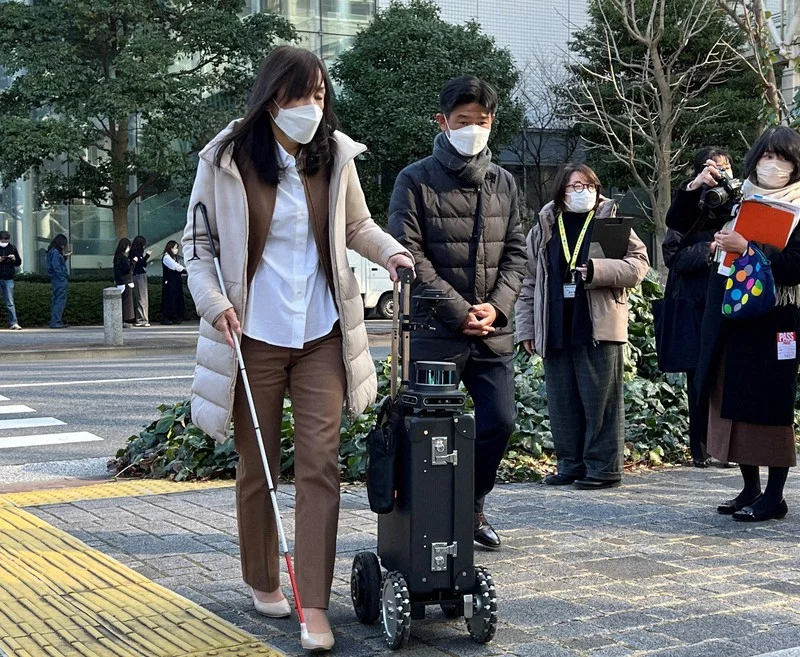
Photo credit: Mainichi/Tomohiro Ikeda

 mainichi.jp
Photo credit: Mainichi/Tomohiro Ikeda
One hurdle in seamlessly moving the suitcase from indoor to outdoor spaces is that it needs large wheels and a motor to overcome steps and other outdoor obstacles, according to the researchers. In addition, the suitcase uses two vastly different methods to determine its location. Indoors, it uses a light detection and ranging (LiDAR) system to detect obstacles with laser light. In outdoor settings, it employs the real-time kinematic (RTK) satellite positioning system. It is difficult for the AI-assisted suitcase to use both systems while calculating its location, planning a route and helping users to move between indoor and outdoor spaces or guiding them through a crowd. The outdoor edition of the AI-powered suitcase is about 100 centimetres tall, including its handle, and 50 cm wide. It is equipped with a camera and a sensor on the upper part, while a personal computer and a graphic processing unit are installed inside to run the AI system. Weighing about 30 kilograms, the suitcase can move at a top speed of 3.6 kph. The demo experiment under the Road Traffic Law showed the challenges that must be addressed.
Japan-developed 'AI suitcase' tested as replacement for guide dogs - The Mainichi
TOKYO -- An automated device that aims to serve the same purpose as guide dogs for the visually impaired was taken on its first outdoor test run here


