- 14 Mar 2002
- 21,053
- 18,906
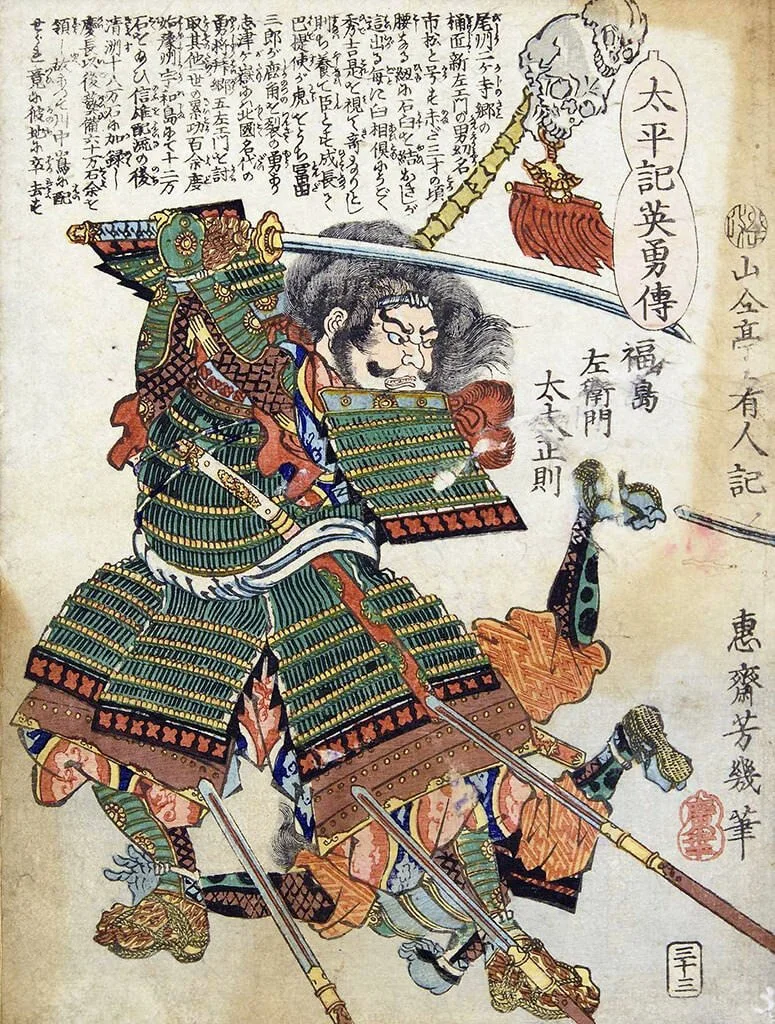
Masanori (太平記英勇伝 福島左衛門太夫正則) — c. 1860s, colour woodblock print (nishiki-e), vertical ōban format, collection of the Tokyo Metropolitan Library.
Taiheiki Eiyūden: Fukushima Saemon no Tayū Masanori
Utagawa Yoshiiku (歌川芳幾, 1833–1904), Taiheiki Eiyūden: Fukushima Saemon no Tayū Masanori...
This print is part of Yoshiiku's Taiheiki Eiyūden (太平記英勇伝, "Illustrated Tales of Heroes of the Taiheiki")—this popular Edo-period series recast historical and semi-legendary warriors in dramatic, highly stylised compositions. Although linked to the medieval chronicle Taiheiki, the series freely incorporates figures from later periods, including Fukushima Masanori (福島正則, 1561–1624), whose reputation as a bold and forceful commander made him well suited to the heroic genre.
Masanori is shown in full armour, occupying the centre of the composition in a powerful, forward-driving stance. His body twists slightly as he raises a long sword overhead, the blade cutting a diagonal line across the upper half of the image. The pose conveys both motion and immediacy, as if the strike is already in progress. His expression is fierce, eyes narrowed, brows knotted, mouth tense, capturing the conventional Edo-period image of Masanori as a man of impulsive courage rather than measured restraint.
The armour is rendered in dense, layered detail, with alternating bands of green, brown, and red lacquer plates bound by intricate lacing. Decorative fittings and cords are picked out in gold and deep blue, creating a rich visual texture typical of late ukiyo-e warrior prints. The elaborate shoulder guards and helmet cords emphasise bulk and weight, reinforcing the impression of physical strength.
Beneath him lies a fallen opponent, partially obscured but clearly defeated, pierced by multiple spears. The diagonal thrusts of these weapons echo the line of Masanori's raised sword, creating a visual rhythm and guiding the viewer's eye through the composition. The defeated figure's contorted posture and scattered weapons heighten the drama without overcrowding the scene.
Above Masanori's shoulder, a skeletal figure emerges, gripping a halberd-like weapon. This element introduces a supernatural or allegorical layer, a common device in warrior prints of the period. The skeleton may be read as a personification of death or battlefield fate, shadowing the warrior's action and underscoring the lethal stakes of combat. Its presence contrasts sharply with the solidity of Masanori's armour, adding tension between the material and the ephemeral.
The vertical cartouche to the right bears the series title, while adjacent inscriptions identify the figure as Fukushima Saemon no Tayū Masanori (福島左衛門太夫正則), one of his formal names. Additional text blocks provide brief narrative context in a semi-literary style, typical of such prints, though often more evocative than strictly historical.
Yoshiiku's handling of line and colour reflects the transition of ukiyo-e in the mid-19th century, when dynamic compositions and heightened theatricality became increasingly prominent. Figures are exaggerated, gestures amplified, and space compressed to maximise impact. In this respect, the print aligns with the broader trend ofmusha-e (武者絵, warrior prints), which sought to appeal to popular tastes for action, loyalty, and martial virtue.
While not intended as a documentary image, the print draws on established perceptions of Fukushima Masanori as one of the "Seven Spears of Shizugatake" (賤ヶ岳七本槍), a figure associated with decisive action in battle. The emphasis here is less on specific historical events than on character: strength, ferocity, and unwavering momentum. The result is a vivid, almost theatrical portrait that blends history, legend, and artistic convention into a single striking image.
Masanori is shown in full armour, occupying the centre of the composition in a powerful, forward-driving stance. His body twists slightly as he raises a long sword overhead, the blade cutting a diagonal line across the upper half of the image. The pose conveys both motion and immediacy, as if the strike is already in progress. His expression is fierce, eyes narrowed, brows knotted, mouth tense, capturing the conventional Edo-period image of Masanori as a man of impulsive courage rather than measured restraint.
The armour is rendered in dense, layered detail, with alternating bands of green, brown, and red lacquer plates bound by intricate lacing. Decorative fittings and cords are picked out in gold and deep blue, creating a rich visual texture typical of late ukiyo-e warrior prints. The elaborate shoulder guards and helmet cords emphasise bulk and weight, reinforcing the impression of physical strength.
Beneath him lies a fallen opponent, partially obscured but clearly defeated, pierced by multiple spears. The diagonal thrusts of these weapons echo the line of Masanori's raised sword, creating a visual rhythm and guiding the viewer's eye through the composition. The defeated figure's contorted posture and scattered weapons heighten the drama without overcrowding the scene.
Above Masanori's shoulder, a skeletal figure emerges, gripping a halberd-like weapon. This element introduces a supernatural or allegorical layer, a common device in warrior prints of the period. The skeleton may be read as a personification of death or battlefield fate, shadowing the warrior's action and underscoring the lethal stakes of combat. Its presence contrasts sharply with the solidity of Masanori's armour, adding tension between the material and the ephemeral.
The vertical cartouche to the right bears the series title, while adjacent inscriptions identify the figure as Fukushima Saemon no Tayū Masanori (福島左衛門太夫正則), one of his formal names. Additional text blocks provide brief narrative context in a semi-literary style, typical of such prints, though often more evocative than strictly historical.
Yoshiiku's handling of line and colour reflects the transition of ukiyo-e in the mid-19th century, when dynamic compositions and heightened theatricality became increasingly prominent. Figures are exaggerated, gestures amplified, and space compressed to maximise impact. In this respect, the print aligns with the broader trend ofmusha-e (武者絵, warrior prints), which sought to appeal to popular tastes for action, loyalty, and martial virtue.
While not intended as a documentary image, the print draws on established perceptions of Fukushima Masanori as one of the "Seven Spears of Shizugatake" (賤ヶ岳七本槍), a figure associated with decisive action in battle. The emphasis here is less on specific historical events than on character: strength, ferocity, and unwavering momentum. The result is a vivid, almost theatrical portrait that blends history, legend, and artistic convention into a single striking image.