Art Ukiyo-e: Japanese woodblock prints and paintings

Topics, threadsm and news related to Japanese art and artists
Masanori (太平記英勇伝 福島左衛門太夫正則) — c. 1860s, colour woodblock print (nishiki-e), vertical ōban format, collection of the Tokyo Metropolitan Library.
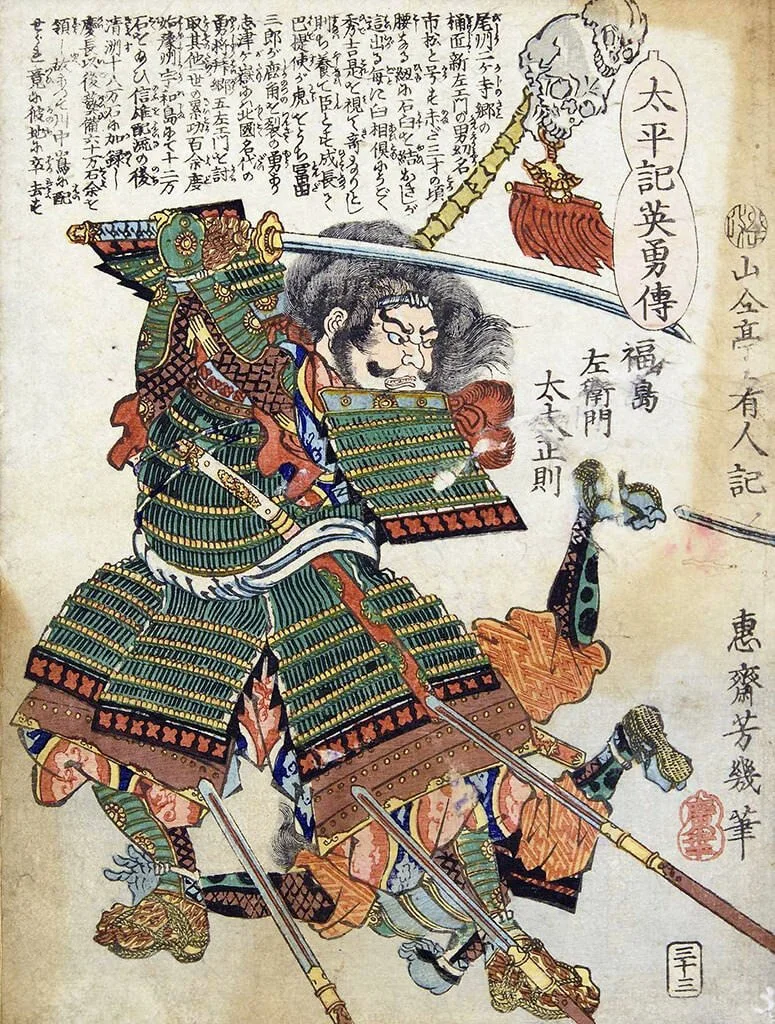

This print is part of Yoshiiku's Taiheiki Eiyūden (太平記英勇伝, "Illustrated Tales of Heroes of the Taiheiki")—this popular Edo-period series recast historical and semi-legendary warriors in dramatic, highly stylised compositions. Although linked to the medieval chronicle Taiheiki, the series freely incorporates figures from later periods, including Fukushima Masanori (福島正則, 1561–1624), whose reputation as a bold and forceful commander made him well suited to the heroic genre.

Masanori is shown in full armour, occupying the centre of the composition in a powerful, forward-driving stance. His body twists slightly as he raises a long sword overhead, the blade cutting a diagonal line across the upper half of the image. The pose conveys both motion and immediacy, as if the strike is already in progress. His expression is fierce, eyes narrowed, brows knotted, mouth tense, capturing the conventional Edo-period image of Masanori as a man of impulsive courage rather than measured restraint.

The armour is rendered in dense, layered detail, with alternating bands of green, brown, and red lacquer plates bound by intricate lacing. Decorative fittings and cords are picked out in gold and deep blue, creating a rich visual texture typical of late ukiyo-e warrior prints. The elaborate shoulder guards and helmet cords emphasise bulk and weight, reinforcing the impression of physical strength.

Beneath him lies a fallen opponent, partially obscured but clearly defeated, pierced by multiple spears. The diagonal thrusts of these weapons echo the line of Masanori's raised sword, creating a visual rhythm and guiding the viewer's eye through the composition. The defeated figure's contorted posture and scattered weapons heighten the drama without overcrowding the scene.

Above Masanori's shoulder, a skeletal figure emerges, gripping a halberd-like weapon. This element introduces a supernatural or allegorical layer, a common device in warrior prints of the period. The skeleton may be read as a personification of death or battlefield fate, shadowing the warrior's action and underscoring the lethal stakes of combat. Its presence contrasts sharply with the solidity of Masanori's armour, adding tension between the material and the ephemeral.

The vertical cartouche to the right bears the series title, while adjacent inscriptions identify the figure as Fukushima Saemon no Tayū Masanori (福島左衛門太夫正則), one of his formal names. Additional text blocks provide brief narrative context in a semi-literary style, typical of such prints, though often more evocative than strictly historical.

Yoshiiku's handling of line and colour reflects the transition of ukiyo-e in the mid-19th century, when dynamic compositions and heightened theatricality became increasingly prominent. Figures are exaggerated, gestures amplified, and space compressed to maximise impact. In this respect, the print aligns with the broader trend ofmusha-e (武者絵, warrior prints), which sought to appeal to popular tastes for action, loyalty, and martial virtue.

While not intended as a documentary image, the print draws on established perceptions of Fukushima Masanori as one of the "Seven Spears of Shizugatake" (賤ヶ岳七本槍), a figure associated with decisive action in battle. The emphasis here is less on specific historical events than on character: strength, ferocity, and unwavering momentum. The result is a vivid, almost theatrical portrait that blends history, legend, and artistic convention into a single striking image.
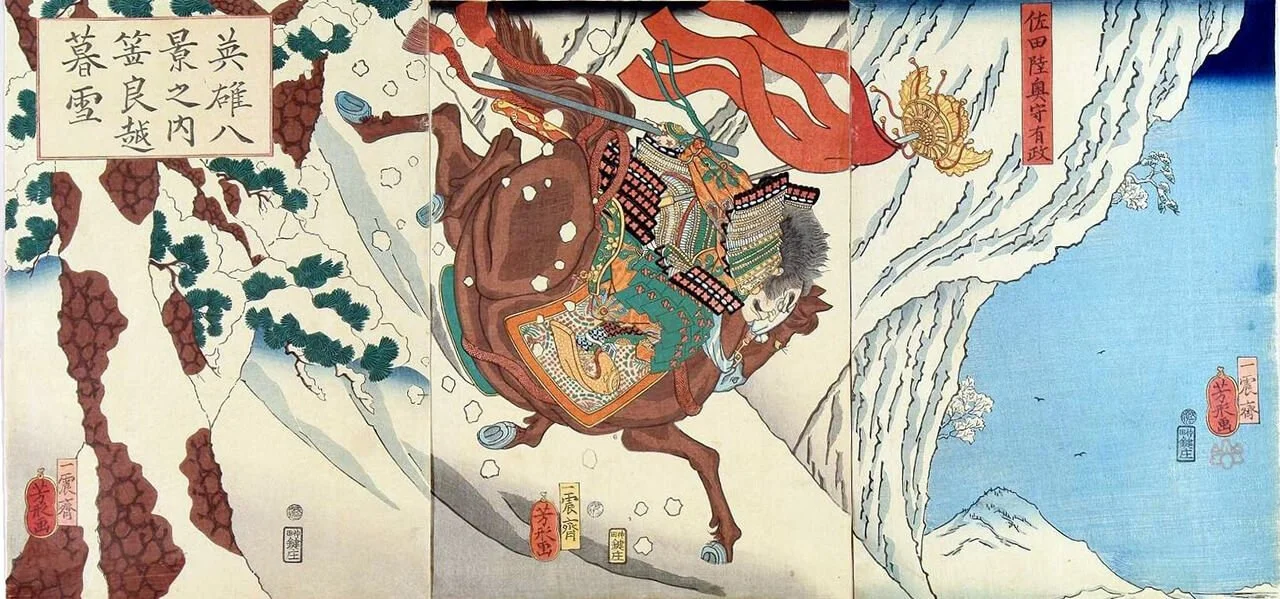
 
Utagawa Yoshikazu (歌川芳員), Sassa Narimasa (佐々成政, 1536–1588), during the episode known as Sarasaragoe (さらさら越え), his supposed winter crossing of the Tateyama mountains.


Narimasa is depicted riding through steep, snow-covered terrain, his horse struggling against the slope. The sharply angled cliffs and drifting snow dominate the composition, turning the landscape into an obstacle rather than a setting. The scene is less a literal record than a stylised image of hardship. The event refers to Narimasa's attempt, around 1584, to reach Ieyasu and renew resistance against Hideyoshi.
 
19th‑century design by Utagawa Yoshitora titled Genji Corps Sailing Against the Wind.
IMG_4916.webp
 
When you think about it, the making of something like this is pretty incredible. I wonder how many blocks and layers it took.
Yes, I've always assumed it was one block/one colour which is mind boggling. But I suppose they could've used a few colours on each block as long as they kept careful notes of what went where!
 
We're still in hanami season:

Utagawa Hiroshige (歌川広重, 1797–1858) — Yamashiro Province: The Togetsu Bridge in Arashiyama (山城 あらし山 渡月橋), 1853 from Rokujūyoshū meisho zue (六十余州名所図会).

full.jpeg.webp

Yamashiro Province: The Togetsu Bridge in Arashiyama (山城 あらし山 渡月橋), designed by Utagawa Hiroshige (歌川広重, 1797–1858) around 1853, forms part of his late series Rokujūyoshū meisho zue (六十余州名所図会). The series presents views from across Japan, each sheet focusing on a well-known landscape associated with a particular province. In this case, Hiroshige turns to Yamashiro Province (山城国), depicting the Togetsu Bridge spanning the Katsura River at Arashiyama, regarded as one of the most celebrated scenic sites on the western edge of Kyoto.

The composition is set from an elevated vantage point, allowing the bridge, river, and surrounding hills to unfold in a single, carefully arranged view. The scene is shaped by seasonal atmosphere—soft mist, moving water, and shifting light create a sense of transience rather than a strict topographical record. The print belongs to a broader tradition of meisho-e (名所絵), or images of "famous places", which circulated widely in the late Edo period. Such works drew on earlier illustrated guidebooks while adapting them for a growing urban audience interested in travel, whether real or imagined.
 
Utagawa Sadahide (歌川貞秀), Battle of Itsukushima (厳島合戦), c. 1855.

full.jpeg.webp

This work, attributed to Utagawa Sadahide (歌川貞秀, active mid-19th century), is a late Edo-period visualisation of the Mōri campaigns around Miyajima. Produced around 1855, it reflects not a contemporary record but a retrospective interpretation of 16th-century events, most likely the Battle of Itsukushima (厳島合戦, 1555).

The composition follows the conventions of narrative scroll painting (絵巻 emaki), presenting the movement of troops, ships, and terrain in a continuous, unfolding scene. Mōri forces are typically shown advancing across the Inland Sea, with an emphasis on naval manoeuvres and the dramatic geography of Itsukushima. The sacred setting—home to the Itsukushima Shrine (厳島神社)—is often included, underscoring the tension between warfare and a site traditionally considered inviolable. As with much late Edo historical imagery, the work blends documentation with imagination. Armour, banners, and formations are rendered in a stylised manner, sometimes reflecting Edo-period aesthetics more than Sengoku reality. The aim is not strict accuracy but narrative clarity and visual impact.

Today, the scroll is held at the Miyajima History Folklore Museum (宮島歴史民俗資料館), where it forms part of a broader corpus of visual materials relating to the history and cultural memory of Miyajima and the Mōri clan.
 
One last sakura-themed ukiyo-e:

Katsushika Hokusai (葛飾北斎, 1760–1849), Cherry Blossoms at Yoshino – Snow, Moon and Flowers (吉野山 花雪月)

Cherry Blossoms at Yoshino

Katsushika Hokusai (葛飾北斎, 1760–1849) was one of the most influential artists of the Edo period, best known for his innovative woodblock prints and for turning familiar landscapes into striking visual designs. Over a long career marked by constant experimentation, he produced thousands of works, including iconic series such as Thirty-six Views of Mount Fuji. In Cherry Blossoms at Yoshino – Snow, Moon and Flowers (吉野山 花雪月), he turns to Yoshino, Japan's most famous cherry blossom site, depicting its slopes covered in dense, cloud-like clusters of blooms. Small figures and buildings are scattered across the hills, but they remain secondary to the overwhelming presence of nature.

The print also draws on the traditional theme of "Snow, Moon, and Flowers" (花雪月), in which cherry blossoms symbolise spring and its brief, fragile beauty. Rather than isolating individual flowers, Hokusai treats them as soft masses that flow across the landscape, giving the scene both structure and a slightly abstract quality. At the same time, the image reflects Edo-period travel culture, when places like Yoshino became widely known through prints like this. It works both as a recognisable view and as an idealised vision of seasonal change—quietly suggesting how quickly such beauty appears and fades.
 
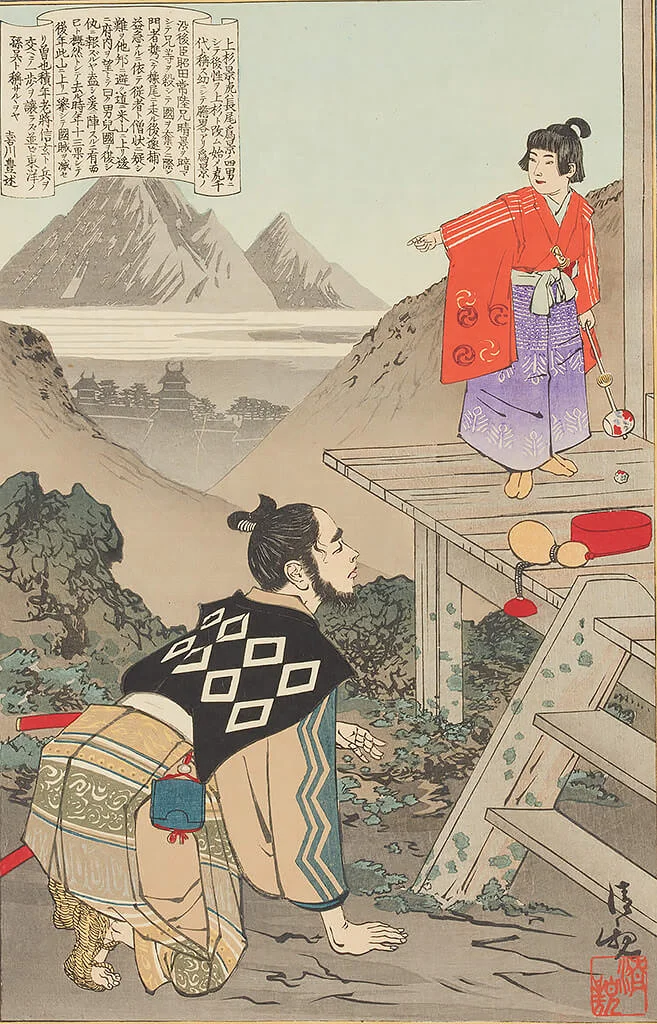
Kobayashi Kiyochika (小林清親, 1847–1915), Uesugi Kagetora (上杉景虎) from the series Kyōdō Risshi no Motoi (教導立志基), 1902; colour woodblock print.


This woodblock print by Kobayashi Kiyochika depicts the future Uesugi Kenshin as a child, when he was still known as Uesugi Kagetora. Standing atop Mount Yoneyama in Echigo Province, in present-day Kashiwazaki, Niigata Prefecture, the young Kagetora boldly declares that he will one day return and establish his headquarters there when taking revenge against his enemies. The scene presents him not simply as a child, but as a figure already marked by determination and military ambition.

According to later tradition, Kenshin eventually fulfilled the promise he made as a child. Mount Yoneyama later became an important base during his rise to power in Echigo Province. After the death of his father, Nagao Tamekage (長尾為景, 1489–1536), the region fell into conflict between branches of the Nagao and Uesugi families. Kenshin, who was born Torachiyo (虎千代), later seized power from his elder brother, Uesugi Harukage, and unified Echigo under his rule. He eventually became Kantō Kanrei and expanded his influence into Etchū Province. Known for his military skill, he fought in around seventy battles and became famous as the "Dragon of Echigo".

The print belongs to the series Kyōdō Risshi no Motoi (教導立志基), usually translated as "Foundations of Instruction and Success" or "Foundations of Morality and Ambition". Produced collaboratively by prominent Meiji-period artists including Tsukioka Yoshitoshi and Toyohara Kunichika, the series portrayed famous historical figures as moral examples for a modernising Japan. Originally issued as newspaper supplements between 1886 and 1890 by the publisher Matsuki Heikichi, the prints blended historical subjects with Meiji educational ideals.

Kiyochika, often called the "last ukiyo-e master", was especially known for his dramatic depictions of the Sino-Japanese and Russo-Japanese wars. In this work, however, he turned to the distant Sengoku past, presenting the youthful Kenshin in a romantic and heroic light that reflected both historical nostalgia and the patriotic atmosphere of the late Meiji era.
 
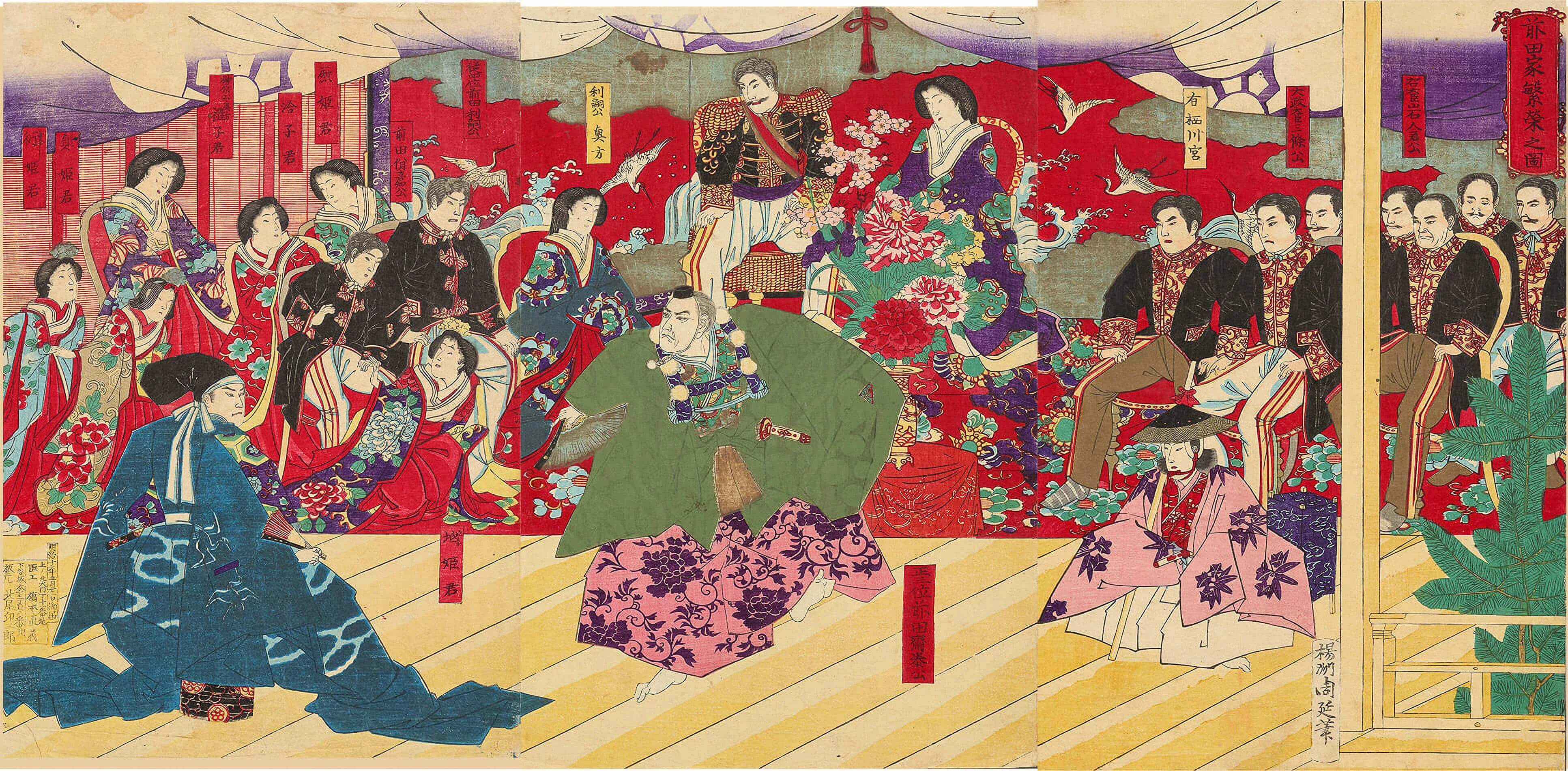
Yōshū Chikanobu (楊洲周延, 1838–1912), "Picture of the Prosperity of the Maeda House" (前田家繁栄之圖) — Meiji period woodblock triptych.


The print celebrates the prestige and prosperity of the Maeda family (前田家), the daimyō of Kaga Domain (加賀藩 Kaga-han). At the centre sits a noble figure associated with the Maeda lineage founded by Maeda Toshiie (前田利家, 1538–1599), surrounded by court ladies, attendants, and retainers in richly decorated robes. The men on the right wear Western-style military uniforms, reflecting Japan's rapid modernisation during the Meiji period. Combining traditional courtly imagery with modern elements, the work presents the Maeda as an aristocratic house that successfully carried its prestige from the feudal age into modern Japan.
 
It's that time of the year.

Hydrangea at the Flower Garden at Asakusa

This colourful late Edo-period ukiyo-e (浮世絵) print depicts two kabuki actors beneath large blooming hydrangeas, or ajisai (紫陽花), a flower strongly associated with Japan's rainy early-summer season. The scene is set at the Hanayashiki (花やしき) pleasure garden in Asakusa, one of Edo's best-known entertainment districts, where seasonal flower displays attracted large crowds of townspeople.

The composition combines actor portraiture (役者絵 yakusha-e) with seasonal floral imagery, a popular theme in late Edo-period ukiyo-e. Hiroshige II followed the style of his teacher, Utagawa Hiroshige (歌川広重, 1797–1858), though his prints often used brighter colours and more decorative patterns.

Large white hydrangeas dominate the scene above the two actors, whose dark patterned kimonos contrast sharply with the flowers. One holds a folding fan (扇子 sensu), while the other carries a bowl and cloth. The close composition and detailed textile patterns are typical of late Edo ukiyo-e design. The red cartouche identifies the flower theme, while the series itself celebrated seasonal flowers and famous beauty spots in Edo.
 

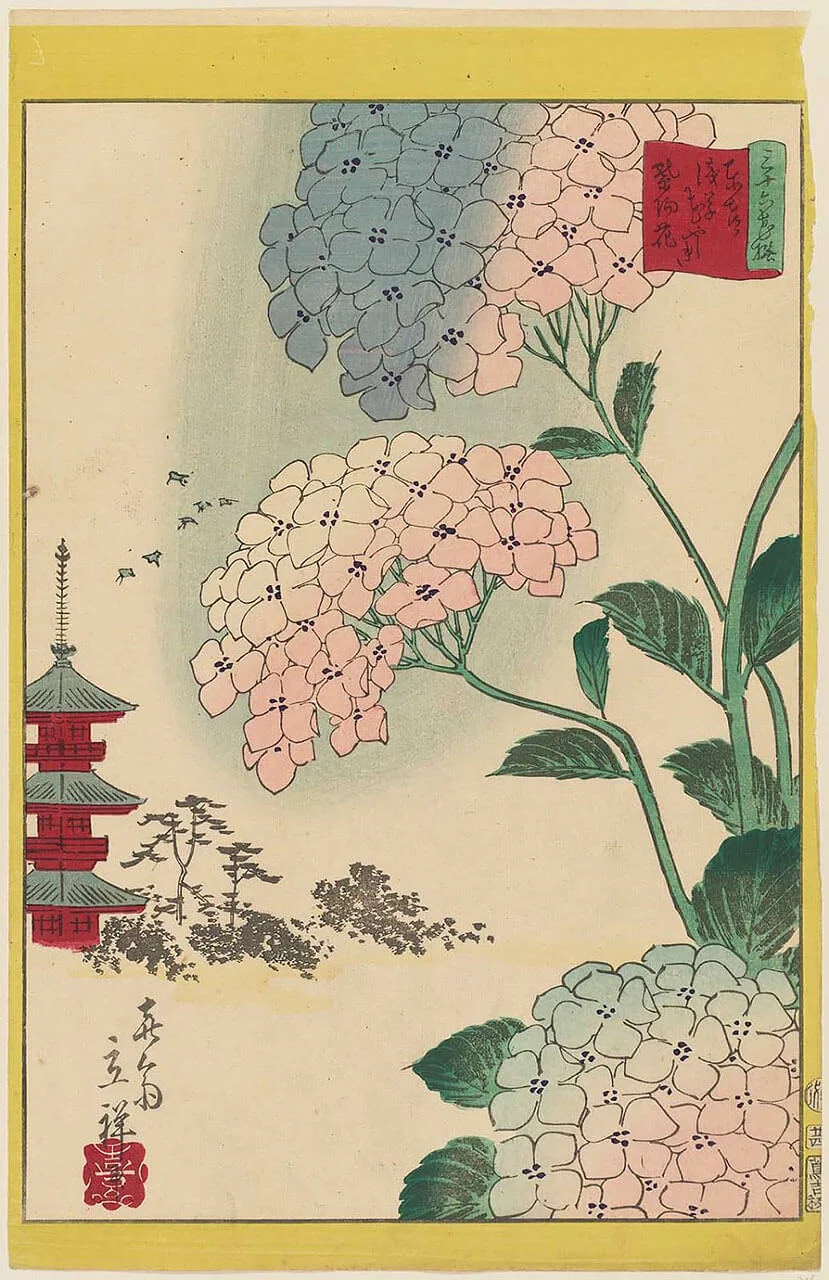
Large clusters of hydrangeas dominate the foreground of this print, while a vermilion pagoda appears in the distance. The contrast between oversized flowers and a famous landmark was a favourite compositional device of both Hiroshige and Hiroshige II, creating depth and an unusual perspective. Associated with the rainy season, hydrangeas symbolised the changing moods of early summer. The print reflects the lyrical landscape style of the Hiroshige school, combining seasonal beauty with a celebrated view.
 

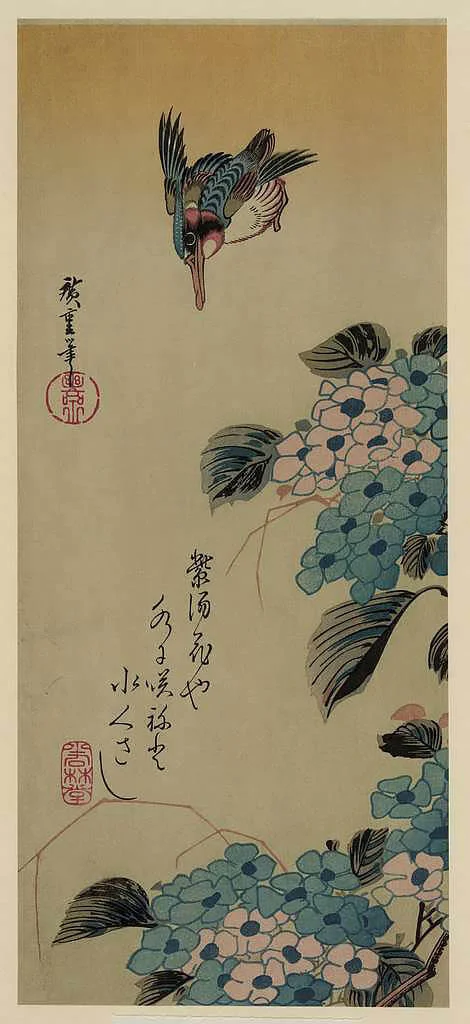
This polychrome woodblock print (nishiki-e 錦絵), titled Ajisai ni Kawasemi (紫陽花に翡翠, "Kingfisher and Hydrangeas"), was created by Utagawa Hiroshige (歌川広重, 1797–1858) around 1832–1834. Usually classified among his independent bird-and-flower prints, it is a fine example of the kachō-e (花鳥絵) genre.

A kingfisher (翡翠 kawasemi) dives from the upper left while clusters of hydrangeas (ajisai 紫陽花) fill the lower portion of the sheet. The bird, caught just before striking its prey, introduces a sense of movement that contrasts with the calm, decorative treatment of the flowers. The print also includes a kyōka (狂歌), a witty poem, reflecting the Edo-period taste for combining visual and literary arts. Hiroshige's skill is evident in the asymmetrical composition, the unusual overhead view of the bird, and the expansive areas that create a sense of openness and balance.

Hydrangeas were closely associated with the rainy season (梅雨 tsuyu) and early summer, while the kingfisher symbolised beauty and vitality. Together they evoke a fleeting seasonal moment rather than a specific location. Although best known for landscape series such as The Fifty-three Stations of the Tōkaidō (東海道五十三次 Tōkaidō Gojūsan-tsugi), Hiroshige's bird-and-flower prints were highly regarded during his lifetime. They later influenced European artists during the nineteenth-century craze for Japanese art known as Japonisme.
 

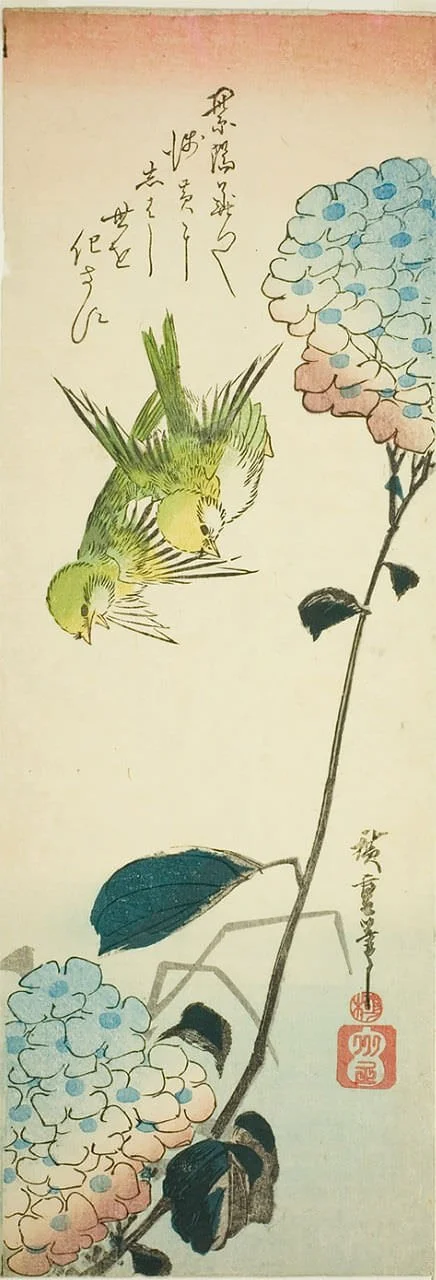
This elegant kachō-e (花鳥絵, "bird-and-flower picture") depicts two small green birds swooping among flowering hydrangeas. Hiroshige captures the birds in mid-flight, their dynamic movement contrasting with the stillness of the delicate blossoms. The asymmetrical composition, extensive use of space and subtle colour gradations are characteristic of Hiroshige's refined bird-and-flower prints, which combined close observation of nature with poetic evocations of the changing seasons.
 
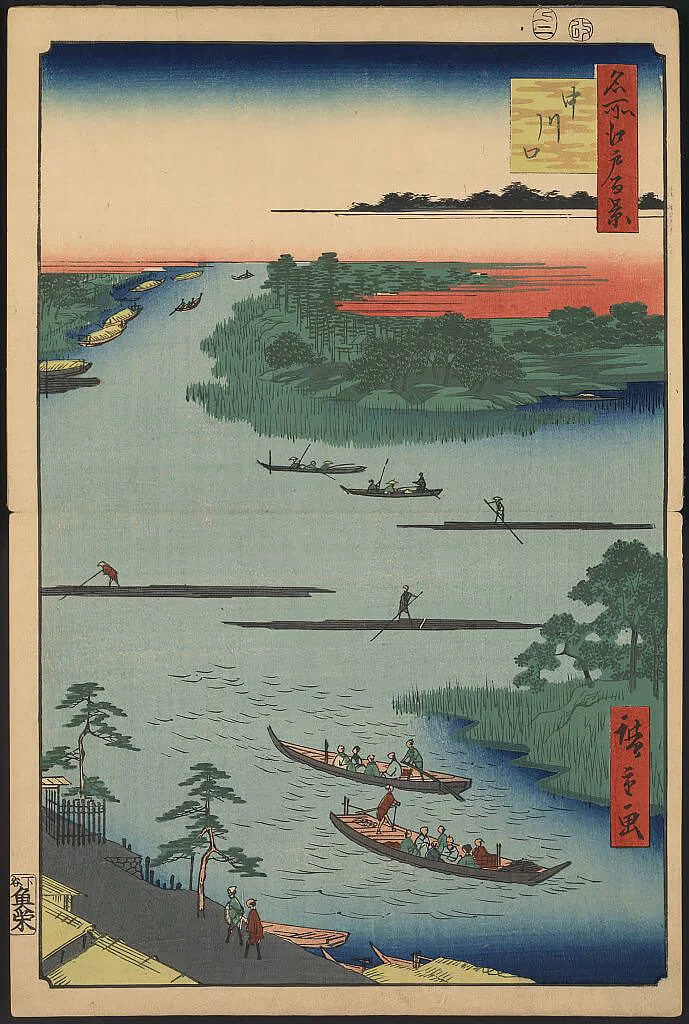
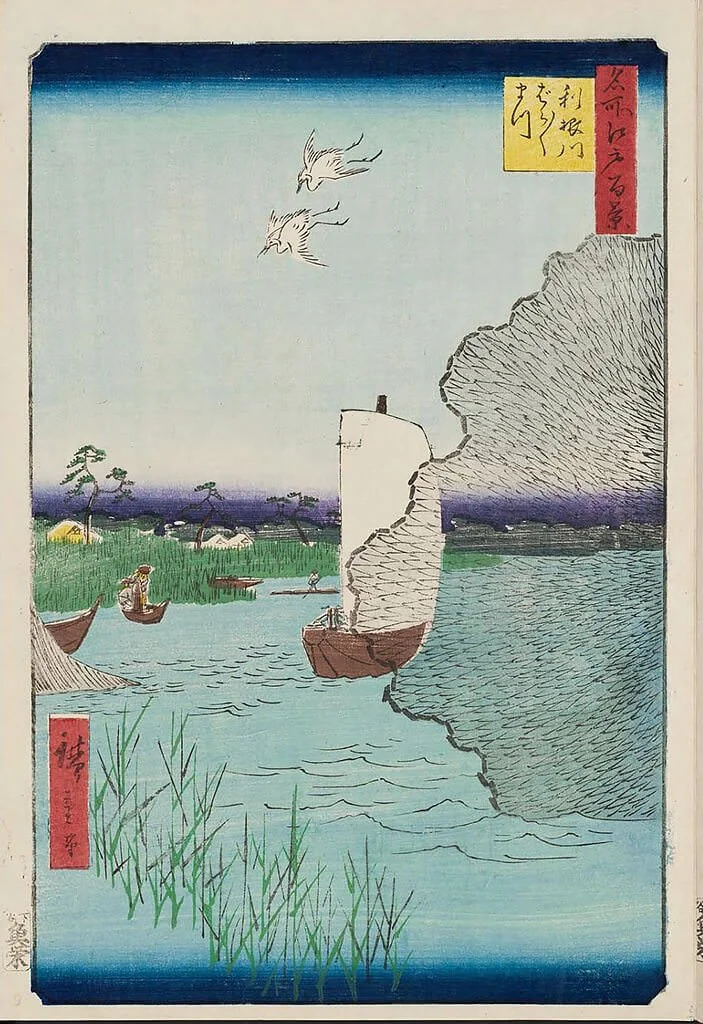
Two of Hiroshige's woodblock prints relating to Kantō rivers. The second print depicts cast-net fishing on the Tone River, which, according to an NHK documentary, is still practised today in the area of Kasai, on the Arakawa and Kyu-Edogawa (as depicted in the first print).


Suruga-chō by Utagawa Hiroshige

Suruga-chō, by Utagawa Hiroshige, 1856, from the series One Hundred Famous Views of Edo (名所江戸百景). Looking north along Suruga-chō (駿河町), now part of Nihonbashi and Muromachi, the print depicts one of Edo's busiest commercial streets. The large premises of the Mitsui family's Echigoya (越後屋) drapery, the predecessor of today's Mitsukoshi department store, line both sides of the avenue, while Mount Fuji rises prominently in the distance. The composition captures Edo's prosperity as Japan's commercial capital and reflects the city's close visual and cultural ties to the iconic mountain.
 
One of Hiroshige's most iconic Edo-themed ukiyo-e:

Morning View (日本橋 朝之景)


Nihonbashi: Morning View (日本橋 朝之景), by Utagawa Hiroshige, c. 1833–1834, from The Fifty-three Stations of the Tōkaidō (東海道五拾三次). Nihonbashi served as the geographical and commercial centre of Edo, where the distances along Japan's five principal highways were officially measured. Hiroshige portrays the bridge at dawn as fishmongers hurry from the nearby fish market, merchants prepare for the day's trade, and a daimyō procession sets out along the Tōkaidō, vividly illustrating the rhythm of everyday life in the shogunal capital.
 
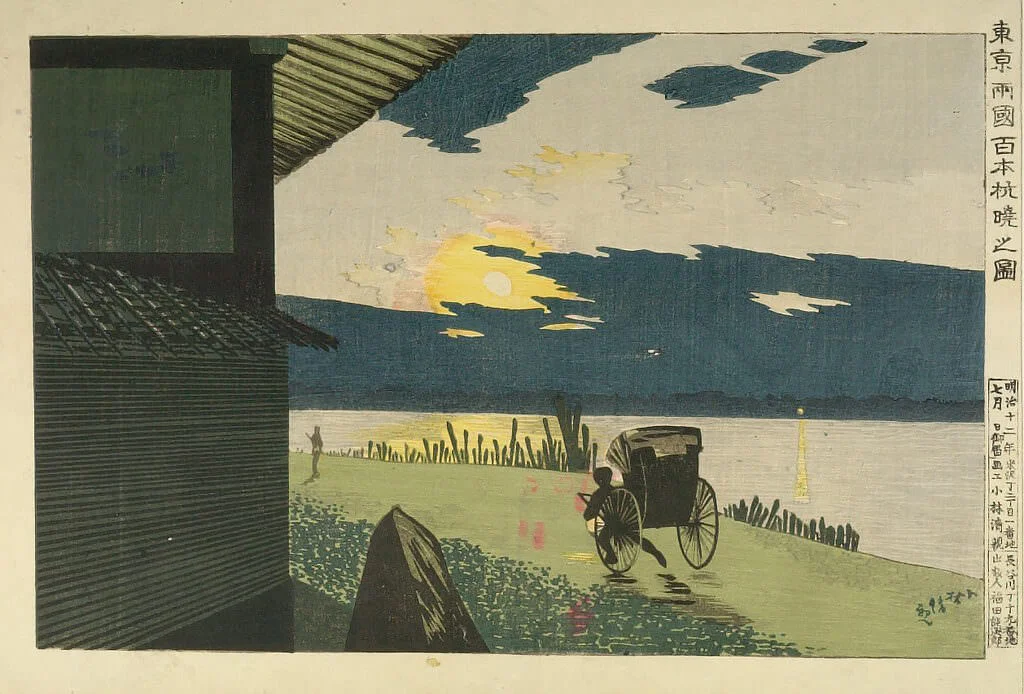
From the Banks of the Tone River (利根川ばたより), from Pictures of One Hundred Views of Western Tokyo (東京西國百景之圖). Woodblock print by Kobayashi Kiyochika (小林清親, 1847–1915), published by Matsuki Heikichi on 7 October 1889. The moonlit riverside, waiting rickshaw and dramatic contrasts of light and shadow exemplify Kiyochika's atmospheric Meiji-period landscapes documenting a rapidly changing Japan.


Artist: Kobayashi Kiyochika
Title: 東京西國百景之圖 利根川ばたより
Reading: Tōkyō Saigoku Hyakkei no Zu – Tonegawa Bata Yori
English: From the Banks of the Tone River
Series: Pictures of One Hundred Views of Western Tokyo
Date: 7 October 1889 (Meiji 22)
Publisher: Matsuki Heikichi (大黒屋平吉)
 
Back
Top Bottom