Science Japan aims to complete nuclear fusion reactor by 2038

thomas

Unswerving cyclist
Admin
Joined
14 Mar 2002
Messages
21,050
Reaction score
18,904
Japan's National Institute for Quantum Science and Technology (QST) plans to begin building a prototype nuclear fusion reactor in the late 2020s, with completion targeted for 2038. The plan sets out a timeline that could speed up work on fusion power generation. Nuclear fusion, the process that powers the Sun, occurs when atomic nuclei combine. It can release large amounts of energy. One gram of fusion fuel is often compared to about 8 tonnes of petroleum in terms of energy output. The process does not produce carbon dioxide or high-level radioactive waste.
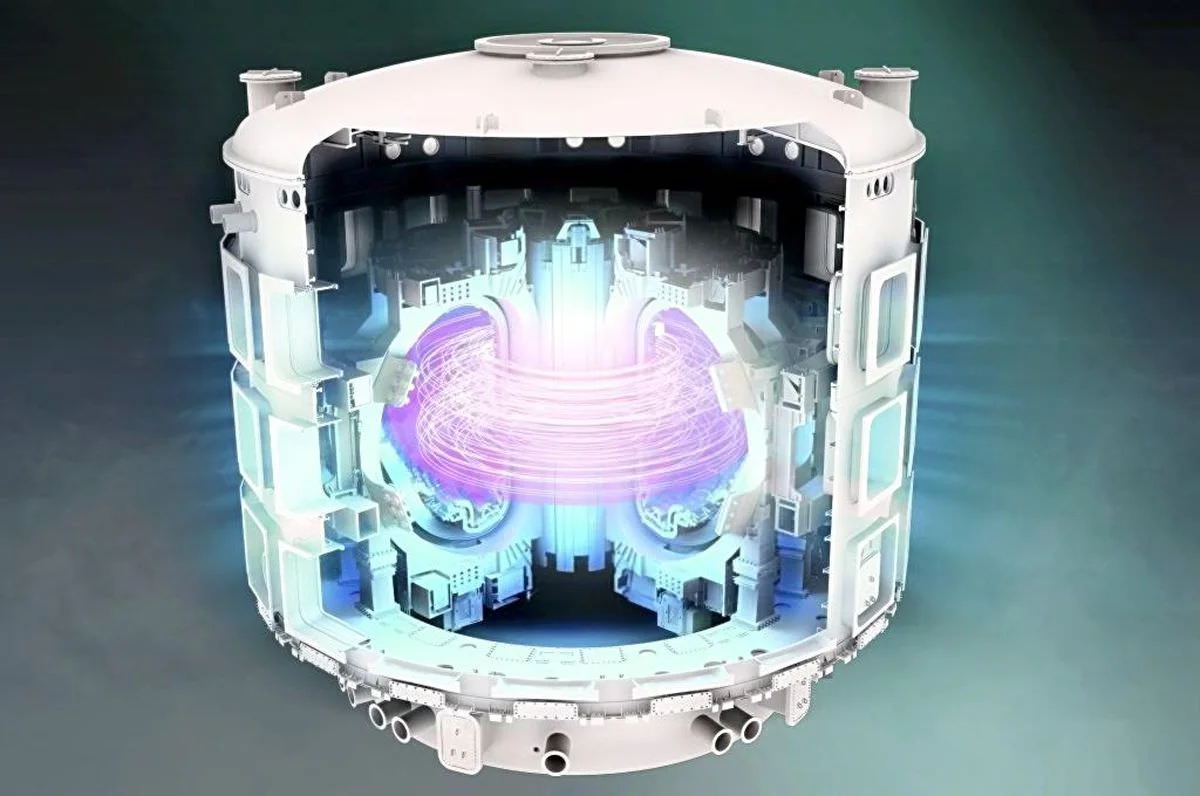
nuclear fusion reactor

The government's goal is to test fusion power generation in the 2030s. When it is built, the prototype reactor will measure about 30 meters in both diameter and height, the same size as the International Thermonuclear Experimental Reactor (ITER), which Japan, the United States, Europe and others are currently constructing in France. Under the QST's initial plan, a reactor was designed to be 1.4 times the size of the ITER and scheduled to be commercialized around the 2050s. However, it has been downsized to bring the timeline forward. There are three phases in the development of the prototype reactor: testing power generation integrating the fusion reactor and power generation facilities; testing technology to breed tritium — the fuel — in the reactor; and testing the reactor's stable operations. One year after completing the prototype, the QST aims to successfully generate power for several minutes, with a net output of about 10,000 kilowatts. It then aims to increase that output to about 100,000 kilowatts when the reactor reaches stable operations.


Link:

National Institutes for Quantum Science and Technology

National Institutes for Quantum Science and Technology

The official website of the National Institutes for Quantum Science and Technology.
 
Virtually every year since I was a child, some group of scientists in some country has declared that clean, cheap and never ending fusion power is merely 20-30 years hence…

Plasma containment is a very difficult problem to solve.
 
Virtually every year since I was a child, some group of scientists in some country has declared that clean, cheap and never ending fusion power is merely 20-30 years hence…

Plasma containment is a very difficult problem to solve.
They have a made a lot of progress though. I expect we'll see working fusion in about 20 years. :)
 
I happened to read about this recently and the article did sound encouraging.

Now, two companies—Germany's Proxima Fusion and Tennessee-based Type One Energy—have taken a major step forward, publishing peer-reviewed blueprints for their competing stellarator designs. Both firms say the papers demonstrate that their machines can deliver commercial fusion energy.

At the heart of both approaches is the stellarator, a mesmerizingly complex machine that uses twisted magnetic fields to hold the plasma steady. This configuration, first dreamed up in the 1950s, promises a crucial advantage: Unlike its more popular cousin, the tokamak, a stellarator can operate continuously, without the need for a strong internal plasma current. Instead, stellarators use external magnetic coils. This design reduces the risk of sudden disruptions to the plasma field that can send high-energy particles crashing into reactor walls.

The downside? Stellarators, while theoretically simpler to operate, are notoriously difficult to design and build. Recent advances in computational power, high-temperature superconducting (HTS) magnets, and AI-enhanced optimization of magnet geometries are changing the game, helping researchers to uncover patterns that lead to simpler, faster, and cheaper stellarator designs.
 
That's interesting. The next issue will be procuring sufficient quantities of fuel for the reactor-deuterium and tritium. Seawater has good amounts of deuterium and tritium is bred in the reactor. But the most plentiful supply is in lunar material. Apollo 17 astronaut and geologist , Harrison Schmitt the only scientist to have worked on the moon, promoted a return to the moon for the purposes of lunar deuterium mining (amongst other things).
IMG_4905.webp
 
Back
Top Bottom