


- 14 Mar 2002
- 21,050
- 18,904
Japan extended the designation of its continental shelf to the eastern part of islands approximately 1,000 kilometres south of Tokyo on Saturday, enabling the resource-poor country to begin research on extracting maritime natural resources such as rare metals from the region. A revised Cabinet order took effect, designating a significant portion of the Ogasawara Plateau sea area as part of its continental shelf, around 120,000 square kilometres. This move to enlarge the shelf has triggered opposition from China. Yoshifumi Matsumura, minister for ocean policy, stated on June 25, when the Cabinet approved the expansion, that the expanded continental shelf represents around half of Japan's Honshu main island area. He also mentioned that Japan could exercise its sovereign rights to explore the continental shelf and develop natural resources. The government confirmed the existence of a cobalt-rich crust, including rare metals, in the region, noting that cobalt is used for electric vehicle batteries.
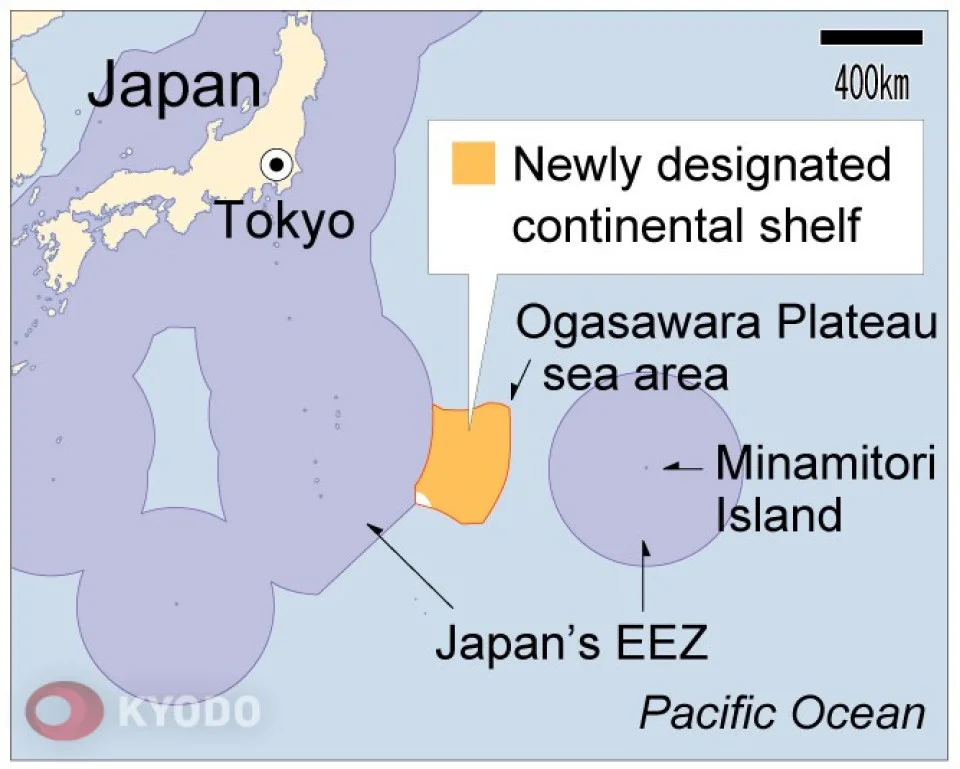
Image credit: Kyodo
Rare earth minerals are essential for high-tech products like batteries and semiconductors. Experts suggest that China, a leading producer, has been aiming to dominate industries with a significant market share and enhance its economic influence in emerging sectors dependent on these materials. Due to financial security concerns, Japan has been intensifying its efforts to secure supplies of these resources. According to U.N. law, a coastal state can claim control of the seabed beyond the traditional 200-nautical-mile limit for exclusive economic use if it can demonstrate that the ocean floor is connected to its continental shelf.
 english.kyodonews.net
Image credit: Kyodo
To have its continental shelf recognized beyond its exclusive economic zone, Japan needed the approval of an institution established under the U.N. Convention on the Law of the Sea on the continuity of the seabed topography and agreement from relevant countries, which in this case was solely the United States. Following consultations with Washington, Japan set the area for expansion in December 2023. China has criticized Japan's move. Foreign Ministry spokeswoman Mao Ning said on 27 June that the expansion "contravenes the stipulations of U.N. Convention on the Law of the Sea and universal practice." Rare earth minerals are crucial for high-tech products such as batteries and semiconductors. China, a major producer of them, has apparently been seeking to dominate industries where it already holds a large market share and to boost its economic clout in growing sectors that rely on such materials, experts said.
Rare earth minerals are essential for high-tech products like batteries and semiconductors. Experts suggest that China, a leading producer, has been aiming to dominate industries with a significant market share and enhance its economic influence in emerging sectors dependent on these materials. Due to financial security concerns, Japan has been intensifying its efforts to secure supplies of these resources. According to U.N. law, a coastal state can claim control of the seabed beyond the traditional 200-nautical-mile limit for exclusive economic use if it can demonstrate that the ocean floor is connected to its continental shelf.
Japan expands continental shelf eastward for rare metals research
Japan on Saturday extended its designation of its continental shelf to the eastern part of islands some 1,000 kilometers south of Tokyo, enabling the resource-poor country to start research on extracting maritime natural resources such as rare metals from the region.


