News 'Customer abuse' rampant in Japan's service industry

thomas

Unswerving cyclist
Admin
Joined
14 Mar 2002
Messages
21,053
Reaction score
18,905
Customer abuse (カスハラ), to be sure, harassment of front-line workers BY customers with aggressive behaviour or unreasonable requests, has become an increasing problem in the service industry, prompting municipalities and companies to take stricter measures. A 2022 survey conducted by the Japan Trade Union Confederation, better known as Rengo, found that 67.5% of respondents had experienced some customer harassment in the past three years, among which another 76.4% said such experiences had negatively affected their lives.

The case below—prominently featured in the national news—has become a sad example of the harassment many eateries face.


While big corporations can typically handle the negative impact on their reputation and finances due to confrontational customers or those engaging in unsanitary stunts for attention, such customer behaviour can drive small business owners to their limits.


One extreme case of customer abuse occurred at the Ibadai branch of the Ikkenme ramen chain in Mito. The problem started after a man entered the restaurant conveniently located near Ibaraki University in spring 2022. After being served a bowl of ramen, he ordered additional toppings of chopped onion every two minutes. He exited the eatery without even touching the meal, leaving behind a bowl covered with a heap of chopped onion. The same customer visited the noodle shop at a later date and was recognized by staff. They declined his requests for additional toppings. Infuriated, the man poured condiments and about 500 toothpicks into the soup. The 51-year-old manager banned the customer. When the man came back and continued his annoying antics in March last year, the manager called police. Ibaraki prefectural police reprimanded the man. But that only seemed to escalate the man's abuse of the ramen shop. He started calling the restaurant at least 20 times a day, and even threatened to kill staff and set the place on fire. At least one employee was too scared to work and quit. The eatery made a tough decision to close in July last year. "I thought human life and safety must come first," the manager said. The customer was indicted on a charge of intimidation, and the Mito Summary Court in January this year ordered him to pay 100,000 JPY (USD 640) in fines.


 
I don't understand what motivates that behavior, in the case of the man mentioned. It could be at least understood why a customer would be unhappy if there was some issue, food quality or the cleanliness of the store or behavior of the staff, but in this example there just doesn't seem to be any motivation.
 
I don't understand what motivates that behavior, in the case of the man mentioned. It could be at least understood why a customer would be unhappy if there was some issue, food quality or the cleanliness of the store or behavior of the staff, but in this example there just doesn't seem to be any motivation.

I was wondering about this, too. It looks like an inflated sense of entitlement (fairly common in Japanese customers) combined with sociopathic/psychopathic tendencies.
 
And it's not only the small eateries that are concerned with "kasu-hara":

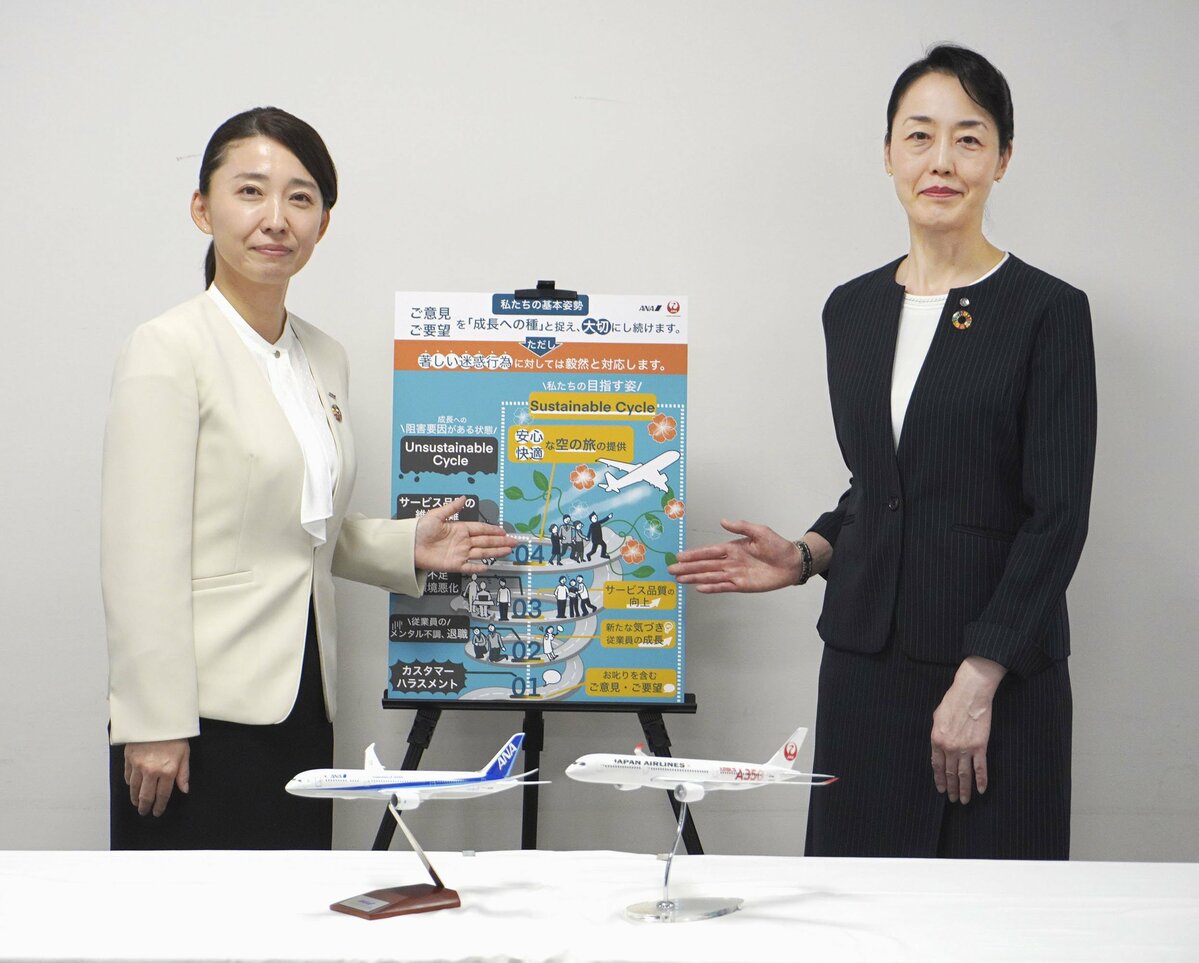
On Friday, ANA Holdings Inc. and Japan Airlines Co. announced they will tackle customer harassment through newly established joint guidelines. These guidelines aim to prevent staff resignations caused by abusive customers. They address behaviours such as harassment, unreasonable demands, and physical violence, as well as unauthorized access to workspaces and property damage.


JAL and ANA tackle kasu-hara (customer harassment)

Photo credit: Kyodo

The move comes as so-called kasu-hara, Japanese slang for customer harassment, has become a social issue in recent years in Japan, a country known for its hospitality culture. The two carriers follow convenience stores and railway companies in taking measures to protect their employees from such abuse. ANA and JAL said they will call on other airlines to take similar steps.


カスハラ has attracted the attention of bureaucracy:

The Ministry of Health, Labor and Welfare announced on 19 July that it plans to require companies to implement measures to protect their employees from "customer harassment." The policy, outlined in a draft report by an expert panel, defines customer harassment as involving three elements: unacceptable language and behaviour, actions harming the working environment, and abuse by stakeholders such as customers or business partners.

Examples of actions considered customer harassment:
  • Demands that significantly exceed contracted terms or service offerings
  • Physical abuse like hitting, kicking or spitting
  • Posting employees' names on the internet without their consent
  • Demanding employees to kneel
  • Taking photos without permission
  • Making frequent complaints
  • Requiring too much of an employee's time, refusing to leave and making prolonged phone calls

 
Yesterday, the Tokyo metropolitan government enacted an ordinance against kasu-hara to protect businesses and shop staff from abusive customers. "Customer harassment" seems to have become more commonplace across the capital.

Kasu-hara

Local governments, too, have begun to act: Hokkaido , Saitama, and Mie prefectures are also considering enacting ordinances. Based on its ordinance on diversity, Akita Prefecture's guidelines specify examples of kasu-hara and points to consider when addressing the issue. Miyazaki Prefecture, Kyoto City, and Okayama City are among the municipalities that have adopted the practice of using first names only on staff ID tags. Fukuoka Prefecture created a manual earlier this year on how to deal with kasu-hara at administrative offices. Officials want to clarify where to draw the line between a legitimate customer request and an act that constitutes harassment.


A 47-year-old man who worked as an assistant manager at a supermarket in Tokyo recalled a complaint he received from a customer: "The tofu I purchased is rotten." The man, eager to set things right, visited the customer's home to check the product and found that more than two weeks had passed since the purchase. "Of course, the tofu would be rotten after such a long time," he told himself. But he kept his thoughts to himself because he didn't want to lose the customer. So, he adopted a humble attitude toward the person, who then made an extraordinary request: that the man prostrate himself and apologize.

 
Back
Top Bottom