Warring States Period (1467-1568)
The Sengoku Period (戦国時代) lasted from 1467, the beginning of the Ōnin War (応仁の乱 Ōnin no Ran), until 1568, the year Oda Nobunaga entered Kyōto to assert national hegemony. Other historians set the end at 1573, the end of the Muromachi period , or even around 1603, the beginning of the Edo era and the Tokugawa shogunate.
Some historians date it from 1490, when Hosokawa Katsumoto (細川 勝元, 1430-1473), the kanrei (管領, shogunal deputy), took over the actual power of the Muromachi shogunate; others from 1491, when Hōjō Sōun (北条 早雲, 1432-1519) conquered Izu Province (modern-day Shizuoka Prefecture) and began to rise to control over the Kantō region . Although the Sengoku Period is often described as a transitional period between the medieval and premodern ages, most historians regard it as the final stage of Japan's Middle Ages.
As a result of weakening shogunal leadership, local shugodai (守護代 , deputy military governors) and kokujin (国人, local military proprietors) established military and political control over provinces that had previously been ruled by the great shugo (守護 , military governor) houses. The imperial court, the Ashikaga shōgun, the shugo based in Kyoto, and temples found themselves powerless against this new group of local rulers, known as the Sengoku daimyō. These regional warlords waged constant war to defend or enlarge their domains. Only in the 1560s did Oda Nobunaga succeed in defeating his competitors and emerge as a potential national unifier of Japan.
Economic boom
Despite political instability, the Sengoku period witnessed remarkable economic growth. The Sengoku daimyō worked to enrich their domains, build up their armies, and implement flood control and land reclamation projects. Agriculture expanded, and rice harvests increased substantially, as did the production of raw materials for handicraft industries. The mining industry experienced a significant boom, with numerous new mines opening to produce gold, silver, copper, and iron, thereby furthering the development of smiths and foundries. The cotton industry also had its beginnings in this period. Before that time, all cotton, yams and cloth had been imported. Still, the cultivation of cotton began in Mikawa Province (a part of modern-day Aichi Prefecture ) around this time, leading to the production of domestic yams and cloth, with cotton cloth becoming the primary fabric of the premodern period. Along with industrial development, commerce also expanded: numerous stores were established in towns and along heavily travelled roads, boat transportation flourished, and the daimyō were able to trade with distant provinces.The increase in trade over a wide area resulted in the formation of commercial cities, where commodities were collected and distributed. Sakai, Hyōgo (now Kobe), Kuwana, and Hakata were representative towns. With the end of the Ōnin War, Kyōto, a battlefield of eleven years, regained its former importance as Japan's industrial and commercial centre. Influential merchants managed the affairs of these cities and towns, attaining a degree of political autonomy while defending them in cooperation with the ordinary citizenry. Christian missionaries in Sakai at the time were struck by the similarities between Sakai and the free cities of medieval Europe. During the later Sengoku Period, castle towns grew around the castles of influential daimyō and served as political and commercial centres.
Flourishing culture
Another paradoxical development during the century of the civil war was the nationwide diffusion of culture, formerly the prerogative of the nobility and clergy in Kyōto and Nara. A significant role in this process was played by Zen priests and rengashi (連歌師, linked-verse poets) who were invited to the provinces by the Sengoku daimyō. The Zen priests taught Confucianism, classical Chinese poetry (漢詩 kanshi), and ink painting and were also influential in the publication of various books. The rengashi taught renga and haikai (俳諧 or 誹諧, humorous or vulgar renga poetry), as well as the Japanese classics. Under the patronage of the wealthy merchants of Sakai and Kyōto, who were themselves outstanding practitioners, the traditional arts, the tea ceremony , Nō theatre, and various types of music flourished. Books aimed at the general public, such as Otogi-zoshi (お伽草子, collections of moralistic stories) and the Kanginshu (感吟, a collection of popular songs), were published. The setsūyoshū (節用集), a dictionary for everyday use compiled by Zen priests, was also published. Christianity was introduced to Japan by the Jesuit priest Francis Xavier in 1549. He and his fellow missionaries also brought with them European, or namban (南蛮, "southern barbarian"), culture.References:
- Nussbaum, Louis-Frédéric. Japan Encyclopedia. Harvard University Press, 2005.
- Papinot, Edmond. Historical and Geographical Dictionary of Japan. Tuttle, third printing 1988.
- Sansom, George. History of Japan to 1334. Stanford University Press, 1965.
- Sansom, George. A History of Japan 1334-1615. Stanford University Press, 1961.
- Totman, Conrad. A History of Japan. Wiley-Blackwell; second edition 2005.
- Turnbull, Stephen, The Samurai: A Military History, Macmillan, 1977.
Media:

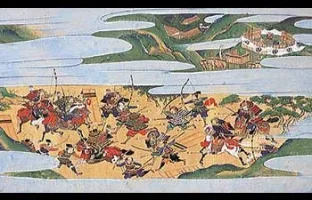
Scene from the Ōnin War by Kamonnosuke Hisakuni (掃部助久国), Shinnyodō engi, vol.3
Major Sengoku daimyō and their territories around 1565.

Sengoku daimyō 1572 (Source: Harvard FAS)