

The shizoku (士族) were the descendants of Japan's former samurai class who retained a distinct legal status after the Meiji Restoration . Established in 1869 as part of the new government's sweeping social reforms, the category encompassed most former warriors who were not elevated to the new hereditary nobility, the kazoku (華族). Although shizoku ranked above commoners in the official family register, they enjoyed no legal privileges. They gradually lost the stipends, exclusive rights and social status that had defined the samurai under the Tokugawa shogunate.
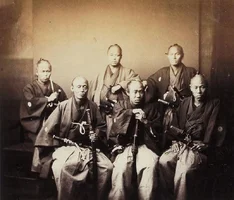
Studio portrait of samurai from the Satsuma domain by Felice Beato, c. 1867–1868. The photograph captures members of Japan's warrior class on the eve of the Meiji Restoration, before the abolition of the feudal order and the creation of the shizoku class in 1869.
Although the shizoku lost their legal status with the post-war reforms of 1947, their influence extended well beyond the Meiji period . Many of Japan's early political leaders, bureaucrats, military officers, educators and industrialists came from shizoku families, and the values associated with education, discipline and personal advancement continued to influence Japanese society long after the class itself disappeared.
Origins
The creation of the shizoku was closely tied to the political transformation of the Meiji Restoration. In 1868, imperial forces overthrew the Tokugawa shogunate and began dismantling the feudal order that had governed Japan for more than two and a half centuries. One of the new government's immediate priorities was to abolish the rigid hereditary status system that divided society into warriors, peasants, artisans and merchants, while simultaneously creating a modern administrative state.A decisive step came with the return of the domain registers (版籍奉還 hanseki hōkan) in 1869, when the daimyō surrendered their lands and populations to the Emperor. The former court nobility (公家 kuge) and feudal lords were merged into a new aristocratic class known as the kazoku. In contrast, most former samurai retainers became members of the newly established shizoku. Commoners formed the third major legal category, known as heimin (平民).
The government formally declared on 2 August 1869 that all former domain retainers, from senior hereditary families to ordinary samurai, were to be known collectively as shizoku. In practice, however, implementation varied considerably between domains. Some incorporated lower-ranking ashigaru into the new class, while others assigned servants and lower-status retainers to a separate category known as sotsu (卒). Former hatamoto of the Tokugawa shogunate were likewise incorporated into the shizoku after their earlier titles were abolished.
During the following years, the government continued to broaden the category. Retainers of court nobles who had not entered the kazoku, attendants attached to noble households, and various retainers serving temples and shrines were gradually absorbed into the shizoku or sotsu. In 1872, the separate sotsu classification was abolished. Families whose status had been hereditary were incorporated into the shizoku, while those employed only for a single generation reverted to commoner status.
The reorganisation was intended to simplify what had been a highly fragmented warrior hierarchy. By replacing hundreds of domain-specific ranks with a single legal category, the Meiji government sought to create a more uniform social structure while strengthening central authority.
At the same time, the new status carried few tangible advantages. Unlike the kazoku, the shizoku received no hereditary titles or political privileges. Their designation was primarily administrative, recorded in the family register rather than expressed through legal rights. The distinction nevertheless remained important as a marker of family background and social identity for decades after the samurai class itself had disappeared.
According to the first nationwide family register compiled in 1872, the shizoku numbered approximately 1.28 million people in 258,952 households, representing about 3.9% of Japan's population. Following the abolition of the separate sotsu category and the incorporation of hereditary lower-ranking retainers, their numbers rose to nearly 1.9 million by 1876, or around 5.5% of the population. Although the absolute number continued to increase thereafter, the proportion gradually declined as Japan's population expanded.
The establishment of Okinawa Prefecture also required the Meiji government to redefine the status of the former Ryūkyū Kingdom's ruling class. Members of the royal family were admitted to the kazoku, while many officials of the former Ryūkyū administration were recognised as shizoku. Their circumstances differed from those of former mainland samurai, however, as the Ryūkyū Kingdom had possessed its own distinctive administrative and social structure.
Loss of privileges
The creation of the shizoku did not preserve the social and economic position that the samurai had enjoyed under the Tokugawa shogunate. Although former warriors initially retained government stipends, the Meiji leadership regarded the old system as incompatible with a modern state based on equality before the law, centralised taxation and national conscription. During the 1870s, nearly every traditional privilege associated with the samurai was dismantled.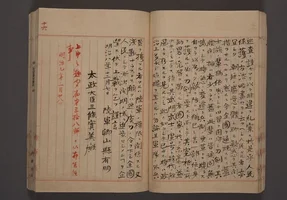
The second page of the Haitōrei (廃刀令, Sword Abolishment Edict), promulgated in 1876. The ban on wearing swords in public deprived the shizoku of one of the defining symbols of their former status, reflecting the Meiji government's determination to dismantle the privileges of the old warrior class. National Archives of Japan.
To reduce these costs, the government gradually reformed the stipend system. In 1873, shizoku were given the option of exchanging their hereditary stipends for government bonds. Three years later, the conversion became compulsory under the chitsuroku shobun (秩禄処分), or Commutation of Hereditary Pensions. Lifetime and hereditary stipends were abolished and replaced with interest-bearing government bonds whose value varied according to the former stipend. While the reform significantly improved the state's finances, it deprived many former samurai families of their principal source of income.
Other long-standing privileges disappeared in quick succession. In 1871, marriage between people of different social backgrounds was formally permitted. The following year, reforms to the family register simplified status distinctions, and commoners increasingly acquired rights that had previously belonged only to the warrior class. Surnames, once largely restricted to samurai, were first permitted for commoners in 1870 and became compulsory for all Japanese in 1875.
Military reform proved even more symbolic. The Conscription Ordinance of 1873 introduced universal military service for adult males, replacing the hereditary warrior class with a national army modelled largely on European examples. For many former samurai, this represented the loss of the very function that had justified their privileged status for centuries. Their exclusive responsibility for bearing arms and defending the state had come to an end.
The process culminated in the Haitōrei (廃刀令) of 1876, which prohibited the wearing of swords in public except for members of the military, police and a limited number of officials. The sword had long been the visible emblem of samurai identity, and its prohibition carried a significance far beyond practical regulation. Although many former samurai continued to own family swords, they could no longer wear them as symbols of their status.
Despite these sweeping reforms, the shizoku did not become legally indistinguishable from commoners. Their status continued to be recorded in the family register, placing them formally between the kazoku and the heimin. In practical terms, however, the distinction was increasingly symbolic. Apart from their recorded lineage and, in some cases, a measure of social prestige, the shizoku possessed no legal rights that separated them from the rest of the population.
The cumulative effect of these reforms transformed the former warrior class within less than a decade. By the late 1870s, the hereditary military elite that had dominated Japanese society since the medieval period had ceased to exist as a privileged estate. Many former samurai faced severe economic hardship, while others adapted to the opportunities offered by a rapidly modernising society. Their varied responses would shape both the unrest and the remarkable social mobility that characterised the early Meiji period.
Economic adaptation
The abolition of hereditary stipends forced the shizoku to seek new livelihoods, often for the first time in generations. Under the Tokugawa system, samurai served as administrators, soldiers, and officials rather than as farmers or merchants. The Meiji reforms abruptly removed their traditional occupations without providing an equivalent place in the new social order. For many families, adapting to a market economy proved difficult.The government encouraged former samurai to enter agriculture, forestry, commerce and industry. Financial assistance was offered through programmes collectively known as shizoku jusan (士族授産), or "shizoku rehabilitation", which aimed to help former warriors establish productive occupations. Some were encouraged to settle in Hokkaidō , where the government viewed colonisation both as a means of relieving social unrest and as a strategic measure to strengthen Japan's northern frontier. The scheme met with mixed results. While some settlements prospered, many participants lacked agricultural experience, and numerous ventures failed.
Commerce presented another challenge. Many former samurai opened small shops, restaurants or trading businesses, often with little understanding of the competitive marketplace. Their difficulties became a familiar subject of public satire. The expression "shizoku no shōhō" (士族の商法, "the business methods of the shizoku") entered the language as a sarcastic description of an enterprise managed with little commercial sense. It referred to former samurai who relied on inherited pride rather than practical business skills, quickly exhausting their capital.
Contemporary observers noted that many unsuccessful businesses were confectioners, tea houses, second-hand dealers and charcoal merchants. Some former samurai displayed inherited household goods for sale in makeshift antique shops, hoping to survive by disposing of family possessions. Their formal manners and reluctance to bargain often stood in sharp contrast to the expectations of ordinary customers, reinforcing popular stereotypes of the impractical former warrior.
The phrase became sufficiently well known to inspire satirical woodblock prints , comic stories and rakugo performances. Utagawa Yoshitora's 1877 print Shizoku no Shōhō lampooned unsuccessful former samurai entrepreneurs while simultaneously commenting on the Satsuma Rebellion then unfolding in Kyūshū . Kabuki and popular literature also drew upon the theme, reflecting widespread public awareness of the social upheaval experienced by the former warrior class.
Government assistance likewise produced uneven results. Loans, grants and settlement schemes frequently failed because recipients lacked practical experience or because the projects themselves were poorly planned. Although some politicians argued that overseas expansion or military campaigns, particularly the proposed invasion of Korea during the Seikanron debate, would provide employment and purpose for unemployed former samurai, such proposals were rejected, contributing to growing dissatisfaction among sections of the shizoku.
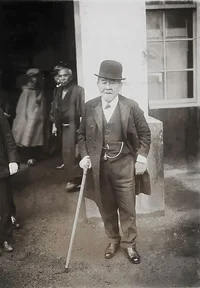
Shibusawa Eiichi (渋沢栄一, 1840–1931), a former Tokugawa retainer who became one of the leading entrepreneurs of modern Japan. His career exemplifies the successful adaptation of many members of the shizoku to the economic and social changes of the Meiji era.
Others became prominent entrepreneurs. Among the best-known were Shibusawa Eiichi, often called the "father of Japanese capitalism"; Godai Tomoatsu , who played a major role in Ōsaka's economic development; and Aikawa Yoshisuke. Others helped establish banks financed by former samurai capital, founded manufacturing enterprises, or entered emerging industries such as dairy farming, where traditional agricultural communities had been reluctant to invest.
Education offered another important avenue of advancement. Former samurai also became teachers, journalists, lawyers and local officials, while many found employment in prefectural administrations through long-standing ties with their former domains. Rather than disappearing as an elite, the shizoku increasingly exchanged hereditary privilege for influence based on education, administrative experience and professional expertise. Their transition was often difficult, but it also supplied much of the skilled workforce that underpinned Japan's rapid modernisation.
Shizoku in government and society
Although the shizoku lost their hereditary privileges, they remained among the best-educated groups in Japan during the early Meiji period. Centuries of service as administrators, scholars and military officers had produced a class with relatively high levels of literacy and experience in governance. The Meiji government, despite dismantling the old social order, depended heavily on these skills while building the institutions of a modern state.Many former domain officials continued in public service after the abolition of the domains. At first, former daimyō became prefectural governors, while many of their retainers remained as local officials. As the new prefectural administration expanded, large numbers of shizoku found employment in ministries, prefectural offices and the judiciary. Their administrative experience made them indispensable during the state's formative years.
Statistics from the early 1880s illustrate their prominent position. In 1881, roughly 52,000 of Japan's 78,000 central and prefectural government officials were shizoku. They were also well represented in local government, holding thousands of positions as district and municipal officials. Although these proportions steadily declined as recruitment became more merit-based, former samurai remained disproportionately influential in public administration throughout the first decades of the Meiji period.
Education followed a similar pattern. The government rapidly expanded a national school system and required qualified teachers, principals and administrators. Former samurai, accustomed to literacy and formal learning, filled many of these posts. In 1882, around four-fifths of the principals and teachers at secondary schools and teacher-training colleges came from shizoku families. Even in elementary education, where commoners formed the majority of teachers, the proportion of shizoku remained considerably higher than their share of the general population.
Their educational advantages also translated into academic success. During the late nineteenth century, students from shizoku families accounted for a disproportionately large share of enrolments at higher schools, the preparatory institutions for the Imperial University. Between the mid-1880s and the early 1890s, they commonly accounted for around half of all students despite constituting only about five per cent of the national population. As educational opportunities gradually broadened, the proportion declined, yet shizoku remained strongly represented well into the twentieth century.
The introduction of competitive civil service examinations slowly altered this balance. Regulations adopted in 1887 opened senior government appointments to candidates selected through examinations rather than hereditary background. Even so, shizoku applicants initially performed well, reflecting their comparatively strong educational foundations. Throughout the 1890s and early twentieth century, they continued to account for between one-fifth and one-third of successful candidates in the higher civil service examinations.
Outside government, many former samurai entered professions that relied on education rather than inherited status. Journalism, law, medicine and academia attracted increasing numbers of shizoku, while others became officers in the new Imperial Army and Navy or joined the expanding police force. Their influence extended into politics as well. Many early leaders of the Freedom and People's Rights Movement (自由民権運動 Jiyū Minken Undō), which campaigned for constitutional government and an elected national assembly, came from shizoku backgrounds. Figures such as Itagaki Taisuke (板垣退助, 1837–1919) redirected the political ambitions of former samurai away from armed resistance and towards parliamentary reform.
The shizoku, therefore, occupied an unusual position in Meiji society. As a legal class, they had lost almost everything that had distinguished the samurai under the Tokugawa shogunate. As a social group, however, they retained substantial advantages in education, administrative experience and personal networks. These assets allowed many former samurai to become the bureaucrats, teachers, officers and professionals who staffed Japan's emerging modern institutions, even as opportunities gradually widened for talented commoners.
Rebellions and political activism
Not all former samurai accepted the rapid transformation of Japanese society. For many shizoku, the loss of hereditary income, military status and social prestige was compounded by the belief that the Meiji government had betrayed those who had helped bring about the Restoration. The resulting frustration found expression in both armed resistance and constitutional politics.One of the most contentious issues was the debate over Korea known as the Seikanron (征韓論). Several influential leaders argued that a military expedition would both strengthen Japan's international position and provide a renewed purpose for the former warrior class. When the government rejected the proposal in 1873, many disillusioned shizoku concluded that peaceful reform offered little prospect of restoring their standing.
Tsukioka Yoshitoshi's triptych Shinpūren Daikyōdō (1876) portrays the Shinpūren Rebellion, in which disaffected members of the shizoku attacked government forces in protest against the Meiji reforms. The uprising was part of a broader wave of rebellions by former samurai that culminated in the Satsuma Rebellion of 1877.
Their dissatisfaction intensified after the introduction of universal conscription in the same year. For centuries, military service had been the exclusive responsibility of the samurai. The creation of a national army recruited from all social backgrounds not only deprived former warriors of their traditional role but also challenged the values on which their identity had rested. The Haitōrei Edict of 1876, which prohibited the wearing of swords in public, reinforced the perception that the government was deliberately dismantling the symbols of the samurai estate.
Between 1874 and 1877, more than thirty armed uprisings involving former samurai broke out across Kyūshū and western Honshū. The first major conflict was the Saga Rebellion of 1874, led by former retainers of the Saga domain after the government refused to invade Korea. Although quickly suppressed, it revealed the depth of dissatisfaction among sections of the shizoku.
The unrest escalated in 1876. The Shinpūren Rebellion erupted in Kumamoto on 24 October when members of the conservative Shinpūren society attacked government offices and military installations. Inspired in part by its initial success, further revolts followed almost immediately, including the Akizuki Rebellion and the Hagi Rebellion. All were defeated within days or weeks by the new Imperial Army.
The largest and most famous uprising was the Satsuma Rebellion of 1877, led by Saigō Takamori (西郷隆盛, 1828–1877), himself one of the principal architects of the Meiji Restoration. What began as a regional dispute developed into a full-scale civil war requiring the mobilisation of some 65,000 government troops. After months of fighting, Saigō's forces were overwhelmed. Mortally wounded during the final battle at Shiroyama, he committed seppuku, and the defeat effectively ended organised military resistance by the former samurai.
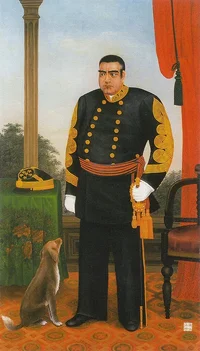
Posthumous portrait of Saigō Takamori (1828–1877) by Edoardo Chiossone, completed in 1888. A leading figure of the Meiji Restoration who later led the Satsuma Rebellion, Saigō became the enduring symbol of armed resistance by disaffected members of the shizoku against the new Meiji state.
Yet armed resistance represented only one response to the changing times. Many shizoku abandoned the idea of restoring the old order and instead sought to reshape the new one through political participation. Former samurai played a prominent role in the Freedom and People's Rights Movement, which campaigned for constitutional government, civil liberties and an elected national assembly. Leaders such as Itagaki Taisuke argued that national strength depended not on reviving feudal privilege but on creating representative political institutions.
The transition from rebellion to political activism marked an important shift in the history of the shizoku. During the 1870s, some had attempted to defend their position through force of arms. By the following decade, many of the same social groups had become advocates of constitutional reform, helping to lay the foundations for Japan's parliamentary system. Their influence did not disappear with the end of the samurai class; rather, it evolved alongside the institutions of the modern Japanese state.
Identity, education and the rise of Risshin Shussei
The disappearance of the samurai estate created not only economic hardship but also a profound crisis of identity. For centuries, social status had been inherited, reinforced by hereditary stipends and defined by service to a feudal lord. The Meiji reforms dismantled this framework within little more than a decade, forcing former samurai to redefine their place in society.For many families, the transition was painful. The loss of hereditary income frequently resulted in declining living standards, repeated moves and, in some cases, extreme poverty. Contemporary accounts describe former samurai households struggling to maintain their social standing despite dwindling resources. In Kanazawa, for example, observers noted that impoverished shizoku families often saw sons enter the police force, while daughters sought work in occupations previously considered unthinkable. Such examples, although not representative of the entire class, illustrate the severity of the adjustment many former warriors faced.
At the same time, the Meiji period witnessed the emergence of a new ideal that gradually replaced inherited status with individual achievement. This concept, known as Risshin Shussei (立身出世), literally "rising in the world through one's own efforts", encouraged advancement through education, diligence and professional success rather than birth. Although similar ideas had existed earlier, they acquired unprecedented prominence during the late nineteenth century as Japan embraced modern education and merit-based careers.
The new ethos was promoted by some of the leading intellectuals of the age. Nakamura Masanao (中村正直, 1832–1891) introduced Samuel Smiles's influential work Self-Help to Japanese readers through his translation Saigoku Risshi Hen (西国立志編). The book argued that perseverance, thrift, self-discipline and hard work, not inherited privilege, formed the basis of success. Its message resonated strongly with educated members of the former samurai class who were searching for a new role in a rapidly changing society.
Fukuzawa Yukichi (福澤諭吉, 1835–1901) advanced similar ideas in Gakumon no Susume (学問のすゝめ, "An Encouragement of Learning"). Rather than looking to hereditary status, he urged individuals to acquire practical knowledge (実学 jitsugaku) through education and engagement with the modern world. For many former samurai, education became the principal means of recovering both social standing and economic security.
This emphasis on learning built upon the strengths the shizoku already possessed. Literacy rates among former samurai were generally much higher than those of the wider population, and many had long experience of administration, scholarship and record-keeping. These advantages enabled them to compete successfully for places in the expanding education system, the civil service and the professions, even as recruitment became increasingly based on competitive examinations rather than family background.
By the late nineteenth century, the ideology of Risshin Shussei had become closely intertwined with national objectives. Personal advancement was presented not merely as an individual ambition but as a contribution to Japan's modernisation and its efforts to revise the unequal treaties imposed by the Western powers. Success through education and public service came to be viewed as strengthening both the individual and the nation.
This represented a significant shift in values. Under the Tokugawa shogunate, honour had been rooted primarily in hereditary status and loyalty to one's lord. During the Meiji period, honour increasingly became associated with achievement, expertise and service to the state. The transformation did not erase memories of the samurai past, but it helped integrate many former warriors into a society where advancement depended less on birth than on education, ability and ambition. In that sense, one of the most enduring legacies of the shizoku was not political or military but cultural: the popularisation of an ideal of self-improvement that continued to shape Japanese society long after the class itself had ceased to exist.
Decline and abolition
By the late nineteenth century, the shizoku had ceased to function as a distinct social elite, even though the designation remained in the family register. Their numbers continued to grow in absolute terms through natural population increase, rising from roughly 1.9 million in 1876 to more than 2.3 million by 1913. As Japan's overall population expanded more rapidly, however, its share of the population steadily declined from around 5.5% to just over 4%.The legal distinction between shizoku and commoners likewise became increasingly symbolic. Although family registers continued to record class status, reforms gradually removed their practical significance. The revision of the Family Register Law in 1914 abolished the separate status registration system, but references to shizoku remained as part of the information recorded in the household register. By this time, the designation served chiefly as an indication of family origin rather than conferring any legal or political advantage.
Nevertheless, shizoku identity retained considerable social prestige. References to one's former warrior background frequently appeared in official biographies, school diplomas, university degree certificates and publications such as shinshiroku (紳士録), directories of prominent citizens. Family gravestones occasionally bore inscriptions identifying the deceased as a shizoku of a particular prefecture, reflecting continued pride in samurai ancestry even after its legal privileges had disappeared.
Memoirs by prominent twentieth-century figures illustrate the lingering significance of that identity. Kishi Nobusuke (岸信介, 1896–1987), later Prime Minister of Japan, recalled that although his family had become poor, they continued to take pride in their former shizoku background and regarded education as a defining family tradition. Similarly, Abe Genki (安倍源基, 1894–1989), who served as Home Minister during the Second World War, wrote that being born into a shizoku household, while conferring no political privilege, nevertheless carried a sense of honour and responsibility that shaped his outlook throughout his life.
Even as their legal status faded, the former warrior class continued to influence Japanese society through education and public service. Shizoku families remained disproportionately represented among government officials, military officers, educators and professionals during the late Meiji and Taishō periods. However, many opportunities increasingly became available to talented individuals regardless of social origin. By the early twentieth century, merit rather than hereditary status had become the principal route to advancement.
The final legal remnants of the class disappeared after Japan's defeat in the Second World War. The Constitution of Japan, which came into force on 3 May 1947, abolished the remaining legal status distinctions inherited from the Meiji era. The revised Family Register Law, promulgated on 22 December 1947 and effective from 1 January 1948, removed references to shizoku and other hereditary status groups from the family register.
Even after these reforms, traces of the old classification survived for some years in older household registers. Until access restrictions were introduced in the late 1960s, earlier registers could still reveal whether a family had belonged to the shizoku. Because these records were increasingly misused to investigate family origins, particularly in matters of marriage and employment, the government restricted access to the early Jinshin koseki (壬申戸籍), the first nationwide family register compiled in 1872. Later registers containing hereditary status information were likewise redacted, effectively removing the last practical means of identifying former class affiliation.
Legacy
The history of the shizoku illustrates the complex transition from a feudal society to a modern nation-state. The Meiji government stripped the former samurai of their hereditary privileges, yet relied heavily on their education, administrative experience and leadership while constructing new political and social institutions. Many former warriors experienced financial hardship, and some resisted the reforms through armed rebellion. Far more, however, adapted to the changing order and became civil servants, teachers, soldiers, entrepreneurs, journalists and political leaders.Their influence extended beyond the individuals themselves. The educational traditions of the samurai helped supply much of the skilled workforce that staffed Japan's expanding bureaucracy, school system and armed forces during the late nineteenth century. The ideal of Risshin Shussei encouraged advancement through education and personal achievement rather than inherited status, becoming one of the defining social ideals of modern Japan.
Historians have also reassessed the role of the shizoku in the Meiji period. Earlier accounts often portrayed the conflicts of the 1870s simply as "samurai rebellions", emphasising resistance to modernisation. More recent scholarship has highlighted the wider context, including the economic consequences of the abolition of stipends, the difficulties of social adaptation, and the diverse paths taken by former samurai after the Restoration. While the uprisings remain an important part of the story, they represented only one response among many to the unprecedented changes of the age.
Although the legal category disappeared in 1947, the legacy of the shizoku continued to shape Japanese public life well into the twentieth century. Their experience reflects both the human cost of the Meiji reforms and the remarkable capacity of a former hereditary elite to adapt to a society increasingly defined by education, professional ability and service to the modern state.
References:
- Shizoku (士族). From Japanese Wikipedia.
- Beasley, W. G., The Meiji Restoration, Stanford University Press, 1972.
- Duus, Peter, Modern Japan, 2nd ed., Houghton Mifflin, 1998.
- Jansen, Marius B., The Making of Modern Japan, Harvard University Press, 2000.
- Najita, Tetsuo and J. Victor Koschmann (eds.), Conflict in Modern Japanese History: The Neglected Tradition, Princeton University Press, 1982.
- Ravina, Mark, The Last Samurai: The Life and Battles of Saigō Takamori, Wiley, 2004.
- Totman, Conrad, A History of Japan, 2nd ed., Blackwell, 2005.
- Kodansha (ed.), Kodansha Encyclopedia of Japan, Kodansha, 1983.
- Kokushi Daijiten (国史大辞典), Yoshikawa Kōbunkan, 1979–1997.

