

The Battle of Nomoto (野本合戦) was fought in the second month of Jōhei 5 (承平5年, 935) between the forces of Taira no Masakado (平将門, 903–940) and Minamoto no Tasuku (源扶), eldest son of the former governor Minamoto no Mamoru (源護). Fought near Nomoto (野本) on the border of Hitachi Province (常陸国) and Shimōsa Province (下総国), it was the first recorded military engagement of Masakado's career. Although relatively small, the battle had far-reaching consequences. Tasuku's defeat and death transformed a bitter dispute among powerful provincial families into a wider conflict that spread across eastern Japan and culminated in the Jōhei–Tengyō Rebellion (承平・天慶の乱) of 939–940.
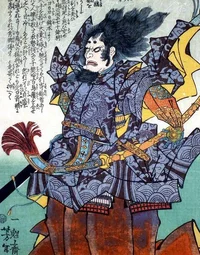
Taira no Masakado, detail from Mirror of the Famous Generals of Great Japan (Dai Nippon Meishō Kagami / 大日本名将鑑), woodblock print by Tsukioka Yoshitoshi (月岡芳年, 1839–1892), c. 1880. The Meiji-period print presents Masakado as a fierce warrior in ornate armour, reflecting the dramatic style of late nineteenth-century historical prints rather than his appearance in the tenth century.
Almost everything known about the Battle of Nomoto derives from the Shōmonki (将門記, The Chronicle of Masakado), a near-contemporary account probably compiled shortly after Masakado died in 940. As one of the earliest surviving works devoted to a provincial warrior, it provides an unusually detailed narrative of the conflict. Its opening section, however, has been lost, leaving historians without the author's original explanation for the outbreak of hostilities. Modern reconstructions therefore combine the surviving text with later historical compilations, genealogical records, and archaeological and geographical evidence. While the immediate causes of the conflict remain debated, there is broad agreement that the Battle of Nomoto marked the beginning of the chain of events that ultimately led to Masakado's rebellion against the imperial court.
Historical Background
The Battle of Nomoto cannot be understood without considering the political and social landscape of eastern Japan during the first half of the tenth century. Although the institutions of the ritsuryō (律令) state remained formally intact, the balance of power in the provinces had begun to shift. Provincial governors (国司), appointed by the imperial court in Heian-kyō (平安京), continued to administer the countryside in the emperor's name, but their authority increasingly depended on cooperation with influential local families whose wealth, landholdings, and armed followers often gave them greater practical power than the officials sent from the capital.The eastern provinces, particularly Hitachi (常陸国), Shimōsa (下総国), Musashi (武蔵国), and Kazusa (上総国), lay far from the political centre. Slow communications and limited military resources made direct intervention by the court difficult, allowing regional elites considerable freedom in managing local affairs. Competition for landed estates was therefore more than an economic matter: it determined political influence, access to agricultural wealth, and the ability to recruit and maintain armed retainers. As a result, disputes over property and inheritance increasingly became struggles for regional leadership.
Among the most prominent families in the Kantō were branches of the Kanmu Taira (桓武平氏) and the Seiwa Minamoto (清和源氏), both descended from imperial princes who had received hereditary surnames after leaving the line of succession. Despite their later fame as rival warrior houses, neither lineage functioned as a unified political organisation during the early tenth century. Loyalty was shaped primarily by kinship, marriage, patronage, and local interests rather than by clan identity. Members of the same branch frequently opposed one another, while alliances between Taira and Minamoto families were common when political circumstances aligned.
The region around Nomoto occupied a strategically valuable position on the Kantō Plain near the border of Hitachi and Shimōsa Provinces. Fertile farmland, river crossings, and established transport routes made the surrounding estates both economically productive and politically important. Control of these resources enabled influential households to expand their authority, attract followers, and strengthen their position against competing families.
Although the participants in the Battle of Nomoto are often described as samurai , the term should be used with caution. The institutionalised warrior class of the Kamakura period had yet to emerge. Instead, the combatants belonged to a provincial military elite whose authority rested on family connections, landed wealth, and personal leadership. They were administrators, landholders, and warriors at the same time, representing an intermediate stage in the development of the class that would later dominate Japanese politics.
Viewed against this background, the conflict at Nomoto was more than a private dispute between neighbouring families. It reflected broader changes in provincial society, where military strength was becoming an increasingly important source of political authority, and where the imperial court's ability to resolve local conflicts was steadily diminishing.
It was within this political environment that the rivalries surrounding Taira no Masakado developed. What began as disputes over inheritance and local influence would ultimately expose the growing inability of provincial institutions to contain conflicts among the emerging military elite.
Principal Participants
The Battle of Nomoto was not a confrontation between the Taira and Minamoto clans in the sense understood from later Japanese history. Instead, it arose from a network of closely related provincial families whose interests had become increasingly difficult to reconcile. Kinship, marriage alliances, inheritance, and local politics all played a part, producing shifting loyalties that defy simple clan divisions.Taira no Masakado (平将門)
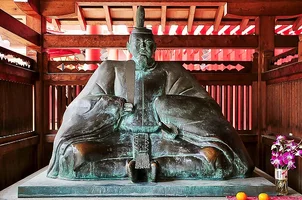
Modern bronze statue of Taira no Masakado at Kanda Myōjin in Tōkyō. Although no contemporary portrait of Masakado survives, he has long been venerated at the shrine as a protective deity (goryō) and guardian of Edo, later Tōkyō.
The surviving sources provide little evidence that Masakado initially sought to challenge the imperial court. Rather, he emerges as an ambitious provincial landholder determined to defend inherited estates and strengthen his family's position in an increasingly competitive political environment. The Battle of Nomoto marks his first recorded appearance as an independent military commander.
Minamoto no Mamoru (源護)
Masakado's principal opponent was Minamoto no Mamoru, a former governor of Hitachi Province and a prominent member of the Seiwa Minamoto (清和源氏). Although no longer in office by 935, Mamoru retained considerable influence through his landed estates, family connections, and regional standing.Rather than confronting Masakado directly, Mamoru's interests were represented at Nomoto by his eldest son, Minamoto no Tasuku, supported by his younger brothers Takashi (源隆) and Shigeru (源繁). Their deaths during the battle would ensure that the dispute could no longer be settled through negotiation.
Taira no Kunika and Taira no Yoshikane (平国香・平良兼)
Among the most significant figures behind the conflict were Masakado's paternal uncles, Taira no Kunika and Taira no Yoshikane. Both belonged to senior branches of the Kanmu Taira and possessed extensive estates and political influence in the eastern provinces.Their relationship with Masakado was shaped by competing claims to inherited property as well as broader struggles for regional leadership. Through marriage alliances with Mamoru's family, they also became closely connected to the coalition opposing their nephew. Although neither played a central role in the fighting at Nomoto itself, both emerged as Masakado's principal adversaries in the years that followed.
A Conflict Within the Provincial Elite
The relationships among these men illustrate why the Battle of Nomoto cannot be reduced to an early struggle between the Taira and Minamoto clans. Marriage ties linked the two lineages, while members of the same branch often found themselves on opposite sides of the dispute. Political interests, family obligations, and local rivalries proved more important than clan identity.Understanding these relationships is essential to explaining why a dispute that initially involved only a handful of provincial families rapidly escalated into one of the defining conflicts of the middle Heian period.
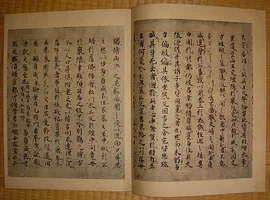
Shōmonki (将門記, The Chronicle of Masakado), the principal near-contemporary source for the Battle of Nomoto.
Origins of the Conflict
The immediate cause of the Battle of Nomoto remains uncertain. Although the Shōmonki (将門記) describes the fighting in considerable detail, its opening section has been lost, depriving historians of the contemporary account that originally explained how relations between Taira no Masakado and the family of Minamoto no Mamoru deteriorated into open warfare. Modern reconstructions therefore rely on the surviving text together with later historical compilations, genealogical records, and the broader political context of the eastern provinces.Most scholars agree that the conflict cannot be attributed to a single incident. Instead, it developed from a combination of inheritance disputes, competition over landed estates, marriage alliances, and rival claims to regional influence. By the mid-930s, these tensions had become so closely intertwined that separating one cause from another is no longer possible. Rather than competing explanations, these factors are now generally understood as interconnected elements of a single political crisis.
Inheritance and Land
The explanation most widely accepted by modern historians centres on disputes over the estates of Masakado's father, Taira no Yoshimasa (平良将). During the Heian period, landed property was commonly divided among several heirs rather than passing intact to a single successor. Such arrangements frequently produced competing claims, particularly where estate boundaries were poorly defined or customary rights outweighed formal documentation.Control of land meant far more than ownership alone. Productive estates generated agricultural wealth, but they also brought political influence, judicial authority, and the means to maintain armed followers. In the eastern provinces, where government oversight was comparatively weak, inheritance disputes quickly became contests for regional leadership.
The Shōmonki repeatedly portrays the later fighting as an extension of an existing quarrel within the Kanmu Taira. Although the missing opening prevents historians from reconstructing the dispute in detail, it strongly suggests that relations between Masakado and several of his paternal relatives had already broken down before the battle.
Marriage Alliances and Political Rivalries
Family politics further complicated the situation. Minamoto no Mamoru had strengthened his regional position by marrying several of his daughters into branches of the Kanmu Taira, creating alliances that linked the two lineages. Among those connected to Mamoru through marriage were Masakado's uncles, including Taira no Kunika and Taira no Yoshikane, whose interests increasingly diverged from those of their nephew.These relationships demonstrate why the conflict cannot be understood as an early stage of the later Taira–Minamoto rivalry. Clan identity remained secondary to immediate political interests. Members of the same lineage often opposed one another, while alliances between Taira and Minamoto families were entirely consistent with the political realities of the period.
Some historians have also drawn attention to Masakado's involvement in a dispute between the local magnate Taira no Maki (平真樹) and Minamoto no Mamoru. Although the surviving evidence is fragmentary, this episode suggests that disagreements within the Kanmu Taira had become entangled with a wider struggle for influence among the leading families of the region. Rather than a single feud, the conflict appears to have united several overlapping disputes into an increasingly unstable political situation.
The "Woman Dispute"
Later medieval chronicles offer a more dramatic explanation, claiming that the conflict began with a dispute over a woman connected to one of the families involved. The details vary considerably from one source to another, and none can be traced with confidence to the surviving Shōmonki. Most historians therefore regard these accounts as later literary embellishments rather than reliable evidence for the events of 935.While such a personal quarrel cannot be ruled out entirely, few scholars believe it could by itself have produced the prolonged conflict that followed. At most, it may have served as the immediate catalyst for tensions that had accumulated over many years.
An Escalating Crisis
Whatever the immediate trigger, the Battle of Nomoto was the culmination of a political crisis rather than the beginning of one. By the mid-930s, rival provincial families increasingly relied on military force to defend their interests as the authority of the imperial court weakened in the eastern provinces. Long-standing disputes over inheritance, land, marriage, and regional influence had become inseparable, making a peaceful settlement progressively less likely.When violence finally erupted at Nomoto, it reflected far more than a quarrel between neighbouring families. It exposed the growing inability of existing provincial institutions to contain conflicts among powerful local elites. Once blood had been shed, the dispute entered a cycle of retaliation that neither side proved able to control.
The Road to Nomoto
By the beginning of Jōhei 5 (承平5年, 935), relations between Taira no Masakado and the coalition surrounding Minamoto no Mamoru had deteriorated beyond the point of compromise. Years of disputes over inherited estates, political influence, and family alliances had created an increasingly volatile situation in which both sides appear to have regarded armed confrontation as inevitable.According to the Shōmonki, Masakado was travelling through the region when he learned that Minamoto no Tasuku had assembled an armed force. Whether Tasuku intended to block his movements, defend territory controlled by his allies, or eliminate a dangerous rival before his influence grew further cannot be determined. The surviving account nevertheless portrays Tasuku as taking the initiative, with Masakado responding rather than provoking the encounter. Since the Shōmonki was written to commemorate Masakado after his death, historians treat this portrayal with appropriate caution.
Tasuku was accompanied by his younger brothers, Minamoto no Takashi (源隆) and Minamoto no Shigeru (源繁), together with retainers drawn from the wider network of Mamoru's supporters. Their numbers are unknown, but the engagement was almost certainly fought by relatively small bands of mounted warriors and their attendants rather than by organised armies. Military strength in the early Heian period depended on household followings assembled by individual landholders, and even the most influential provincial families could mobilise only limited forces at short notice.
Masakado likewise travelled with a modest retinue. Significantly, the Shōmonki does not attempt to exaggerate the size of either force, a restraint that has generally enhanced historians' confidence in its account. The confrontation at Nomoto was a clash between rival provincial coalitions, not between state armies.
The opposing forces met near Nomoto (野本), a place in Makabe District (真壁郡) of Hitachi Province generally identified with the area around present-day Chikusei and Sakuragawa in Ibaraki Prefecture. Situated near the border of Hitachi and Shimōsa Provinces, the area occupied a strategic position where roads linking the eastern provinces crossed fertile agricultural land and river valleys.
Whether the meeting at Nomoto resulted from careful planning or from a chance encounter that quickly escalated remains uncertain. The Shōmonki suggests that Tasuku deliberately sought to intercept Masakado before he could attract further support among neighbouring landholders, but the surviving evidence does not permit a definitive conclusion. What is clear is that neither side withdrew. Once the two forces met, a battle that would shape the course of Masakado's career became unavoidable.
The Battle
The Battle of Nomoto was fought in the second month of Jōhei 5 (935). Although the Shōmonki provides only a concise account of the engagement, it remains one of the earliest surviving descriptions of combat involving provincial warriors in Japan. Its narrative is notably restrained, concentrating on the course and outcome of the fighting rather than on individual feats of heroism.According to the Shōmonki, Minamoto no Tasuku struck first. His force intercepted Masakado near Nomoto, apparently hoping to overwhelm him before he could consolidate his position or attract additional supporters. Whether the attack was carefully planned or taken in response to Masakado's movements is uncertain, but Tasuku clearly sought to seize the initiative.
The opening stages of the battle are described only briefly. Masakado's followers recovered quickly from the initial assault and mounted an effective counterattack, exchanging arrows with the opposing force before closing for hand-to-hand combat. Like most fighting during the early Heian period, the engagement was probably fluid rather than tightly organised, with small groups of mounted warriors manoeuvring under the leadership of individual household heads rather than advancing in formal battle lines.
One of the best-known episodes in the Shōmonki concerns a sudden change in the wind. During the fighting, the wind is said to have shifted in Masakado's favour, carrying his arrows towards the enemy while hindering those of Tasuku's warriors. Medieval readers would have understood this as a sign of divine favour. Modern historians are more cautious. Some regard the episode as a literary convention intended to demonstrate Heaven's support for Masakado, while others suggest it may preserve the memory of an actual change in battlefield conditions that later acquired symbolic significance. Neither interpretation can be verified.
Whether contemporaries regarded the event as miraculous cannot now be determined. Its inclusion nevertheless illustrates how military success was commonly interpreted through the language of divine favour in Heian-period historical writing.
As the fighting continued, Tasuku's position rapidly collapsed. He was killed together with his younger brothers, Takashi and Shigeru, depriving the coalition of its principal leaders. The Shōmonki offers no detailed description of their deaths, focusing instead on the decisive nature of Masakado's victory. Leaderless, the remaining members of Tasuku's force abandoned the field and dispersed.
The engagement itself was probably brief. Battles between provincial warrior bands rarely developed into prolonged engagements, and the cohesion of such forces depended heavily on the survival and authority of their commanders. Once Tasuku and his brothers had fallen, organised resistance became difficult to sustain.
Measured in military terms, the Battle of Nomoto was a relatively modest encounter. Yet its consequences were immediate. The deaths of Mamoru's heirs made reconciliation between the opposing factions increasingly unlikely, replacing a political dispute with a cycle of blood vengeance. What had begun as a local confrontation would soon draw in additional members of the Kanmu Taira and expand into a regional conflict that neither side could control.
Map of sites related to Taira no Masakado (based on a map by VR Ibaraki).
Aftermath and Escalation
Masakado's victory at Nomoto resolved nothing. Instead, it transformed a dispute among rival provincial families into a prolonged conflict that spread across much of eastern Japan. The deaths of Minamoto no Tasuku and his brothers removed any realistic prospect of reconciliation. For their relatives and allies, the battle demanded vengeance.Although the Shōmonki portrays Masakado as acting in self-defence, the political consequences were profound. Blood feuds among leading families rarely ended once close relatives had been killed. Honour, family prestige, and the obligation to avenge slain kin encouraged further retaliation, making compromise increasingly unlikely regardless of who had initiated the fighting.
In the months that followed, Minamoto no Mamoru himself faded from the surviving narrative, while leadership of the opposition passed increasingly to Masakado's paternal relatives within the Kanmu Taira. Chief among them were Taira no Kunika (平国香) and Taira no Yoshikane (平良兼), whose rivalry with Masakado predated the battle but now intensified. The conflict was no longer centred on the Minamoto family alone; it had become an internal struggle within the Kanmu Taira that drew in an expanding circle of allies and dependants.
The Shōmonki describes a succession of raids, retaliatory attacks, and armed confrontations as both sides sought to weaken their rivals while consolidating their own regional position. Estates were attacked, alliances shifted, and long-standing grievances resurfaced. Warfare in the eastern provinces remained highly personal, directed against rival households rather than abstract political institutions. Military success depended as much on attracting and retaining followers as on victory in battle.
Masakado emerged from Nomoto with greatly enhanced prestige. His victory demonstrated not only personal courage but also the ability to lead men successfully in combat, strengthening his standing among local landholders at a time when military capability had become an increasingly important measure of political authority. As his reputation grew, so too did the perception among his opponents that he represented a threat extending beyond the original dispute.
The imperial court in Heian-kyō appears to have paid little attention to these developments. To the court, the fighting probably appeared to be another local dispute among provincial magnates rather than the beginning of a wider political crisis. This limited response allowed the conflict to develop largely unchecked, giving both sides time to strengthen their alliances and prepare for further confrontation.
During the following years, the violence continued to escalate. In the months following the battle, Masakado retaliated against the estates of Tasuku's supporters. During one of these raids, his uncle Taira no Kunika was killed at his residence in Ishida. Kunika's death proved to be another turning point in the conflict, prompting his son, Taira no Sadamori (平貞盛), to assume leadership of his branch of the Kanmu Taira and join the coalition opposing Masakado. Together with Taira no Yoshikane, Sadamori became one of Masakado's principal adversaries, and both later played leading roles in the campaign that ended with Masakado's death in 940. As the struggle widened, it drew in additional warrior families whose loyalties shifted according to local interests and changing political circumstances.
By 939, the conflict had assumed an entirely different character. Masakado seized several provincial headquarters, defeated government forces, and proclaimed himself the "New Emperor" (新皇). Whether this represented a genuine attempt to establish an independent regime or a symbolic assertion of regional authority remains debated. What is beyond doubt is that the chain of events leading to this dramatic confrontation began with the relatively small engagement fought near Nomoto four years earlier.
In retrospect, the Battle of Nomoto marks the point at which a local dispute crossed the threshold into sustained regional warfare. None of those involved could have foreseen the outcome, but the patterns of retaliation, alliance-building, and military mobilisation established after the battle shaped every subsequent stage of Masakado's rebellion.
Military Analysis
The Battle of Nomoto provides a rare and valuable glimpse of provincial warfare in tenth-century Japan. Although the Shōmonki offers only a concise description of the fighting, it preserves valuable evidence for the organisation, tactics, and character of military conflict during the middle Heian period, before the emergence of the fully developed samurai culture of later centuries.Forces and Organisation
Neither the Shōmonki nor any contemporary source records the size of the opposing forces. Modern historians generally agree that both sides fielded relatively small contingents drawn from their own households, relatives, and dependent landholders rather than large standing armies. Military power in the tenth century rested on personal ties of loyalty and obligation, with influential provincial families assembling armed followers as circumstances required.Leadership was correspondingly decentralised. Individual warriors fought under the authority of household heads rather than within a formal chain of command, and success depended largely on the ability of local leaders to maintain the loyalty and cohesion of their followers. The battle therefore illustrates a style of warfare that was still rooted in aristocratic households rather than professional military institutions.
Although the exact battlefield cannot be reconstructed, the geography of the Sakuragawa basin suggests terrain well suited to the type of fighting described in the Shōmonki. Broad river terraces, cultivated fields, and low ridges would have favoured mobile engagements by mounted warriors while providing opportunities to control important routes across the Kantō Plain. While modern topography cannot be projected directly onto the landscape of the tenth century, it broadly accords with the surviving narrative.
Weapons and Tactics
The bow remained the principal weapon of mounted warriors during the Heian period, and the Shōmonki emphasises the exchange of arrows before close combat developed. Swords, spears, and other edged weapons were used once the distance between the opposing forces narrowed, although the source offers few tactical details.The engagement appears to have been highly mobile rather than fought in rigid formations. Provincial warfare at the time relied on the initiative of individual commanders and small groups of retainers, making battles comparatively fluid. Victory often depended less on destroying the opposing force than on breaking its cohesion by killing or dispersing its leaders.
The decisive deaths of Minamoto no Tasuku and his brothers illustrate this pattern. Once the coalition lost its principal commanders, organised resistance quickly collapsed, leaving the remaining warriors little reason to continue the fight.
The Wind Episode
One of the most frequently discussed passages in the Shōmonki describes the wind changing direction during the battle, carrying Masakado's arrows towards the enemy while impeding those of his opponents. Medieval audiences would have recognised this as a sign that Heaven favoured the victorious side, a familiar literary motif in East Asian historical writing.Whether the account preserves the memory of an actual change in weather or represents a symbolic embellishment cannot be determined. Most historians regard the episode primarily as a narrative device that reinforced Masakado's legitimacy without altering the broader reliability of the battle narrative.
Assessing the Battle
From a purely military perspective, the Battle of Nomoto was a relatively small engagement. It involved local warrior bands rather than state armies and was fought over regional rivalries rather than national political objectives. Its historical importance lies not in its scale but in its consequences.The battle also illustrates the transitional character of warfare in the tenth century. Provincial elites increasingly relied on private military forces to resolve disputes that local government could no longer contain, foreshadowing the emergence of the warrior class as Japan's dominant political and military elite. Although later samurai warfare would become far more sophisticated in organisation and scale, many of its defining features, including mounted combat, personal leadership, and the importance of household loyalty, were already visible at Nomoto.
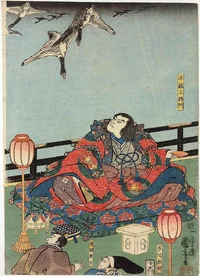
Taira no Masakado, woodblock print by Utagawa Kuniyoshi (歌川国芳, 1798–1861), c. 1843–1847. The print portrays Masakado reclining as a flock of wild geese passes overhead, alluding to legends surrounding the warrior's extraordinary abilities and his association with omens and the supernatural.
Historical Significance
Militarily, the Battle of Nomoto was a relatively small engagement. Its historical importance, however, far exceeded its scale. It marked the first recorded military success of Taira no Masakado and set in motion a chain of events that culminated in the Jōhei–Tengyō Rebellion (承平天慶の乱), one of the most serious challenges to imperial authority during the middle Heian period.The Emergence of Masakado
For Masakado personally, victory at Nomoto established his reputation as a capable military leader. Before 935, he appears in the historical record primarily as a member of a prominent provincial family engaged in local disputes. After the battle, he emerged as one of the most influential warrior leaders in the eastern provinces, attracting supporters while provoking increasing resistance from rival families.His success also demonstrated that political authority in the Kantō was becoming closely tied to military capability. The ability to protect estates, command followers, and prevail in armed conflict enhanced a leader's standing at least as much as formal rank or court appointment.
Provincial Power and the Heian State
The conflict revealed the growing limits of imperial administration in eastern Japan. Provincial governors continued to represent the authority of the court, but their ability to prevent or resolve disputes among powerful local families had steadily weakened. Landholders increasingly relied on their own armed followers rather than official institutions to defend property and assert their claims.The imperial government does not appear to have regarded the Battle of Nomoto as a matter requiring immediate intervention. Local conflicts of this kind were not unprecedented, and the court probably viewed them as provincial disturbances rather than threats to the political order. In retrospect, however, this limited response allowed the conflict to intensify over the following years until direct military intervention became unavoidable.
The court's restrained response also illustrates an important feature of middle Heian government. Provincial violence was generally tolerated as long as it remained a local matter. Only when Masakado seized provincial headquarters and proclaimed himself "New Emperor" did the conflict become a direct challenge to imperial authority requiring coordinated military intervention.
A Turning Point in Provincial Warfare
Nomoto illustrates a broader transformation taking place during the tenth century. Warfare was no longer conducted primarily by forces mobilised through the central government but by regional elites commanding private military followings based on kinship, landholding, and personal loyalty.This development did not yet represent the fully formed samurai society of the Kamakura period . Nevertheless, the battle demonstrates that many of the institutions and relationships associated with later warrior rule were already emerging. Provincial magnates increasingly exercised military authority independent of the court, while political disputes were settled by force with growing frequency.
Prelude to the Jōhei–Tengyō Rebellion
The Battle of Nomoto did not itself threaten the imperial government, nor was it intended as a rebellion against the throne. It began as a dispute among provincial families competing for land, influence, and prestige.Its long-term significance lies in the way it transformed those local rivalries into a much wider conflict. The cycle of retaliation that followed eventually brought Masakado into confrontation with both rival warrior families and the imperial state. By 939 he controlled several provincial headquarters and proclaimed himself the "New Emperor", forcing the court to organise a major military response.
Although four years separated Nomoto from Masakado's rebellion, the connection between the two events is unmistakable. Without the victory at Nomoto, and the prestige and momentum it gave him, Masakado's later challenge to the authority of the Heian court is difficult to imagine.
An Early Window into Samurai History
The Battle of Nomoto occupies a distinctive place in Japanese military history because it is one of the earliest engagements involving provincial warriors that can be reconstructed from a near-contemporary narrative source. While later conflicts such as the Genpei War are far better documented, the Shōmonki offers a rare glimpse of an earlier stage in the evolution of warrior society, when aristocratic landholders were beginning to rely on private military power as an essential instrument of political authority.For that reason, historians regard Nomoto not simply as the opening battle of Masakado's career but as an important milestone in the gradual emergence of the provincial warrior class that would dominate Japanese politics in the centuries to come.
Historiography and Sources
The Battle of Nomoto is documented primarily in the Shōmonki (将門記), an anonymous military chronicle written in the mid-tenth century, probably within a few decades of the events it describes. Although the identity of its author remains unknown, the work is generally regarded as the earliest surviving Japanese war tale (gunki monogatari) and the principal source for the career of Taira no Masakado. Unlike later medieval chronicles, it was composed close to the events themselves, making it an indispensable source for the history of the eastern provinces during the middle Heian period.The Shōmonki is not an official government record but a literary narrative that combines historical reporting with moral interpretation. It portrays Masakado as an exceptional warrior and capable leader while acknowledging the political consequences of his rebellion. The account is broadly sympathetic to its protagonist, yet it does not conceal his eventual defeat or avoid describing the complexity of the conflicts in which he became involved. Most historians therefore regard the work neither as impartial history nor as simple heroic fiction, but as a contemporary narrative whose perspective must be considered when interpreting its account. Consequently, historians compare its account with later chronicles, genealogies, and official records whenever possible.
One significant limitation is that the opening portion of the Shōmonki has been lost. As a result, the circumstances leading directly to the Battle of Nomoto are no longer preserved, leaving historians to reconstruct the origins of the conflict from later passages, genealogical records, official documents, and subsequent historical compilations. This gap explains why the precise causes of the dispute remain uncertain and why modern scholarship generally emphasises a combination of inheritance disputes, marriage alliances, and regional political rivalries rather than a single triggering event.
Modern historians generally accept the Shōmonki as reliable for the broad sequence of events while remaining cautious about individual details. Episodes such as the sudden change in the wind during the battle are often interpreted as literary devices reflecting divine favour rather than as verifiable descriptions of battlefield conditions. Likewise, the source provides no precise figures for troop numbers or casualties, and many tactical details cannot be reconstructed with confidence. Where the narrative is silent, historians avoid speculation and instead compare the text with archaeological evidence, place-name studies, and what is known about provincial society and warfare in the tenth century.
Other important sources include the Shoku Nihon Kōki (続日本後紀), the Nihon Kiryaku (日本紀略), the Azuma Kagami (吾妻鏡), and medieval genealogical collections. However, these were compiled later and often reflect different historical or literary traditions. They are valuable for corroborating names, relationships, and chronology but are generally less informative than the Shōmonki for the battle itself.
Despite its limitations, the Shōmonki remains one of the most important narrative sources for early samurai history. Read critically, and alongside later sources and modern scholarship, it provides an unusually detailed glimpse into the political rivalries, military practices, and social transformations that characterised eastern Japan in the middle Heian period. For that reason, the Battle of Nomoto continues to attract scholarly attention not only as the opening engagement of Masakado's career but also as one of the earliest documented examples of provincial warfare in Japanese history.
Although overshadowed by later conflicts such as the Genpei War, the Battle of Nomoto marks an important stage in the political transformation of tenth-century Japan. It reveals a society in which provincial elites increasingly relied on private military power as the authority of the Heian state weakened. Thanks largely to the survival of the Shōmonki, the battle can be reconstructed in greater detail than most local conflicts of the period. Its significance therefore lies not in its scale but in the rare insight it offers into the emergence of the warrior class that would come to dominate Japanese politics for centuries.
Kanda Myōjin in Tōkyō venerates Taira no Masakado, whose memory evolved from rebel to local protector.
References:
Primary Sources
- Shōmonki (将門記).
- Shoku Nihon Kōki (続日本後紀).
- Nihon Kiryaku (日本紀略).
- Azuma Kagami (吾妻鏡).
Secondary Sources
- Friday, Karl F., Hired Swords: The Rise of Private Warrior Power in Early Japan, Stanford University Press, 1992.
- Friday, Karl F., Samurai, Warfare and the State in Early Medieval Japan, Routledge, 2004.
- Hall, John Whitney (ed.), The Cambridge History of Japan, Vol. 2: Heian Japan, Cambridge University Press, 1999.
- Kokushi Daijiten Henshū Iinkai (ed.), Kokushi Daijiten (国史大辞典), Yoshikawa Kōbunkan.
- Nihon Rekishi Chimei Taikei (日本歴史地名大系), Heibonsha.
- Sansom, George, A History of Japan to 1334, Stanford University Press, 1958.
- Souyri, Pierre François, The World Turned Upside Down: Medieval Japanese Society, Columbia University Press, 2001.

