

Ashikaga Fujiuji (足利藤氏) was a military commander (武将 bushō) of the Sengoku period (戦国時代) and a member of the Ashikaga clan (足利氏). He was the son of Ashikaga Haruuji (足利晴氏, 1513-1557), the fourth Koga kubō (古河公方, 1533-1546), and for a brief period, he himself was set up as kubō in Koga between 1561 and 1562. His position was even formally acknowledged by Konoe Sakihisa (近衛前久, 1536-1612), who held the office of kampaku (関白), yet in later historiography, Fujiuji is not officially counted among the successive holders of the Koga kubō title.
Fujiuji was born as the eldest son of Haruuji. His mother was a daughter of Yanada Takasuke (簗田高助), a retainer of the Ashikaga. In his boyhood, he received a name-character (偏諱 henki) from the thirteenth shōgun of the Ashikaga shogunate in Kyōto , Ashikaga Yoshifuji (義藤, later Ashikaga Yoshiteru 義輝, 1536-1565), a sign that the Muromachi bakufu had at one point recognised him as the designated heir of the Koga kubō line. In March 1549, during the eighteenth year of the Tenbun era, Fujiuji underwent his coming-of-age ceremony (genpuku). This event firmly marked him as Haruuji's successor.
Yet the succession was not straightforward. According to some historians, the Koga kubō did not traditionally take formal wives, but treated all women of their households as concubines (妾 shō). Fujiuji, as the eldest among Haruuji's children by such unions, was chosen as heir on the grounds of primogeniture. Other scholars have argued that Haruuji originally promised to make the son of Hōjō Ujitsuna 's (北条氏綱, 1487-1541) daughter, Hōshun'in (芳春院), his heir once that marriage alliance produced a boy. When Haruuji's relations with the Hōjō later soured, particularly with Ujitsuna's successor Hōjō Ujiyasu (北条氏康, 1515-1571), the promise was rescinded.
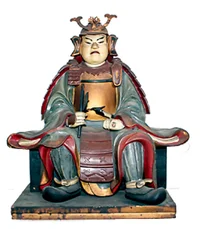
Statue of Uesugi Norimasa, ally of Fujiuji's father, Haruuji.
According to Asakura's interpretation, the political straits of Haruuji's later years forced him, upon making peace with Ujiyasu in December 1551, to treat Hōshun'in as his principal wife, which meant that her son Yoshiuji—born of a "lawful wife"—displaced Fujiuji, who was merely the child of a concubine. The Koga headquarters was moved to Kasai Castle. At the same time, Fujiuji remained behind in Koga, a circumstance that made him a latent threat to the Hōjō. It is also said that when Yoshiuji underwent his genpuku, he received the prestigious character "義" (Yoshi) from Shōgun Yoshiteru, rather than the lesser "輝" (Teru), an intentional denial of Fujiuji's legitimacy.
Fujiuji, denied the path to the Koga kubō, rose in rebellion. In 1557, the third year of Kōji, he attempted to reclaim the Koga palace by force but failed. His father, Haruuji, was confined in Kurihashi Castle (栗橋城, in modern-day Ibaraki ), and Fujiuji himself was driven into exile. He found refuge with Satomi Yoshitaka (里見義堯, 1507-1574) in Awa Province and continued to plot a return. His allies, including Yanada Harusuke (簗田晴助), appealed for help to the exiled Uesugi Norimasa and his protector, the young warlord Nagao Kagetora (長尾景虎, 1530-1578), later famed as Uesugi Kenshin (上杉謙信).
In 1561, during the fourth year of Eiroku, Kagetora launched a great expedition into the Kantō. Though officially under the pretext of restoring Fujiuji, the campaign was legitimised by the presence of Uesugi Norimasa, the authority of the kampaku Konoe Sakihisa, and the backing of numerous Kantō magnates. The host swelled to over 100,000 men. Though unable to take Odawara Castle, the main Hōjō stronghold, Kagetora succeeded in installing Fujiuji in Koga, temporarily expelling Yoshiuji. This campaign is remembered as the Siege of Odawara (小田原城の戦い).
After the campaign, Norimasa formally transferred to Kagetora the headship of the Uesugi and the title of Kantō kanrei. In consultation with Norimasa and Sakihisa, Kenshin formally rejected Yoshiuji's claim and, in the name of the kampaku and the Kantō kanrei, declared Fujiuji the legitimate successor of his father Haruuji as the new Koga kubō. This recognition was accepted by anti-Hōjō lords such as the Satomi and the Satake. For several years, Fujiuji held the title of the rightful kubō.
Yet the tide soon turned. When Kenshin withdrew to Echigo, the Hōjō struck back. In October of 1561, they attacked Koga, forcing Fujiuji to flee to Ikewada Castle in Kazusa, held by Taga Nobuie, a Satomi retainer. Thereafter, Koga became the focus of repeated struggles between the Uesugi and the Hōjō, with Fujiuji alternating between brief restorations and forced flights. In 1562, the fifth year of Eiroku, the Hōjō captured the Koga palace; Fujiuji was taken prisoner and sent to Odawara.
After his capture, Fujiuji's movements remain uncertain. He was reportedly transferred from one Hōjō stronghold to another in Sagami and Izu, but by 1566, the ninth year of Eiroku, he vanishes from the record. Some accounts claim he was assassinated on the orders of Ujiyasu.
Fujiuji's loss was a grave setback for Kenshin's ambitions in the Kantō. Deprived of a puppet kubō, he was eventually compelled, when seeking peace with the Hōjō, to recognise Yoshiuji formally as Koga kubō. Some of Fujiuji's younger brothers—Fujimasa, Teruuji, and Iekuni—appear in later records making attempts to revive their brother's claim, but these efforts left little mark, and by the Tenshō era (1573-1592) such activities had ceased altogether. Kuroda Motoki has even suggested, based on the lateness of specific references, that one of them, Fujimasa, might not have been Haruuji's son at all, but rather Fujiuji's own.
Link:
- 藤姓足利氏 (in Japanese)
References:
- Ashikaga Fujiuji (足利藤氏). From Japanese Wikipedia.
- Hall, John Whitney, Toyoda Takeshi. Japan in the Muromachi Age. Cornell East Asia Series 2001.
- Mason Richard H.P., Caiger John Godwin, A History of Japan, Revised Edition, Tuttle Publishing, 1997
- Nussbaum, Louis-Frédéric. Japan Encyclopedia. Harvard University Press, 2005.
- Papinot, Edmonde; Historical and Geographical Dictionary of Japan, Tuttle, 1972
- Sansom, George. A History of Japan 1334-1615. Stanford University Press, 1961.
- Totman, Conrad; A History of Japan, Wiley-Blackwell; second edition 2005.
- Turnbull, Stephen, Samurai Sourcebook, London 1998
- Turnbull, Stephen, War in Japan: 1467-1615, Oxford 2002

