News NYT: Why Japan became a safe haven for Russian spies

thomas

Unswerving cyclist
Admin
Joined
14 Mar 2002
Messages
21,135
Reaction score
19,073
After a Russian Kh-101 cruise missile struck a residential tower block in Kyiv in May, killing at least 24 people, investigators searched the wreckage. A Ukrainian assessment found that the missile had been guided by Japanese-made components, despite broad export bans on such technology being in place.

Using confidential government documents, company records, and interviews with dozens of intelligence and government officials across three continents, The New York Times traced the operations of Russia's 20th Directorate and the important role its Tokyo station played in supporting President Vladimir Putin's war against Ukraine. Most of those interviewed spoke anonymously because they were not authorised to discuss intelligence matters publicly.

Ukrainian officials have provided Japan with evidence that Japanese technology is being used in Russian attacks, according to documents and interviews. Yet despite Tokyo's outspoken support for Ukraine, the Japanese government has been slow to respond.

Japan has long been known as a spy paradise, in part because of post-World War II constraints imposed by the victors that have kept the country's intelligence services weak. Japan does not even have a foreign intelligence agency. Officials say that they recognise the espionage threat and are working to remove decades-old restrictions on intelligence gathering. [...] The Japanese Ministry of Foreign Affairs did not respond to detailed questions about espionage but said that the government had worked with Western allies to ban the export of military-related items to Russia. [...] Nevertheless, Russian spies appear to be operating right under the noses of the Japanese authorities. Aeroflot's office in Tokyo is a 10-minute walk from the headquarters of the National Police Agency, which investigates espionage. Western intelligence officials say that it is there, in the airline office, on the 22nd floor, that the 20th Directorate's man in Tokyo runs his deadly operation.

Article gifted by JREF:

Read more:
 
Japanese media start picking up the NYT investigation:


Asked about the U.S. media report that Japan has become a base for Russian intelligence activity, Chief Cabinet Secretary Kihara declined to comment on the specifics. "We are aware of the report you mentioned, but as this concerns an individual matter, I would like to refrain from answering," Kihara said. Kihara added that the need to respond to foreign intelligence activities, including the theft of important information, is growing. He said Japan is taking action under existing laws, including the Act on the Protection of Specially Designated Secrets, and must respond even more strictly.


Currently, Japan is planning a centralised intelligence agency, and officials have quietly sought advice from the United States, Australia and Germany on everything from technology and staffing to organisational priorities. Japan's intelligence system has long been fragmented, with the police, the defence ministry, diplomats and other agencies collecting and analysing information largely in isolation. Critics say that it has left the country more exposed to espionage and foreign influence operations. The move is said to be a key part of Prime Minister Sanae Takaichi's broader security agenda.

After lifting restrictions on arms exports and pushing through Japan's largest post-war military build-up, its government now wants stronger protection for state secrets and sensitive technologies, while stepping up efforts to counter foreign influence campaigns, particularly those linked to China. One example cited by researchers at the Citizen Lab is a network of websites posing as Japanese-language news outlets that allegedly spread pro-Beijing disinformation.


Gift article by JREF:
 
A Russian man identified by The New York Times as an officer with Russia's GRU military intelligence agency left Japan immediately after the newspaper published its report earlier this month.

According to Japanese intelligence sources, the man is believed to have arrived in Japan around February 2024, when he took up his post as the head of the airline's Tokyo office. It has been confirmed that he left Japan soon after the New York Times report, the sources said.

 
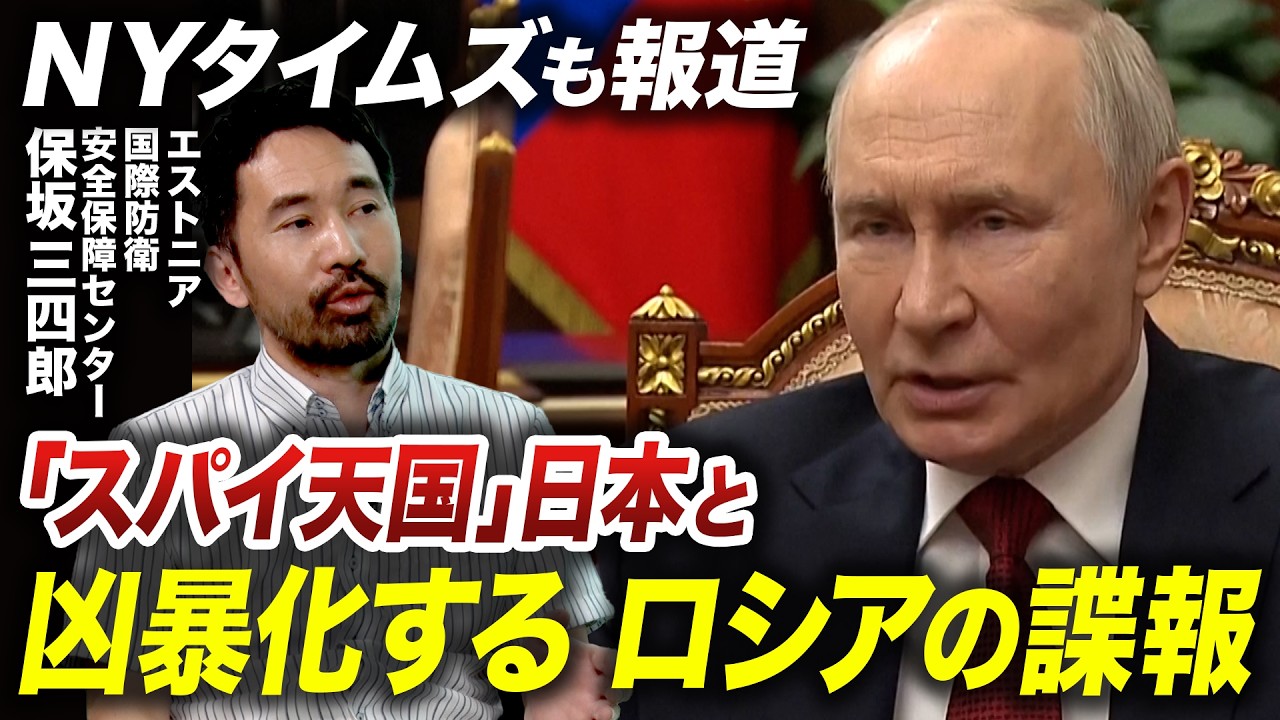
Hosaka Sanshiro, a researcher at the International Centre for Defence and Security in Estonia and a specialist in Russian intelligence agencies, on Russia's spy network in Japan:

Reports that a man posing as an employee of Russian airline Aeroflot carried out intelligence operations in Tokyo have renewed attention to Russian espionage in Japan. Former Soviet intelligence officers have described the country as a "spy paradise", arguing that weaknesses in its laws and counterintelligence system make it relatively easy for foreign agents to operate.


Hosaka said Japanese general-purpose products had already reached Russia through third countries and were being used in connection with the war, making tighter controls an important issue for Japan. Japan's reputation as an easy environment for espionage partly reflects the way its security institutions developed after the Second World War, Hosaka said. While the country maintained its pacifist orientation and eventually established the Self-Defense Forces (自衛隊), its intelligence and counterintelligence capabilities developed more slowly.

A longstanding problem has been the lack of a comprehensive legal framework specifically aimed at espionage. Former Soviet intelligence officers have said there are few countries where intelligence personnel can operate as easily as in Japan. According to Hosaka, Russian intelligence officers assigned to Japan are briefed before arriving on Japanese laws and the country's enforcement environment. Foreign intelligence services therefore have a detailed understanding of what they can do in Japan, and where the limits of the authorities lie.

 
A Japanese electronic components maker has been bribed by a Russian national to supply electronic components to Russia despite the sanctions. Sounds like a corruption scandal more than a spy scandal to me. Sadly Japanese independent journalism is non-existent nowadays, so the mass media simply follows the foreign agenda without analyzing or even fact-checking it first. The result is a biased perspective on many sensitive topics such as the Gaza conflict and war in Ukraine.
 
I asked ChatGPT about it.

Products/components have been found in Russian weapons used against Ukraine, the picture is clearer when we look at Ukraine's current database.
Ukraine's Foreign Components in Weapons database currently lists 5,816 foreign components across 202 weapon systems, updated May 25, 2026.
What Japanese products are being found?
The important point is that these are generally commercial electronic components, not Japanese weapons.
Japanese manufacturer Examples found Russian weapon/system
Murata Batteries, filters, amplifiers, IMUs Shahed/Geran UAVs, Kinzhal, other systems
Toshiba Optocouplers, voltage regulators, integrated circuits Shahed/Geran-2, Iskander-K, KN-23/24
Renesas Microcontrollers, processors, flash memory, PWM controllers Shahed/Geran-2, Kh-101, Eleron UAV
Rubycon Electrolytic capacitors Shahed/Geran-2, FPV drones
Nichicon Electrolytic capacitors Shahed/Geran-2
TDK Motion sensors / IMUs Mugin-5 Pro UAV
Panasonic Relays, SD-card readers and other electronic components Shahed/Geran-2, Kinzhal
Sumida Inductors/coils Kinzhal, Kh-101
Nippon Chemi-Con / related Japanese suppliers Capacitors and electronic components Missiles and UAVs

These aren't hypothetical examples. Ukraine's database identifies, for example, Murata battery packs in the Russian S8000 Banderol cruise missile.
It also identifies Japanese components in Shahed/Geran-2 UAVs, including:

Toshiba 78M05S voltage regulator
Toshiba TLP2361 high-speed optocoupler
Rubycon electrolytic capacitors
Renesas PWM controller

Missiles are also involved
This is perhaps more significant than the drone examples.
Ukraine's database lists Japanese components in the Kh-47M2 Kinzhal and Kh-101 missiles.
For example, components attributed to Japanese manufacturers include:
Murata electromagnetic interference filters/amplifiers
Panasonic electromagnetic relays
Sumida inductors
Renesas processor circuitry
Toshiba components

Japanese components have also been identified in the 9M727 Iskander-K missile, including Toshiba optocouplers and capacitors from Japanese manufacturers.

There is an especially interesting example: North Korean missiles

Ukraine's database also identifies Japanese Toshiba components in the KN-23/KN-24 ballistic missile, which is a North Korean weapon supplied to Russia.

Examples include:

Toshiba TLP281-4 optocoupler
Toshiba ULN2803APG Darlington driver

So Japanese technology can appear even in weapons that aren't Russian-designed, because modern weapons are assembled from international commercial components.

Why are ordinary Japanese electronic parts in weapons?

This is the key issue.

A component such as a capacitor, relay, voltage regulator, processor, sensor or filter isn't necessarily a military product.

For example:

Japanese electronic component

Consumer electronics / industrial equipment / automotive equipment

International distribution network

Third-country distributor

Russia

Russian weapons manufacturer

This is why the issue is primarily one of sanctions evasion and supply-chain diversion, rather than Japan directly supplying weapons to Russia.
Japan's Ministry of Economy, Trade and Industry (METI) explicitly says that Japan and other major countries have investigated components found in Russian weapons recovered in Ukraine and have compiled them into the Common High Priority Items list.
Japan also uses catch-all export controls, meaning that even goods not individually listed as controlled items can require an export license when the exporter knows they may be used for military purposes.

The most important categories
If we simplify everything, the Japanese products found in Russian weapons are mainly:
1. Semiconductors and ICs
→ processors, controllers, memory, interface chips
2. Passive electronic components
→ capacitors, inductors, filters
3. Power-management components
→ voltage regulators, power transistors, relays
4. Sensors
→ gyroscopes, accelerometers, IMUs
5. Batteries
→ lithium-ion battery cells/packs
6. Electronic/optical components
→ optocouplers and related circuitry

In other words, Japan's most important contribution is not complete weapons—it is the high-quality electronic "building blocks" that make modern weapons function.

And the scale is not unique to Japan. Ukraine's database shows that Russian weapons contain components originating from many countries, including the United States, Taiwan, Switzerland, Germany, South Korea and others.
 
A Japanese electronic components maker has been bribed by a Russian national to supply electronic components to Russia despite the sanctions. Sounds like a corruption scandal more than a spy scandal to me. Sadly Japanese independent journalism is non-existent nowadays, so the mass media simply follows the foreign agenda without analyzing or even fact-checking it first. The result is a biased perspective on many sensitive topics such as the Gaza conflict and war in Ukraine.

Honestly, the Japanese mainstream media were quite factual, even critical, regarding the conflict in Gaza. Considering all the circumstances, especially Japan's territorial dispute with Russia over the Southern Kurils, there is no reason for Japan, or any other civilised country, not to oppose Russia's heinous attack on Ukrainian territory. However, I agree with you that the Japanese media often lack the necessary critical scrutiny of domestic politics.
 
Back
Top Bottom