

Navigation
Install the app
How to install the app on iOS
Follow along with the video below to see how to install our site as a web app on your home screen.
Note: This feature may not be available in some browsers.
More options
Style variation
System
Light
Dark

You are using an out of date browser. It may not display this or other websites correctly.
You should upgrade or use an alternative browser.
You should upgrade or use an alternative browser.

- 27 Dec 2003
- 2,854
- 2,103
- Thread starter
- #27
Pronunciation of ず (zu) in the Z column
I want to include a couple of examples of the 'zu' pronunciation because it may be tricky for some people.
いたずら (itazura) = mischief
いたずらこ (itazurako) = mischievous child
The rare pronunciation of ず as 'dzu'
The Japanese word ずるい (cunning; cheating) is pronounced dzurui not zurui. This is a rare pronunciation of ず, it is usually pronounced 'zu' as in いたずらこ (itazurako) (mischievous child), the Japanese family name すずき (Suzuki), すずらん (suzuran) (Lily of the valley), etc.
I want to include a couple of examples of the 'zu' pronunciation because it may be tricky for some people.
いたずら (itazura) = mischief
いたずらこ (itazurako) = mischievous child
The rare pronunciation of ず as 'dzu'
The Japanese word ずるい (cunning; cheating) is pronounced dzurui not zurui. This is a rare pronunciation of ず, it is usually pronounced 'zu' as in いたずらこ (itazurako) (mischievous child), the Japanese family name すずき (Suzuki), すずらん (suzuran) (Lily of the valley), etc.
- 27 Dec 2003
- 2,854
- 2,103
- Thread starter
- #29
The character ぢ (ji) in the D column
The ぢ character can be confusing because there is another hiragana character, じ, which is also pronounced 'ji'.
Another thing about the character ぢ is that it is rarely used and the character じ is almost always used when writing the sound 'ji' into a Japanese word. As a matter of fact, I know of only three words that contains ぢ
はなぢ (hanaji) = nosebleed
ちぢむ (chijimu) = to shrink
ちぢれる (chijireru) = frizzy; wavy (hair)
Note the doubling of ち in ちぢむ and ちぢれる.
All the other Japanese words I know which contain the 'ji' sound are written with じ. Just remember; you will only come across a few Japanese words which contain ぢ, so when in doubt, write じ.
The confusing need to type 'di' to get ぢ
Typing romaji into a Japanese-language word processing program to get ぢ can be tricky. In my software, I cannot type 'ji' to get ぢ or type 'chijireru' to get ちぢれる. The only way I can get ぢ to appear on my screen is by typing chidimu (which gives me ちぢむ) and chidireru (which gives me ちぢれる). Typing hanadi gives me the kanji for はなぢ but will not give me the hiragana for はなぢ. (My Japanese-language word processing program allows me to type 'ji' to get both じ and the katakana version of じ.)
By the way, I did a search on Google Translate for 'chidireru' and it came back with 縮れる in kanji and 'chidjireru' in romaji!
The ぢ character can be confusing because there is another hiragana character, じ, which is also pronounced 'ji'.
Another thing about the character ぢ is that it is rarely used and the character じ is almost always used when writing the sound 'ji' into a Japanese word. As a matter of fact, I know of only three words that contains ぢ
はなぢ (hanaji) = nosebleed
ちぢむ (chijimu) = to shrink
ちぢれる (chijireru) = frizzy; wavy (hair)
Note the doubling of ち in ちぢむ and ちぢれる.
All the other Japanese words I know which contain the 'ji' sound are written with じ. Just remember; you will only come across a few Japanese words which contain ぢ, so when in doubt, write じ.
The confusing need to type 'di' to get ぢ
Typing romaji into a Japanese-language word processing program to get ぢ can be tricky. In my software, I cannot type 'ji' to get ぢ or type 'chijireru' to get ちぢれる. The only way I can get ぢ to appear on my screen is by typing chidimu (which gives me ちぢむ) and chidireru (which gives me ちぢれる). Typing hanadi gives me the kanji for はなぢ but will not give me the hiragana for はなぢ. (My Japanese-language word processing program allows me to type 'ji' to get both じ and the katakana version of じ.)
By the way, I did a search on Google Translate for 'chidireru' and it came back with 縮れる in kanji and 'chidjireru' in romaji!
- 27 Dec 2003
- 2,854
- 2,103
- Thread starter
- #30
The character づ (zu) in the D column
づ is confusing because it can be pronounced two different ways, 'zu' and 'dzu'.
The 'zu' pronunciation
つづく (tsuzuku) (no 'd' sound) = to continue.
つづける (tsuzukeru) (no 'd' sound) = able to continue.
Note the doubling of つ in つづく.
The 'dzu' pronunciation
…づらい (…dzurai) is a word suffix meaning "difficult to do something". Here are some examples.
かきづらい (kakidzurai) = difficult to write
つかいづらい (tsukaidzurai) = difficult to use
いいづらい (iidzurai) = difficult to say
Are ず and づ pronounced the same or differently?
We get different answers from different Japanese speakers. CyberBunny says no, but Moon-chan says yes. (Yes, they are pronounced the same.)
The confusing need to type 'du' to get づ
Type kakidurai to get かきづらい
Type tsukaidurai to get つかいづらい.
Type iidurai to get いいづらい.
'zu' and 'dzu' in Japanese dialects
It is said there are further differences between 'zu' and 'dzu' in some dialects in Japanese (which does not concern beginning students of standard Japanese)
The history of 'zu' and 'ji' (the 1946 changes, and earlier changes)
The use of づ and ぢ has changed over the centuries. Information on this is available at

 japanese.stackexchange.com
づ is confusing because it can be pronounced two different ways, 'zu' and 'dzu'.
The 'zu' pronunciation
つづく (tsuzuku) (no 'd' sound) = to continue.
つづける (tsuzukeru) (no 'd' sound) = able to continue.
Note the doubling of つ in つづく.
The 'dzu' pronunciation
…づらい (…dzurai) is a word suffix meaning "difficult to do something". Here are some examples.
かきづらい (kakidzurai) = difficult to write
つかいづらい (tsukaidzurai) = difficult to use
いいづらい (iidzurai) = difficult to say
Are ず and づ pronounced the same or differently?
We get different answers from different Japanese speakers. CyberBunny says no, but Moon-chan says yes. (Yes, they are pronounced the same.)
The confusing need to type 'du' to get づ
Type kakidurai to get かきづらい
Type tsukaidurai to get つかいづらい.
Type iidurai to get いいづらい.
'zu' and 'dzu' in Japanese dialects
It is said there are further differences between 'zu' and 'dzu' in some dialects in Japanese (which does not concern beginning students of standard Japanese)
The history of 'zu' and 'ji' (the 1946 changes, and earlier changes)
The use of づ and ぢ has changed over the centuries. Information on this is available at
What are the differences between じ and ぢ, and ず and づ?
The Japanese hiragana and katakana syllabaries can mostly be described as phonetic. But there are two exceptions, the two pairs of syllables modified to be voiced with the dakuten diacritic which t...
- 27 Dec 2003
- 2,854
- 2,103
- Thread starter
- #33
Japanese words have "short vowels" and "long vowels" (syllables with double vowels) called ちょうおん. Perhaps the best-known examples are おばさん (aunt) and おばあさん (grandmother), as well as おじさん (uncle) and おじいさん (grandfather).
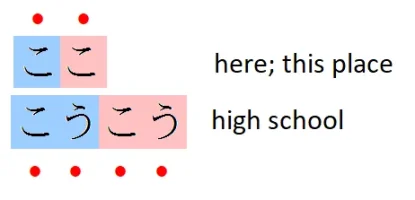
In the first image below we see the word ここ, which means "here" or "this place". It consist of two hiragana characters, each character being one syllable and lasting for one count (shown with red dots). We also see the word こうこう, which means "high school". This word also has two syllables but each syllable lasts for two counts, with the entire word lasting for four counts.
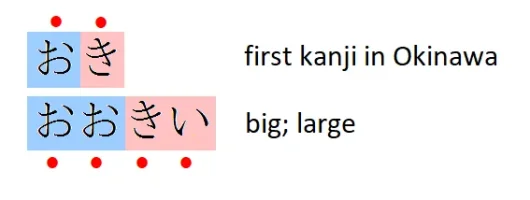
In the second image below we see おき, which is the first kanji in the place name Okinawa (a prefecture in Southwest Japan). Each of the two syllables in おき last for one count. The second word, おおきい (meaning "big" or "large") has two syllables, each syllable lasting for two counts, with the entire word lasting for four counts.
Here is a video with more examples of long vowels. Watch from 1:45 as the lady explains long vowels.
In the first image below we see the word ここ, which means "here" or "this place". It consist of two hiragana characters, each character being one syllable and lasting for one count (shown with red dots). We also see the word こうこう, which means "high school". This word also has two syllables but each syllable lasts for two counts, with the entire word lasting for four counts.
In the second image below we see おき, which is the first kanji in the place name Okinawa (a prefecture in Southwest Japan). Each of the two syllables in おき last for one count. The second word, おおきい (meaning "big" or "large") has two syllables, each syllable lasting for two counts, with the entire word lasting for four counts.
Here is a video with more examples of long vowels. Watch from 1:45 as the lady explains long vowels.
Attachments
Last edited:
- 27 Dec 2003
- 2,854
- 2,103
- Thread starter
- #34
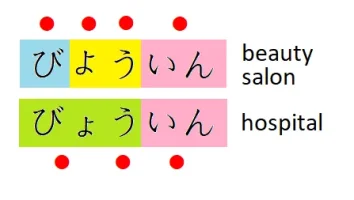
A contracted syllable (also called a ようおん syllable) is a syllable composed of (1) a regular hiragana character and (2) a small や, small ゆ, or small よ, which are combined ("contracted") into a single syllable. Take a look at the two words in the image below.
びよういん = beauty salon
びょういん = hospital
In the image below, the character よ in the first word びよういん (beauty salon) is regular size and takes up one of the four beats in the word. (The four beats are marked with four red dots.) The word consists of three syllables, colored in blue, yellow, and pink. (The long vowel form of よ is よう.) Notice how the pink syllable, いん, only takes up one beat.
The character ょ in the second word びょういん (hospital) is small size and is combined with び to make びょ and takes up one beat. This word has only three beats (marked with three red dots.) The word consists of two syllables, colored in green and pink. (The long vowel form of びょ is びょう.)
It is easy to get mixed up as to how many hiragana characters, how many beats, and how many syllables a word has. The word ぴょんぴょん (hop; hopping) has six hiragana characters, does not have long vowels, and has only two beats and two syllables.
This video introduces the three ようおん syllables kya, kyu, kyo; きゃ, きゅ, きょ. Watch from 2:58 to 3:53 as Mei Sensei gives us real words with these ようおん syllables.
びよういん = beauty salon
びょういん = hospital
In the image below, the character よ in the first word びよういん (beauty salon) is regular size and takes up one of the four beats in the word. (The four beats are marked with four red dots.) The word consists of three syllables, colored in blue, yellow, and pink. (The long vowel form of よ is よう.) Notice how the pink syllable, いん, only takes up one beat.
The character ょ in the second word びょういん (hospital) is small size and is combined with び to make びょ and takes up one beat. This word has only three beats (marked with three red dots.) The word consists of two syllables, colored in green and pink. (The long vowel form of びょ is びょう.)
It is easy to get mixed up as to how many hiragana characters, how many beats, and how many syllables a word has. The word ぴょんぴょん (hop; hopping) has six hiragana characters, does not have long vowels, and has only two beats and two syllables.
This video introduces the three ようおん syllables kya, kyu, kyo; きゃ, きゅ, きょ. Watch from 2:58 to 3:53 as Mei Sensei gives us real words with these ようおん syllables.
Attachments
Last edited:
- 27 Dec 2003
- 2,854
- 2,103
- Thread starter
- #35
Watch from 3:05 to 3:27 as Mei Sensei pronounces words with these three ようおん syllables. The first time you watch the video, look at the words and pronounce them along with Mei Sensei. The second time you watch the video, look at each word, pause the video, write the word down, then go on to the next word. (If you need extra practice, write each word ten times.) The third time you watch the video, do not look at the screen and write the words as you hear them.
- 27 Dec 2003
- 2,854
- 2,103
- Thread starter
- #36
The ようおん (contracted ) syllables cha chu cho: ちゃ, ちゅ, ちょ
Watch from 2:46 as Mei Sensei pronounces three words containing ちゃ, ちゅ, ちょ.
WARNING. The word for tea is technically ちゃ not おちゃ. お means honorable so おちゃ means honorable tea. Mei Sensei uses the word おちゃ because that is what we usually say in Japanese.
Watch from 2:46 as Mei Sensei pronounces three words containing ちゃ, ちゅ, ちょ.
WARNING. The word for tea is technically ちゃ not おちゃ. お means honorable so おちゃ means honorable tea. Mei Sensei uses the word おちゃ because that is what we usually say in Japanese.
- 27 Dec 2003
- 2,854
- 2,103
- Thread starter
- #38
The ようおん (contracted) syllables hya hyu hyo: ひゃ, ひゅ, ひょ
Watch as Mei Sensei pronounces three words from 2:33 to 2:58. Also, please pay special attention from 3:07 to 3:34 as he pronounces similar words that do and do not contain ようおん syllables
WARNING. Mei Sensei tends to pronounce some of these words with an 'sh' sound rather than an 'h' sound. This is common in Tokyo dialect. (Yes, Tokyo dialect is slightly different than standard Japanese.) There are two train stains in Tokyo, Shibuya Station and Hibiya Station. I have heard of cases of people mixing up the two stations because the say 'Shibiya' instead of 'Hibiya' or 'Shibuya'.
Watch as Mei Sensei pronounces three words from 2:33 to 2:58. Also, please pay special attention from 3:07 to 3:34 as he pronounces similar words that do and do not contain ようおん syllables
WARNING. Mei Sensei tends to pronounce some of these words with an 'sh' sound rather than an 'h' sound. This is common in Tokyo dialect. (Yes, Tokyo dialect is slightly different than standard Japanese.) There are two train stains in Tokyo, Shibuya Station and Hibiya Station. I have heard of cases of people mixing up the two stations because the say 'Shibiya' instead of 'Hibiya' or 'Shibuya'.
- 27 Dec 2003
- 2,854
- 2,103
- Thread starter
- #40
The ようおん (contracted) syllables rya ryu ryo: りゃ, りゅ, りょ
Watch from 2:40 as Mei Sensei pronounces three words containing りゃ, りゅ, りょ. Also, please pay special attention from 3:12 to 3:38 as he pronounces similar words that do and do not contain りゃ, りゅ, りょ.
Watch from 2:40 as Mei Sensei pronounces three words containing りゃ, りゅ, りょ. Also, please pay special attention from 3:12 to 3:38 as he pronounces similar words that do and do not contain りゃ, りゅ, りょ.

JayJJ
後輩
- 24 Jun 2022
- 20
- 40
There are many people who would like to learn Japanese but don't know where to begin. I know they would like to start by learning simple phrases such as "Hello," "How are you?", "It's a nice day, isn't it?", "What is your name", etc., but I want everyone to put aside the learning of such phrases for now, and instead begin by learning the basic Japanese writing system.
Here is a YouTube video which gives a general overview of the Japanese language. Please watch this video, then feel free to post any observations and questions you have in a post below.
I spend a lot of time studying foreign languages, this is my main specialty. And in order to succeed in this, with the help of the https://studydriver.com/capital-punishment website, I close some of the homework that I don't want to waste time on. For example, the topic of the death penalty is not interesting to me at all, and I do not want to waste my energy on such work. It's good that the guys from that site helped me.
I'm new to learning Japanese and I'm surprised that I learned so much more about the Japanese language from this 24 minute video compared to the 8 hour long online course.
I'll watch the rest of the videos too, thank you for your efforts!
- 27 Dec 2003
- 2,854
- 2,103
- Thread starter
- #45
I forgot to mention that, at 0:43 in the じゃ, じゅ, じょ video, Mei Sensei gives us two words from the ぢゃ, ぢゅ, ぢょ group. The words are めおとぢゃわん (a pair of matching teacups) and いっぽんぢょうし (monotonous).
The word めおとぢゃわん is formed by combining two words, めおと and ちゃわん.
The word いっぽんぢょうし is formed by combining two words, いっぽん and ちょうし.
In both words, the ち makes a euphonic change to ぢ because it is combined as the second part into a new word.
Words with the ようおん syllables ぢゃ, ぢゅ, ぢょ are quite rare.
---
Please notice that there are no dya dyu dyo hiragana syllables in Japanese.
---
Watch from 2:13 as Mei Sensei pronounces three words with the ようおん syllables bya byu byo: びゃ, びゅ, びょ
The word めおとぢゃわん is formed by combining two words, めおと and ちゃわん.
The word いっぽんぢょうし is formed by combining two words, いっぽん and ちょうし.
In both words, the ち makes a euphonic change to ぢ because it is combined as the second part into a new word.
Words with the ようおん syllables ぢゃ, ぢゅ, ぢょ are quite rare.
---
Please notice that there are no dya dyu dyo hiragana syllables in Japanese.
---
Watch from 2:13 as Mei Sensei pronounces three words with the ようおん syllables bya byu byo: びゃ, びゅ, びょ
Last edited:
- 27 Dec 2003
- 2,854
- 2,103
- Thread starter
- #47
Some Japanese syllables contain a small つ character. These are called double consonant (そくおん) syllables. This small つ is not pronounced, it just serves as a 'silent space' between syllables. Listen from 8:28 as Rubida Sensei explains.
- 27 Dec 2003
- 2,854
- 2,103
- Thread starter
- #49
I know that some people do not like to use mnemonics to remember hiragana, but for other people they are helpful and useful. Take a look. The mnemonics for と at 5:12 is particularly gruesome, so this one will be easy to remember!
- 27 Dec 2003
- 2,854
- 2,103
- Thread starter
- #50
There are a number of YouTube videos that teach hiragana with mnemonics and I have watched almost all of them. One mnemonic I keep seeing pop up is visualizing つ as a giant tsunami wave about to come crashing down on someone. Another one is き visualized as a key and sounding like 'key'. One more is visualizing の as the universal sign for 'not allowed' (a circle with a diagonal line through it).
Each YouTube video has good ways to remember at least 5 to 10 hiragana, so I recommend beginning students of Japanese watch several of these videos and find mnemonics that work for them. (There are 46 hiragana.)
Here is another hiragana mnemonics video.
Each YouTube video has good ways to remember at least 5 to 10 hiragana, so I recommend beginning students of Japanese watch several of these videos and find mnemonics that work for them. (There are 46 hiragana.)
Here is another hiragana mnemonics video.
Similar threads


- Replies
- 2K
- Views
- 305K


- Replies
- 167
- Views
- 117K
