Japan & Taiwan: Bilateral relations

1972年9月の日中共同声明で日本は、中国が主張する「一つの中国」を「理解し、尊重する」 と

Japan only understands china's situation.
However, Japan never agreed with taiwan is a part of china

Japan clarified the interpretation more than USA.
I think USA and other countries are as same as Japan's..
 
Last edited:
TAIWAN has already been independent for the past 60 years because:

1. Taiwanese gov is not controlled by Beijing.

2. Taiwan has its own Ministry of Foreign Affairs and conclude diplomatic ties with many countries.

3. Taiwan has its own military, which has nothing to do with People's Liberation Army.

4. Taiwan has its own currency - NT$ (not RMB)

5. Taiwan has different political system - Democracy, while China is tyranny.

6. Taiwanese have their own passport and go everywhere with their Taiwanese passport.

Probably more....

In short, Taiwan is a perfect "sovereign nation" without any doubt.

Japanese MOFA's statement "understanding China's position" is just a Lip-service for Beijing, nothing more than that.
 
福田表示:"日方在台湾问题上坚持在日中联合声明中表达的明确立场,日方不搞'两个中国'或'一中一台',不支持台独,不支持台湾加入联合国,不支持'入联公投'。"

-------------------
Yasuo Fukuda ,the P.M. of Japan Said: "The Japanese side insisted on the Taiwan issue in the Japan-China joint statement expressed a clear stance, the Japanese side not to engage in 'two Chinas' or' one China, one Taiwan 'and not to support Taiwan independence and does not support Taiwan to join the United Nations, support 'to the referendum'. "
 
TAIWAN has already been independent for the past 60 years because:

In short, Taiwan is a perfect "sovereign nation" without any doubt.

You meant 中華民國 Republic of China's reign on the island of Taiwan,It has always been a sovereign nation .... :-)
 
窶「ナク窶彡窶「\ナスツヲツ:ツ"窶愿コ窶「テサツ催昶?佚、ヒ徘问题ツ湘」坚ナスツ敖催昶?愿コ窶吮??联ツ坂?。ツ青コ窶督セ窶吮??窶「\达窶廬窶督セ确窶板ァ场ツ,窶愿コ窶「テサ窶「s搞ツ'两ヒ慊「窶吮??ツ坂?伉'ヒ?スツ'ヒ?ェ窶吮??ヒ?ェ窶佚、'ツ,窶「sナスxナスツ昶?佚、窶愿?,窶「sナスxナスツ昶?佚、ヒ徘窶ーテ≫?愿シ联ツ坂?。ツ坂?伉,窶「sナスxナスツ敖'窶愿シ联ナ津カ窶愬?'ツ。ツ"
-------------------
Yasuo Fukuda ,the P.M. of Japan Said: "The Japanese side insisted on the Taiwan issue in the Japan-China joint statement expressed a clear stance, the Japanese side not to engage in 'two Chinas' or' one China, one Taiwan 'and not to support Taiwan independence and does not support Taiwan to join the United Nations, support 'to the referendum'. "

It is the same as before.
Not support is not equal to Taiwan belongs to China.

China is a sovereign nation, and Taiwan is another sovereign nation. Japan is not entitled to tell anybody that "you are the part of this or that". None of our business. So please do not confirm us everytime.

But if China invade Taiwan, and if Taiwan resist invasion, it is a different story.

You meant 窶吮??窶ーテ倪?督ッナ。ツ? Republic of China's reign on the island of Taiwan,It has always been a sovereign nation .... :-)

The are changing the name of country to avoid confusion among the rest of world. They are claiming that Taiwan is a country of Taiwanese, not Chinese.

And if they want, nobody can stop it.
 
Last edited:
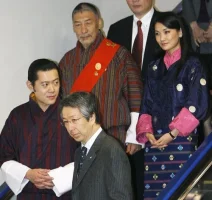
Buhtannese king and Queen are in Japan now
It is so nice to see them in Japan ..
Almost all Japanese were surprised that the donation from Bhutan was ツ ツ?? million in case of the tohoku earthquake disaster.
it said" Ohhh Buhtan, Please Don't strain yourselves. "


89250e5d-s.webp
Dasho Nishioka: a life of selfless contribution
In the history of modern agriculture in Bhutan and Japan-Bhutan relationship, one man stands tall like the Mt Everest in the Himalayas. He is Dasho Nishioka. Today, Bhutan continues to reap the fruits of his immense and selfless contribution which spanned 28 years from 1964 till his sudden demise in 1992.
On 6 May 1964 at Calcutta Airport, Keiji Nishioka, 31, and his wife Satoko, 28, boarded an old transporter plane to Hashimara. This was a long awaited journey and they were excited, but they were also a bit scared because the plane was very old.
Nishioka loved nature from his childhood and took up agriculture at university. Later, a 1958 Himalayan expedition of his university ignited his love for the Himalayas. When Nakao Sasuke, one of Nishioka's teachers visited Bhutan in 1958, Lyonchen Jigme Palden Dorji requested him for an agriculture expert. Consequently, Nakao's recommendation of Nishioka was affirmed when Nishioka and Satoko visited the Bhutan House in Kalimpong in 1962. Since then, it was a long wait until Japan's Overseas Technical Cooperation Agency (now JICA) formally dispatched Nishioka through the Colombo Plan in February 1964.
From Hashimara Airport, a Bhutanese Government jeep brought them to Phuentsholing. After a day's rest, the same jeep took them to Paro. The road to Paro had just been completed a few years ago. When they reached Paro after 15 grueling hours, it was already dark. The next morning, the view of a lush green valley of fields and farm houses with the Rinpung Dzong in the background enthralled them. Since then, they never had second thoughts about the comfortable life they left behind in a fast developing Japan.
Now that he was in Bhutan, Nishioka did not want to waste any time. He immediately reported to the agriculture office. Most of the staff, including the head were Indians. He received a cold welcome. "How can the agricultural techniques of Japan, an island country, suit the needs of Bhutan?" they questioned.
Never the one to give up easily, Nishioka decided to let the results speak for him. Starting with a small experimental farm and three boys as his apprentices, he first attracted the attention of farmers and officials alike with his fresh and healthy vegetables. In particular, his radish, the size of which was never seen before in Bhutan, became the talk of the town.
By the second year, he got a larger and better experimental farm. Working hard, his successes grew. He also successfully experimented with a Japanese variety of rice. He now understood well the climate and soil conditions of Bhutan. But just then, his two year initial appointment was nearing its end. Fortunately, his request for extension was granted by the Japanese government.
Now, the government of Bhutan provided him a much larger area in Bondey for his experimental farm. He named it Paro Farm. He now had enough space to experiment with many varieties of fruits, vegetables and rice. He would get up early and work till late. He grew potato, tomato, onion, asparagus, new varieties of rice, melon, watermelon, cherry, persimmon, peach, pear, apple, grapes, strawberry etc. in his farm.
He also initiated and encouraged the farmers of Paro to sell vegetables in Thimphu and Phuentsholing. In September 1966, he himself rode the first truck carrying vegetables to Thimphu from his experimental farm and other farmers. He was nicely surprised when all the vegetables were sold out within three hours at Thimphu. Selling vegetables in Phuentsholong started in 1967.
Upon his request to the Japanese Government, farm machineries first arrived in the kingdom in 1968.
Among the new methods of farming that he introduced, one of them was transplanting of rice in straight rows using a rope as a guiding line. Farmers were reluctant to give up their age-old method at first. But Nishioka convinced them by proving its effectiveness with better yields.
During the coronation ceremony of His Majesty the King in 1974, Paro Farm was honored to supply fresh fruits and vegetables to be served to the distinguished guests from other countries.
As the government entrusted him with the work of planning the development of agriculture in all Bhutan, it was necessary for him to travel to different places as well. His first visit was to Bumthang during the autumn of 1964. They went by jeep until Punakha where the road ended. From there, it took them eight days to reach Bumthang on foot. In 1966, he also visited Trashigang and Samdrup Jongkhar, met with the farmers, gave them advices and distributed seeds.
Besides introducing better varieties of fruits, crops and vegetables, his other concern was the development of skilled manpower and future leaders in agriculture for Bhutan. He groomed the boys who worked with him to be future leaders. He also initiated and sent the first two Bhutanese, Jampel Dorji and Dolay Penjor, to study the Japanese techniques of agriculture for a year in Japan in 1968.
Meanwhile, Bhutan Government was deeply concerned about the poverty of Zhemgang region. The people of Zhemgang owned almost no rice fields and depended on shifting cultivation which failed to produce enough to feed them. In 1972, the government entrusted Nishioka to prepare a general development plan for the region. He submitted the plan after a year. The government then entrusted him to carry out the plan within a span of five years from 1976 to 1980.
It was 1975 and he was now a father of two kids. His daughter Yoko was seven years old and son Tetsuo was two years old. From 1976, he would have to be in Zhemgang, away from his family in Paro. They also had to think about their daughter's education. Therefore, Satoko returned to Japan with the two children in December 1975. They planned to come to meet him once a year.
From 1976 to 1980, Nishioka, with his ten staff, applied himself totally to Zhemgang's cause. They held numerous meetings with the villagers, constructed 17 suspension bridges, many irrigation canals, over 50 hectares of rice fields, farm roads, schools and clinics and also sent young men to be trained as farm machine drivers and operators in Paro. He introduced the new varieties of rice, potato, maize, orange, apple, cardamom and planting of agar wood which holds great export value. The lives of the people of Zhemgang improved drastically.
For his untiring and selfless contribution, His Majesty the King awarded him the red scarf and the title of 'Dasho' in 1980. 'Dasho' means 'the best one' and it is reserved for outstanding individuals who normally hold high posts. So far, Dasho Nishioka is the only foreigner to receive this title. He humbly dedicated it to all the farmers and staff who had worked with him.
In Paro, the rice yield per hectare tripled with new varieties. When Druk Air started its operations in 1983, he also initiated the export of high value produce like asparagus and strawberry to other countries by air. Paro Farm had now grown to about 13 hectares and had about 40 regular staff and it trained about 150 people annually. Farmers also made study visits to the farm. Agriculture Machinery Centre was established the same year.
Diplomatic relationship between Japan and Bhutan was established in 1986, and in 1987, Prince Naruhito visited Bhutan. A visit to the Paro Farm was part of his schedule. Dasho Nishioka was excited. By now, it also had a nursery and a biotechnology lab.
But impermanence often strikes us when we are least prepared. On the evening of 21 March 1992, Satoko received a telephone call from Bhutan. After an awkward pause, the person on the other end said, "This morning, Dasho Nishioka has passed away in Thimphu Hospital. He complained of toothache, but his condition suddenly worsened." The last time he had met his family was less than two months ago when he was in Japan for the New Year.
The loss gripped the hearts of all Bhutanese with profound grief. His family flew in to Paro to pay their last respects. The government held a grand state funeral on 26 March on a small hillock overlooking the Paro valley, his home. The agriculture minister, members of the royal family and civil servants and farmers attended the funeral.
Dasho Nishioka witnessed the transformation of Bhutan into a vibrant modern country from an isolated mystical kingdom. He played his own big part in it. Today, we continue to enjoy the fruits of his love and sacrifice. He will live forever in the hearts and minds of all Bhutanese. Incidentally, one of the bridges that he built in Zhemgang is called 'Nishioka Bridge'. But more than this physical bridge, the human bridge that he built will continue to connect the peoples of Japan and Bhutan forever.

Dasho Nishioka: a life of selfless contribution | Reflections of a Bhutanese man
 
Interview to the Korean elderly who lived during Japan's annexation Era in korea


Japanese language only


Jeju island and Japan
 
Last edited by a moderator:
Keiji Nishioka: A bridge between two nations

At a time when Japan's economy was in bubble stage, and the people were considering TV, washing machine, refrigerator as necessities at their homes, a Japanese youth, an agriculture expert was writing development plans in a remote village in Bhutan under a lamp-light lit from pine extract. The agricultural development in Bhutan and Japan-Bhutan relationship came out as a one man initiative of this planner, Keiji Nishioka.In 1962, the then Prime Minister of Bhutan Jigme Palden Dorji made a request to one of his Japanese friends, Nakao Sasuke, for an agriculture expert to plan agricultural development in Bhutan. Sasuke recommended one of his students, Keiji Nishioka. Keiji was familiar with Himalayas through his expeditions. One fine day in 1962, he and his wife Satoko reached the Prime Minister's residence, the Bhutan House in Kalimpong. His destiny was penned that day. Two years later, the couple left industrialized Japan for rural Bhutan. They flew to Calcutta airport and then to Hashimara from where a jeep sent by Bhutanese government took them to Paro where destiny was waiting for them. Then, he was 31. Initially, he worked as a member of Japan's Overseas Technical Cooperation Agency (now JICA) under the Colombo Plan. His earlier days were more challenging than imagined. He was in a remote area. He had to work with boss and colleagues from India who were cynical to believe that an expert from an island country has anything to do with the mountanous country than waste the resources. He either had to quit or prove them wrong. He started a small experimental farm, hired young boys as apprentices and began promoting products from his farm. He used Japanese seeds and the products attracted the farmers. Year by year, he increased the size of the farm, and amount and varieties of products. He experimented Japanese rice, large cabbage and long radish, grew asparagus, onion, potato, tomato, melon, watermelon, apple, cherry, grapes, persimmon, peach, pear, strawberry and everything the climate permitted. He grew improved varieties of vegetables, cereals, fruits and trees, and distributed seeds. The farmers were attracted; he worked with them and initiated selling of vegetable in the market. Before this, farmers had no idea if they had any products that would fetch them money. He took the farmers to markets, as far as to Thimphu and Phuntsholing, to sell their products.

After four years, upon his request, Japanese government started sending farm machineries. He taught improved cultivation methods and management techniques. In June 1974, during the coronation ceremony of the fourth monarch of Bhutan, the fresh fruits and vegetables from his farm were on the table for the royal guests. He walked around the country observing people's works, listening to their stories, giving them advices and distributing seeds. He trained youths in farming techinques and sent students to Japan for trainings. He was entrusted the entire development of Shemgang, one of the rural districts, where shifting cultivation was practiced and no rice fields existed. The district was not connected by roads and his two children were nearing school going age. So, he sent his wife and children to Japan and continued his development exercise in the remote Himalayan mountains. He coordinated Shemgang Integrated Area Development Project; introduced agar wood from neighbouring Assam in India, cardamum from neighbouring district Gaylegphug; and started their plantation as cash crops. He groomed apprentices, contructed rice fields, and introduced high yielding varieties of cereals, fruits and vegetables. Besides agricultural development, he mobilized people's participation to construct suspension bridges, irrigation cannals, farm roads, health clinics, senitation and dessiminated concept of healthy cooking and safe meat preservation methods. By now he was a national hero known as Japan ツ"sahibツ" or the Lord.


Bhutan and Japan are distinct in many ways, yet Keiji Nishioka chose to seek uniformities. Born on St. Valentine's day of 1933, educated in Sakuragaoka Primary School in Seoul, Korea, Yao Junior High School in Osaka and Osaka Prefecture University, Keiji spent his life serving the farmers of Bhutan. In 1980, the monarch conferred him with red scarf and a title of ツ'Dasho' equivalent to ツ'Sir', for his selfless service, making him the first foreigner to earn the title. In 1983, an international airport was built near to his farm, in Paro. Three years later, Japan and Bhutan signed a formal diplomatic tie and a year later in 1987, Japanese Prince Naruhito visited Bhutan. In all these mega events, Dasho Keiji Nishioka was the center of talks and the farm established by him was a ツ'must-visit' venue. After twenty eight years of restless work, on 21St March 1992, a toothache stole away his soul from his body in Thimphu hospital. On 26th March a state funeral in his name saw the the paro valley drenched with the tears of the farmers and officers alike and the whole nation was soaked in grief. In 1999, he was awarded Druk Thugsey Award posthumously, for his meritious contributions to the development of agriculture productions in the country. Today, Nishioka bridge in Shemgang, Bonday farm in Paro, Agriculture machinery Centre, National Seed and Plant Protection Program, roads, hospitals, thousand of fruit trees, hundreds of agriculture veterans, high yelding varieties of rice, vegetables, fruits and trees, made-in-Japan farm machineries and automobiles all over the nation are the results of his vision and dedicated service to the mankind. The name of Dasho Keiji Nishioka ties the people and governments of Japan and Bhutan with hearty spiritual knot initiated by him. ツ…ツ…ツ…ツ…..

 
Last edited by a moderator:
Caster 55, we appreciate your contributions, but could you please add some explanations and, more importantly, your personal opinion to the videos? Thank you.
 
Back
Top Bottom