Environment Japan set to start deep-sea rare earth extraction in 2026

thomas

Unswerving cyclist
Admin
Joined
14 Mar 2002
Messages
21,048
Reaction score
18,898
Beginning in January 2026, Japan will undertake a trial to extract rare earth minerals from deep-sea sediments, marking the deepest operation of its kind to date, according to Shoichi Ishii, director of the Cross-ministerial Strategic Innovation Promotion Program. This initiative follows Japan's recent agreement with the United States, India, and Australia to strengthen the supply chain for key minerals amid growing concerns over China's dominance in the sector. Rare earth elements—17 metals used in products such as electric vehicles, wind turbines, hard drives, and missile systems—are difficult to extract and refine. Currently, China accounts for nearly two-thirds of global mining and 92% of refining output, according to the International Energy Agency. The deep-sea drilling vessel Chikyu will carry out a test expedition to collect seabed sediments containing these valuable materials.
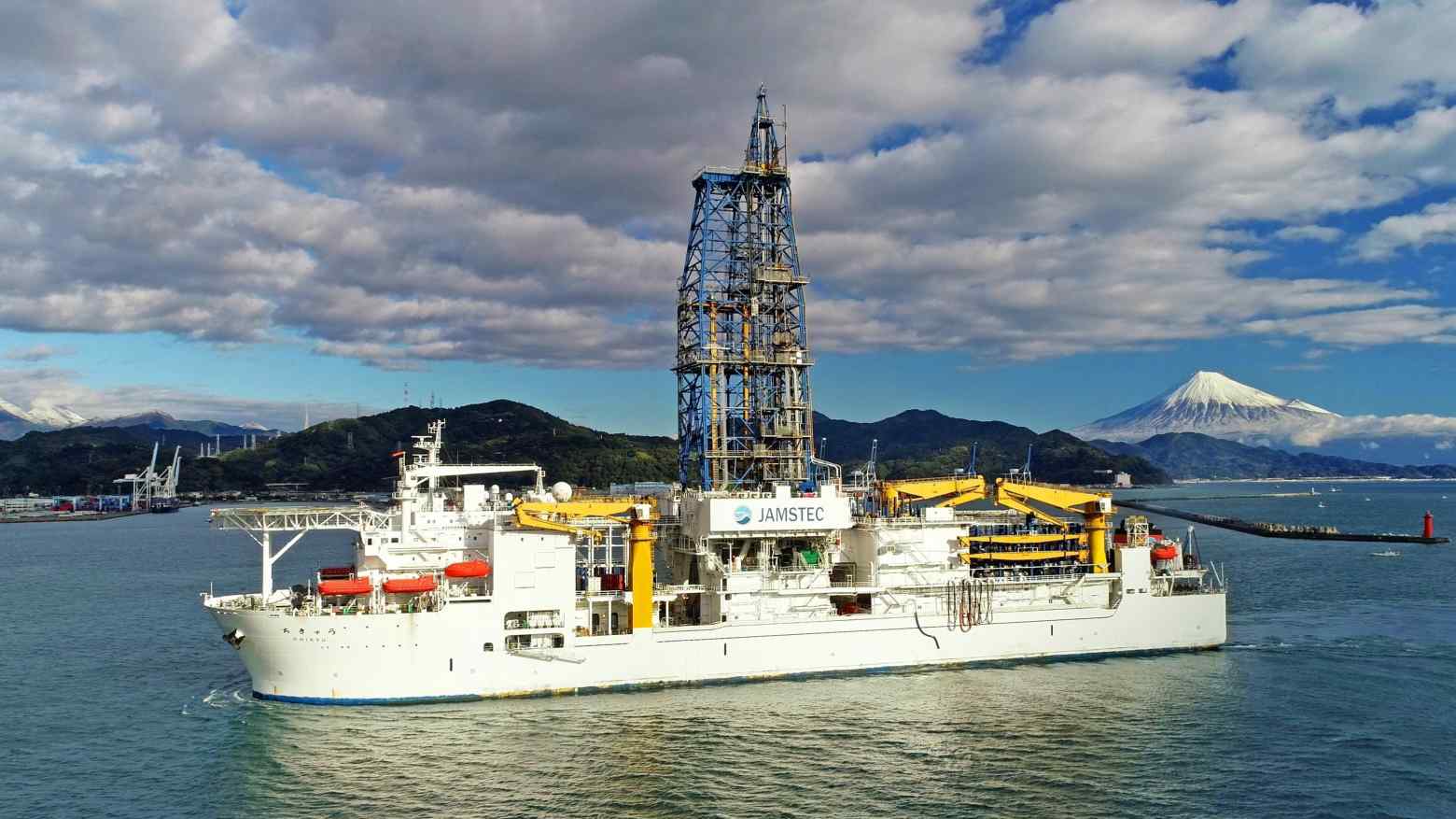
Chikyu

Photo credit: JAMSTEC via Nikkei


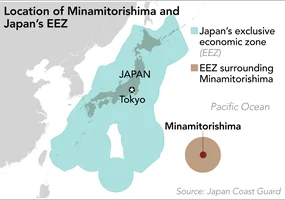
A pipe will be lowered 5,500 meters below the ocean's surface into the seafloor to collect 35 metric tons of mud. If successful, this would be the first time in the world that a vessel has recovered rare earths from such depths. The work, including the placement of the pipe, is expected to take approximately three weeks, with the Chikyu vessel transporting the mud back to Japan's mainland. One ton of mud is expected to contain about 2 kilograms of rare earth minerals. While China produces most of the world's rare earths, the seabed in the exclusive economic zone surrounding Japan is also rich in such materials. The area around Minami-Torishima alone is estimated to contain some 16 million tons of rare earths, the third-largest reserve in the world. Cited as especially abundant are dysprosium, used in magnets for electric-vehicle motors, and gadolinium, found in nuclear control rods. The Japanese government envisions rare earths extracted from Minami-Torishima being used in the private sector as early as fiscal 2028. However, the specifics of the deposits — located below a seafloor that is approximately 4,000 to 6,000 meters below the ocean surface — are not yet clear.


Paywall alert:
 
Yesterday, Japan's Cabinet Office and the national marine research agency reported that mud believed to contain rare-earth elements had been successfully lifted from a depth of 6,000 metres in the Pacific Ocean, near the isolated island of Minamitorishima. The recovery, while preliminary, marks a technically demanding milestone in a long-running effort to tap seabed resources within Japan's waters.

Rare earth extraction Rare earth extraction

The operation is part of the government's Cross-ministerial Strategic Innovation Promotion Program (SIP). SIP and JAMSTEC (海洋研究開発機構 Kaiyō Kenkyū Kaihatsu Kikō, the Japan Agency for Marine-Earth Science and Technology), which are overseeing the mission, describe the achievement as the first step toward the eventual industrial use of domestically sourced rare earths.

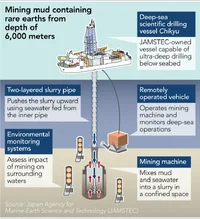
The research vessel Chikyu departed Shimizu Port in Shizuoka Prefecture on 12 January. It reached the designated trial site in Japan's exclusive economic zone near Minamitorishima on 17 January, roughly 1,950 kilometres south-east of Tokyo. Full operations began on Friday, and in the early hours of Sunday, the first slurry containing rare-earth-bearing mud was pumped to the surface. The trial extraction was primarily intended to test specialised seabed collection equipment rather than to secure commercially viable quantities. Engineers lowered a two-layer slurry riser assembled from 600 interconnected pipes, each 10 metres long, from the ship to the ocean floor. A mining vehicle operating on the seabed then mixed sediment with seawater to create a slurry, which was forced upward through the pipe by water pressure generated aboard the vessel.

Yet significant hurdles remain before commercialisation, including the development of reliable extraction and refining technologies. Techniques used in petroleum production can be applied to pump slurry from the seabed, but remote operations in the deep sea -- such as connecting a mining machine to pipes -- are considered particularly difficult. Yasuhiro Yamada, a Kyushu University professor specialising in resource and energy engineering, noted that "complex operations involving heavy equipment on the deep seafloor are technically challenging." Experts believe technologies used to process land-based ores could be adapted to refine rare-earth elements from the mud, but there has not yet been a successful example of this.

Paywall alert:
 
Japan has successfully recovered rare earth elements, including yttrium and dysprosium, from deep-sea mud near the remote Pacific island of Minamitorishima. The achievement has raised hopes that the deposits could one day become a domestic source of critical minerals. However, major technical and economic challenges still need to be overcome before commercial mining is possible. The recovery was carried out as part of the Japanese government's Strategic Innovation Promotion Program (SIP). The mud was collected from the seabed at a depth of 5.6 kilometres near Minamitorishima.

The mud contains high concentrations of valuable rare earth elements, particularly yttrium (29.9%), neodymium (18.9%), gadolinium (4.9%) and dysprosium (4.6%). Overall, about 54% of the recovered material consists of medium and heavy rare earths, which are widely used in semiconductors, electric vehicles, robotics, defence systems and other advanced technologies.

Commercial production is expected to require an investment of around ¥340 billion (US$2.08 billion), with further high costs for processing and refining. Profitability remains uncertain, and experts question whether seabed mining can compete economically with China's lower-cost production.

Large-scale testing is due to begin in February, with a commercial viability assessment planned for fiscal 2027. Commercial production is not expected before fiscal 2029 at the earliest, and Japan is likely to remain dependent on China for most heavy rare earths for the foreseeable future.

Paywall alert:

 
Back
Top Bottom