


- 14 Mar 2002
- 21,062
- 18,921
According to data released by the OECD, Japan has the highest share of childless 50-year-old women among developed countries. Twenty-seven per cent of women born in 1970 had not experienced any live births by the time they were 50 years of age. This is the most significant share among 17 countries with comparable data, the closest being Finland at 20.7%. The research found that difficulty getting married is the biggest obstacle to having kids.
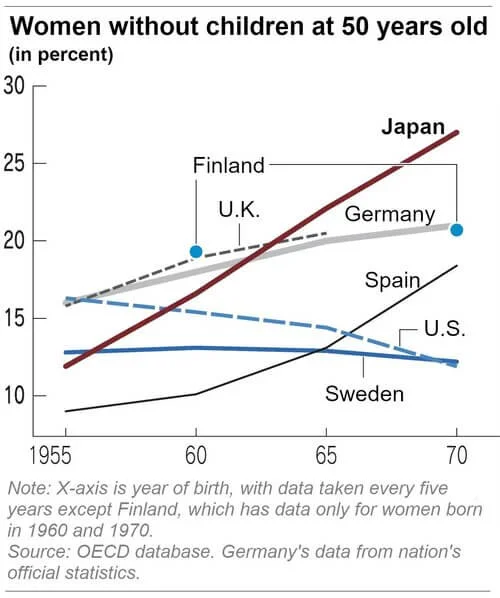
The Top 4 countries with childless 50-year-old women in developed countries were
As previously discussed, the lack of governmental support led to a decline in births.
Paywall alert:

 asia.nikkei.com
The Top 4 countries with childless 50-year-old women in developed countries were
- Japan (27%)
- Finland (20.7%)
- Austria
- Spain
Rie Moriizumi, senior researcher at IPSS, found that women remain childless due to difficulty in getting married, a preference not to have children, because they are putting off having children, or due to infertility or health reasons. The findings are based on survey responses collected by the institute. In recent years, the share of Japanese women remaining childless due to problems getting married has jumped, becoming the top reason among women between the ages of 25 to 49. It appears that one major hurdle to marriage is finding a suitable partner with adequate financial resources. Women who prefer not to have kids make up the second-biggest contingent among childless women. Moriizumi estimates that about 5% of all women have made that choice, and the numbers have especially grown among younger generations. Unmarried women are more likely to decide against having children if they have low incomes or have not found a partner. "This suggests that more women have given up rather than actively choosing" not to have children, said Moriizumi.
As previously discussed, the lack of governmental support led to a decline in births.
Though more women entered the workforce, a lack of measures to help balance work and family forced many to choose between leaving their jobs to raise a family or forgoing children to continue their careers, leading to a decline in births. "As women stopped making marrying and raising children their top priorities in order to develop their careers, marriage and childbirth were increasingly deferred, and more people had no children," said Toshihiko Hara, professor emeritus at Sapporo City University, who has studied childlessness in Germany and Japan. Some experts warn that the rise in childlessness could fray Japan's social fabric. [...] Tokyo Metropolitan University professor Aya Abe conducted quantitative research to show that having no children often leads to an insufficient social support network.
Paywall alert:
Japan leads world in childless middle-aged women
Difficulty getting married is biggest obstacle to having kids, research finds
asia.nikkei.com


