


- 14 Mar 2002
- 21,050
- 18,903
The BBC on why hay fever, also known as allergic rhinitis, has become a national crisis in Japan, with an estimated 43% of the population experiencing medium to severe symptoms. This compares to 26% in the UK and 12-18% in the US.
Why did Japan plant only Japanese cedars and cypresses after WWII?
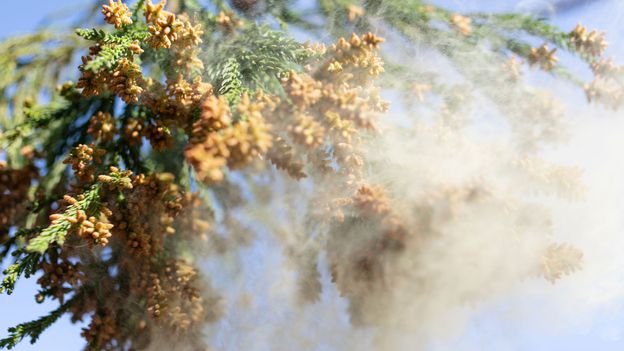
The problem is that sugi and hinoki trees release huge amounts of light pollen that can easily travel into towns and cities. Much of it comes from vast single-species plantations, where the trees often release pollen simultaneously. This has become more serious as the forests have aged. Sugi and hinoki trees begin producing more pollen after about 30 years, and most of Japan's planted forests have now reached that stage. Sato said pollen allergies had become a national health issue in Japan and called the situation urgent. In 2023, the Japanese government officially designated allergies a national social problem and announced a long-term plan to reduce pollen levels by 50% over the next 30 years. As part of that effort, authorities aim to reduce the area covered by sugi plantations by 20%.
Another issue is climate change:
 www.bbc.com
At the peak of Japan's hay fever season, the economic impact from both sick days and lower consumer spending is estimated at $1.6bn (£1.2bn) per day. In 2023, Japan declared allergies a national social problem, and the central government set out an ambitious plan to reduce pollen by 50% in 30 years. As a first step, it aims to reduce the area of forest planted with sugi trees by 20%. Today, these hinoki and sugi plantation forests still cover around 10 million hectares (25 million acres) – a fifth of Japan's entire land area.
Why did Japan plant only Japanese cedars and cypresses after WWII?
"After World War Two, many of Japan's mountains became barren, causing disasters in various regions," says Noriko Sato, a professor and forestry researcher at Kyushu University in Fukuoka, Japan. (Bare mountains can increase the incidence of landslides and flooding). "Large-scale afforestation was carried out by public works, funded by tax revenues, to prevent soil erosion." Aiming for rapid reforestation, the government chose to plant reams of only two different native, fast-growing evergreen species that could quickly reforest landscapes and provide wood for future use in construction: the Japanese cedar, sugi, and the Japanese cypress, hinoki. Today, these hinoki and sugi plantation forests still cover around 10 million hectares (25 million acres) – a fifth of Japan's entire land area.
The problem is that sugi and hinoki trees release huge amounts of light pollen that can easily travel into towns and cities. Much of it comes from vast single-species plantations, where the trees often release pollen simultaneously. This has become more serious as the forests have aged. Sugi and hinoki trees begin producing more pollen after about 30 years, and most of Japan's planted forests have now reached that stage. Sato said pollen allergies had become a national health issue in Japan and called the situation urgent. In 2023, the Japanese government officially designated allergies a national social problem and announced a long-term plan to reduce pollen levels by 50% over the next 30 years. As part of that effort, authorities aim to reduce the area covered by sugi plantations by 20%.
Walking through sugi or hinoki plantation forests is eerie – all the trees are the same height, and there are few birds or insects. The ground is spongy with dry needles, and there's little light or sound. It's a stark contrast to Japan's natural forests, which teem with biodiversity and sound. With their diverse tree species, such as red pine, larch, and maple, these forests support a wider range of wildlife. Japan's unique geography has made it one of the world's biodiversity hotspots, but habitat loss and invasive species have left much of its unique wildlife increasingly at risk.
Another issue is climate change:
Urgency to act is also growing because of another unplanned factor – climate change. Around the world, temperature and weather shifts are impacting pollen spread, and Japan saw its earliest pollen dispersal ever in 2025. Pollen dispersal is greatly influenced by weather conditions such as temperature and wind," says Mai Sato, a spokesperson with the Japan Weather Association (JWA), a forecasting company which releases regular pollen forecasts to the public.
Japan is gripped by mass allergies. A 1950s project is to blame
A decision made 70 years ago to reforest vast swathes of Japan with just two kinds of tree has come back to haunt the country.
www.bbc.com


 , a quick google asking whether pollen could be collected and then used as a foodstuff/ingredient said not really possible, as it can still cause allergic reactions if eaten. But a couple of plant-specific pollens are used in cooking as spices and for flavor.


