Is Japan really a democracy?

Is Japan really a democracy?

  • Yes

    Votes: 33 42.3%
  • No

    Votes: 45 57.7%

  • Total voters
    78
Japanese democracy is still in its infancy

who is adult?

A lot of countries can not help choosing democracy.
Democracy is not the best like Jean-Jacques Rousseau said.
 
Japan is absolitely a democracy but people are just not really taking advantage of it

I don't want to waste my time on terminology discussion. As a Japanese living in Japan, I can't help feeling that ordinary Japanese citizens believe political process is out of touch. In other words, they expect some higher-up guys will come up with policies most appropriate to all those Japanese. They assume policies are something given. This passiveness of Japanese general public makes Japan look less-democratic. But in fact, you can change political tide if you are determined enough. You can even start a new political party and run for a Diet seat. More realistically you may want to start with a municipal legislative office. But you can always make a difference within existing system. How can you call Japan a non-democracy?
 
Democracy rankings... Russia-120... Hm... Very interesting...

Have you heard of the French philosopher Alain de Benoit? He divides democracy into tree types (according to the famous democratic slogan liberty, equality, fraternity).

In brief:

1. Liberal democracy. This type of democracy focuses on an individual, underlines his material and biological needs and demands the structure of society to be subordinated to the free consumption.

2. Egalite democracy (sometimes called people's democracy). This type of democracy is about the equality principle and is a result of popular uprising. It became apparent to a greater extent as tyrannical and totalitarian regimes of Communist types. Such democracy focuses on the society as a whole, not on a single individual.

3. Organic democracy. This type of democracy deals with a nation as with a peculiar unified qualitative and organic community, which took root in the history, has its own spiritual, cultural, national, and political tradition. This tradition becomes a base for political initiating of a nation, serves as a criterion for taking significant decisions and as a collective declaration of intent. Organic democracy deals with a nation as with a living organism, which cannot be divided into parts. Otherwise, it will result in its death.

And so on...


Now concerning what I think about it:

...Every nation has its own mentality, culture, religion... Democracy is not a universal remedy for all. It can be good for some society, but absolutely pernicious to another society. When setting up democracy in a country, it is necessary to take into account its history, the people's traditions, customs, values, Weltanschauung... The West, in essence, is an individualistic society. The first type of democracy (i.e. liberal democracy) suits it more. As for the Russian culture, it is rather based upon entirety and unity. (That is why Russia sank into Marxism ideas so easily.) Historically, a public benefit has been more important for the Russians, than a personal one. Thus, the third type of democracy (organic democracy) gives the best fit to Russia.

Basically, it is possible to invent many types of democracies for every country, which will take into account their peculiarities.

I do not want the Russians to bury their Slavic values and mentality (with the purpose of acquiring, for example, American ones). I do not want them to abnegate Orthodoxy in favour of Catholicism. I do not want them to lose their national identity to become something averaged. Note, I do not say that American values are worse than ours, or that they deserve less respect. They are simply different, and, obviously, not for us.

I understand clearly that it is much easier to manipulate a country if it has the same religion and democracy. But we chose Byzantine. And the West still has a grudge against Russia because of our choice. During The Time of Troubles in Russia (the beginning of the 17th century), Polish interveners tried to catholise Russia. But they failed. Nowadays, the West tries to democracise Russia in its own (western) image. But I hope that Russia will choose its own path again.

So what do I want to say? Japan is also not an American democracy. It must have its own democracy, its own political structure, based upon its history, traditions, culture, mentality of the people, etc.

So if someone keeps on insisting that Japan, Russia, etc. must be, say, like the US, then he/she is likely to understand nothing in historical, cultural, political, etc. realities of those countries. And do we really need to care about such criticism? As Vladimir Putin said, 'The dog barks, the camelcade going on.'

I think that it is necessary to extract such a word as democracy from vocabulary. It results only in misunderstanding and confusion.

Sorry, difficult to express my thoughts in English. I hope you understand what I am talking about. :D
 
Personally I think culture and traditions can be fitted into democracy quite well. I see no problem in this. Cruel dictatorship is still something people should really think about. Its not the meaning of democracy to invade, it would better if people could handel their own problems by themselves. Sometimes this is not possible (becouse the dictators have habit to bring problems also outside of their own country). Yeah yeah, in this world people should learn to share more.
 
Personally I think culture and traditions can be fitted into democracy quite well.

Do you think that Islamic culture can be fitted into democracy very well? That is the culture where women supposedly have no rights. Muslim men consider that it is inadmissible to treat women on equal terms. They also think that during the process of 'training' a woman, men have a right to use force, if necessary. Besides, it is recommended not to strike women on face, head, stomach, and chest; and not to use 'too thick and heavy stick, which can leave bruises and scars.' The strikes, nevertheless, must be hard... Are you ready to call such an attitude towards women a feature of, say, American democracy? Tell French feminists that women have no rights, and they will tear you into pieces. :D


15. USA
...
18. Estonia
...
26. Latvia
...
71. Ukraine
...
74. Georgia
...
120. Russia


Some reflections concerning the democracy ranking.


The USA.

I posed this question before, but I posed it incorrectly (or, perhaps, you misunderstood me). So I pose it again. Can one consider the US a democracy if American politicians care about the rights only of their own nation – the Americans, but they violate rights of other nations (e.g. of the Iraqis)? Does democracy mean only not violating rights of one's own nation?


Estonia.

I seriously doubt that the West have a right to call Estonia a democratic country. Neo-fascism flourishes in the country. And it is much more widespread than that in Russia, Britain and Germany taken together. How is the EU going to strive against it?


Latvia.

In Latvia, national minorities have fewer rights than animals. Even in 'undemocratic' (according to the ranking) Russia, there is no such an awful and irreverent attitude towards national minorities. I wonder how is the EU going to solve this problem?


Ukraine.

Since the Orange Revolution, Yushchenko and Yanukovich have still disputed over how to share the power. What is happening in the Ukrainian parliament can be called just farce and total chaos. Moreover, there is no Constitutional Court in Ukraine yet.

Ukrainians stole – perhaps, still steal (by the way, 'still steal' sounds great! 👍 ) - natural gas consigned to Europe. They argued that Russia had a moral (not legal!) obligation to subsidise the Ukrainian industry and to supply natural gas to Ukraine at the price several times less the price for natural gas for Europe. Is it democracy?


Georgia.

No comment. Who knows the economical, political and social situation in Georgia will agree with me that the situation in the country is rather like that in Stalinist Russia. Democracy in Georgia? I have never heard such rubbish!


So I agree with Sukotto that the list is biased. Definitely...
 
This may be somewhat off-topic, but neo-fascism in Estonia?

Are you mad?

Based on your comments here, it seems that you're nothing more than extremely nationalistic Russian who feels that small countries on Russia's borders don't have the right of national self-determination, including the creation of democratic polities. Why are we supposed to put any stock in your ravings about countries that you would prefer to see crushed under Moscow's thumb?

Your rant makes me put all the more stock into this list. Clearly these countries are doing something right to merit your opprobrium.
 
"Estonia.

I seriously doubt that the West have a right to call Estonia a democratic country. Neo-fascism flourishes in the country. And it is much more widespread than that in Russia, Britain and Germany taken together. How is the EU going to strive against it?"

Yeah mostly becouse history of great soviet union.
 
...Every nation has its own mentality, culture, religion... Democracy is not a universal remedy for all. It can be good for some society, but absolutely pernicious to another society. When setting up democracy in a country, it is necessary to take into account its history, the people's traditions, customs, values, Weltanschauung... :D
hahaha, In China, communist party always use this as an excuse
to refuse any political reform.
It seems that the same thing happened in Russia.
 
Continuing on this thread, I failed to mention the obvious point that the only truly neo-fascist country -- insofar as a country can be "neo-fascist" (this strikes me as nothing more than a word used to describe someone or something as "objectionable," as Orwell described the word "fascist") -- would be Vladimir Putin's Russia.

Contemporary Russia seems to have many of the trademarks: its government has stifled dissent and undermined private enterprise, murdered opponents, and acted to undermine its neighbors' political systems.
 
Originally posted by Japan Observer:

Based on your comments here, it seems that you're nothing more than extremely nationalistic Russian who feels that small countries on Russia's borders don't have the right of national self-determination, including the creation of democratic polities. Why are we supposed to put any stock in your ravings about countries that you would prefer to see crushed under Moscow's thumb?


Your stupid note just reveals the fact that you know nothing about the situation in the countries I described. I have relatives and friends in Estonia and Latvia. They can tell you much about neo-fascism in Estonia and about what means being a Russian in Latvia. You, probably, have never heard about the Latvian term nepilsoni (in Russian – 窶桎窶柆窶枹窶樞?壺?柝窶檜窶柎窶柝窶桎窶柆; in English – non-citizens, aliens). Yeah, what I am talking about you will never meet in European or Japanese news bulletins and newspapers. So instead of talking bullsh!t, it would be great for you to grasp the facts.

So am I an extremely nationalistic Russian? :D Firstly, before drawing a conclusion you must know me, my thoughts, etc. Do not flatter yourself and do not think that you are a profound psychologist – a catcher of human souls, – who can form an opinion about a man, just having lightly touched him. Again, before arriving at the hasty conclusion, it would be great for you to find out my opinion about if I want the countries that neighbour Russia to have democracy or not.

Secondly, it seems to me that you also understand nothing in geopolitics. I do not want to waste my time to explain some evident things to you.


Originally posted by gs001:

hahaha, In China, communist party always use this as an excuse
to refuse any political reform.
It seems that the same thing happened in Russia.

As far as I know, it never happened in Russia.


Originally posted by Japan Observer:

Russia under Vladimir Putin = a neo-fascist country.

Obviously, you believe what you desire and see only what you want to see. By the way, Russia can teach many countries some democratic things. ;-)


Originally posted by Japan Observer:

Are you mad?

I am crazy. 😌


Merry Christmas, by the way, and a happy New Year! 🙂 :-)
 
" would be great for you to find out my opinion about if I want the countries that neighbour Russia to have democracy or not."

This is your right as much as you can vote in USA elections.
 
And I've been to Estonia, which is of about as much value to this discussion as the anecdotal reports of your "friends and relatives."

What is neo-fascism? Can you define it? Can you provide a list of criteria that make a country "neo-fascist?" Can you provide links to sources -- valid sources -- that illustrate how minorities in Latvia have fewer rights than "animals." Why not talk about how ethnic minorities are treated in Russia? Here's what Amnesty International says on that subject: http://www.amnesty.org/russia/minorities.html.

I know there are concerns about how Russian minorities in the Baltic countries are treated, but are the abuses systematic and widespread? Neo-fascist? You have provided no factual support for these radical claims.

And I'm with Mr. Jones -- who cares what you think about whether Russia's neighbors should be democracies. Hey, the cold war's over, and Russia lost, which means it has to watch its neighbors develop faster and enjoy greater freedom than Russia, with its absurdly high mortality rate (due in large part to alcoholism), a worryingly high rate of AIDS infections, and an economy ridden with crime and corruption.

By the by, I "understand nothing in geopolitics?" Please, don't bother wasting your time explaining things to me. You've already wasted enough of mine in attempting to explain why Russia's neighbors are all fascist countries. Your time would be better spent learning the English language.

Lastly, I never called Russia neo-fascist. All I said is that if I were to use the word neo-fascist -- note, WERE -- I would use it to describe Russia. But if you read my post more carefully, you'll note that I said I don't like the word, because I think it has no meaning other than whatever the person using it wants it to mean. I'm actually more sanguine about Russia in the long term than my posts might otherwise suggest; I'm simply calling attention to the negatives just to make it clear what you're failing to mention in your "analysis."

But this is all a distraction from the real matter at hand, namely explaining to people why the myths about Japan's not being a democracy are exactly that: myths.
 
...anecdotal reports of your "friends and relatives."

Actually, I refer not only to my 'friends and relatives.' I have read and watched enough materials on the matter. And I consider them reliable.

What is neo-fascism? Can you define it? Can you provide a list of criteria that make a country "neo-fascist?"

I thought that you would tell me that. :-p I see no reason to explain to you what I mean by the term. Anyway, you will distort the sense of my words (as you already did it).

Can you provide links to sources -- valid sources -- that illustrate how minorities in Latvia have fewer rights than "animals."

I doubt that Internet can be a valid source. Besides, I gave you the premise to start with. First of all, focus your attention on the term nepilsoni.

The link you posted is pretty interesting. You can find many similar articles about other (democratic) countries.

...which means it has to watch its neighbors develop faster and enjoy greater freedom than Russia...

I wonder what countries you are talking about. Finland? But Finland was the part of the Russian Empire, not of the USSR. Estonia and Latvia? Hm... Yeah, the standard of living in these countries is a bit better (thanks to the EU). How, by the way, do you define freedom? I consider myself free in Russia. Or are you going to prove to me that I am not free? Perhaps, you meant Belarus? Yeah, Belarussian industry is developed rather well. (Thanks to low prices for the Russian natural gas.) Perhaps, Kazakhstan? Hm, I think that Kazakhstan deserves respect indeed. I am delighted with it.

Do not forget that it is Russia that is liable for the Soviet external debts. And it successfully pays them off. As far as I know, the external debt of the USA is much heavier than that of Russia.

...with its absurdly high mortality rate (due in large part to alcoholism), a worryingly high rate of AIDS infections, and an economy ridden with crime and corruption.

You forgot to mention the highest in the world suicide rate. But, in general, you are not very knowledgeable on these matters either. Recently, the mortality rate decreases, the birth rate increases. There is surplus of births over deaths. Alcoholism appeared in the USSR. The Russian Empire was one of the most soberest countries in the world. I am sure that we shall solve this problem. It is a matter of time.

Yeah, the rate of AIDS infections is rather high. It increased many times more after the collapse of the USSR. Give us some time, and we shall solve this problem as well. As for crime and corruption, they disappear from the economy rather fast (thanks to Vladimir Putin).

...Russia's neighbors are all fascist countries.

I have never said that. It reveals the fact that the only thing you are good at is distorting the sense of my words.

Your time would be better spent learning the English language.

Thanks for your kindness. I already have... 🙂

Lastly, I never called Russia neo-fascist. All I said is that if I were to use the word neo-fascist -- note, WERE -- I would use it to describe Russia.

These are the same things for me.

Some people still consider Russia a successor of the USSR. It is their problem. I do not mean you, Mr Japan Observer. I really like your phrase "I'm actually more sanguine about Russia in the long term." 👍

Even The 14th Dalai Lama said the following about the Russians, 'The people who spent so much time in fear and lies [about the USSR] need rather much time to forget about the past and to build democracy. Fifteen years are not enough for this purpose.'

Conclusion:

I voted yes on the poll. Japan is a democracy for me. Russia is a democracy for me as well. I am happy and free in Russia. And **** all those who do not agree with me. :D
 
Last edited:
I thought that you would tell me that. :-p I see no reason to explain to you what I mean by the term.
You see no reason? Then I see no reason to take you seriously. You use a word that has no established meaning -- even less established meaning than democracy, because it's usually used as a word to slander someone or something -- and you expect that I'm supposed to read your mind to discover what exactly makes a country "neo-fascist."
I doubt that Internet can be a valid source.
This is a ridiculous canard. It's foolish to talk of "the internet" as a single, undifferentiated source. Yes, there's a lot of shoddy information and data on the internet, but if you were to take a break from whatever rubbish you read, you'll find that there are scores upon scores of reputable, reasonable sources for just about every variety of human knowledge.
The link you posted is pretty interesting. You can find many similar articles about other (democratic) countries.
I don't disagree. No country, no society is perfect, because humanity is imperfect. But at the same time, to tell me that all of Russia's neighbors are terrible places while ignoring Russia's many failings is, at the very least, intellectually dishonest.
I wonder what countries you are talking about. Finland? But Finland was the part of the Russian Empire, not of the USSR. Estonia and Latvia? Hm... Yeah, the standard of living in these countries is a bit better (thanks to the EU).
No, I'm not talking about Finland. I'm talking about the Baltic countries, which you so crudely dismissed as "neo-fascist." Estonia and its neighbors began a period of accelerated growth years before they joined the EU. Did they benefit from the prospect of becoming members of the EU? Indubitably. But to attribute it solely to the EU is a mistake. Estonia, Latvia, and Lithuania have been quick to embrace freedom in all its forms -- economic as well as political -- and they have benefited greatly. Every international survey that measures the advance of freedom has rated them highly, even while noting the concerns about the treatment of ethnic minorities. While one survey may be "biased," when every survey reaches the same conclusions it becomes considerably more difficult to dismiss the results.
In any case, quality of life isn't simply a matter of economic figures. It is more holistic than that, and therefore difficult to put into numbers.
Do not forget that it is Russia that is liable for the Soviet external debts. And it successfully pays them off. As far as I know, the external debt of the USA is much heavier than that of Russia.
Ok, I won't forget that. But this statistic is meaningless. So what? Yes, Russia's external debts are lower than America's. Could it be because Russia is a major exporter of energy and, with energy prices being higher, Russia's external balance is in good shape? Am I supposed to be impressed by your picking an arbitrary economic figure and comparing Russia and America? America's external debt, while worrying, is hardly unsustainable, in part because the US has certain privileges as a result of seigniorage. Why not talk about Russian inflation? Or Russian unemployment?
But, in general, you are not very knowledgeable on these matters either. Recently, the mortality rate decreases, the birth rate increases. There is surplus of births over deaths.
If you're going to be exceedingly arrogant, at least have the facts on your side. Of course Russia has more death than births. That's why the Russian government is concerned about its demographic crisis. (Maybe you filter out the bad news that emanates from Moscow and hear only "good" news?) In any case, here are the numbers provided by Population Reference Bureau, a reputable organization that tracks demographic statistics for all the world's countries.
Russia (http://www.prb.org/TemplateTop.cfm?...profile/countryprofiledisplay.cfm&Country=470)
Population Mid-2005 143,025,000
Births per 1,000 Population 11
Deaths per 1,000 Population 16
Rate of Natural Increase (Percent) -0.6
Projected Population, 2025 130,175,000
Projected Population, 2050 110,459,000
Projected Pop. Change 2005-2050 (%) -23
Infant Deaths per 1,000 Live Births 12.4
Lifetime Births per Woman (TFR) 1.4
Population Age <15 (%) 16
Population Age 65+ (%) 13
Life Expectancy at Birth, Total 66
Life Expectancy at Birth, Male 59
Life Expectancy at Birth, Female 72
Urban Population (%) 73
HIV/AIDS Among Adult Population, Ages 15-49, 2001 (%) 0.7
In terms of population growth, life expectancy, and infant mortality, that is a demographic crisis in the making.
And **** all those who do not agree with me. :D
This seems to be your preferred manner of argumentation. I'm waiting for you to support your arguments with something other than bluster.
 
"As for crime and corruption, they disappear from the economy rather fast (thanks to Vladimir Putin). "

So some proof for this please. I find this stament really absurd, regarding on potical murders noticed in all major newspapers around the world.
 
ツ"This seems to be your preferred manner of argumentation. I'm waiting for you to support your arguments with something other than bluster.ツ"

That was a joke. I thought you had the sense of humour. :rolleyes: Take it easy, Mr Japan Observer! ;-)


ツ"...arrogant...ツ"

Am I arrogant? What do you know about me? I have just realised that you are also good at pinning labels.


ツ"This is a ridiculous canard. It's foolish to talk of "the internet" as a single, undifferentiated source. Yes, there's a lot of shoddy information and data on the internet, but if you were to take a break from whatever rubbish you read, you'll find that there are scores upon scores of reputable, reasonable sources for just about every variety of human knowledge.ツ"

I wanted you to say it. My next step is:


ツ"Can you provide links to sources -- valid sourcesツ"?

Okay, I shall provide you some links. Though it is just a drop of water in the ocean, because there are not so many such articles in English. If you want, I can post hundreds of links in Russian. So here the English articles are:


Expert: Estonian SS legionaries are criminals or victims, not ツ"heroesツ":

http://www.regnum.ru/english/708898.html


Neo-Nazis insult Russians in Daugavpils unpunished (Latvia):

http://www.regnum.ru/english/707330.html


Jewish cemetery desecrated again in Vilnius:

http://www.regnum.ru/english/701360.html


Russia's Jewish Communities Federation: Setting up monuments to SS soldiers in Estonia is attempt to turn criminals and butchers into heroes of liberation war:

http://www.regnum.ru/english/681683.html


Estonian government granted money to museum with monument to SS soldiers:

http://www.regnum.ru/english/653986.html


Monument to Nazism victims is desecrated in Estonia:

http://www.regnum.ru/english/622486.html


Police arrested antifascists (Latvia):

http://www.regnum.ru/english/607624.html


RJCF: Estonian bill ツ"On prohibited structuresツ" launches Nazism rehabilitation in Europe:

http://www.regnum.ru/english/736574.html


Another monument to victims of World War II vandalized in Estonia:

http://www.regnum.ru/english/710657.html


ツ"Book of truthツ" on Latvian Waffen-SS to be translated for Russian president:

http://www.regnum.ru/english/709171.html


Estonian prime minister: Estonians who fought on the side of Germany committed feat of arms:

http://www.regnum.ru/english/671145.html


Boris Chertkov: ツ"Non-citizenツ" term was invented not in contemporary Latvia, but in the Third Reich:

http://www.regnum.ru/english/606897.html


In Latvia, pupils study ツ"the repute of personalityツ" of SS legionary:

http://www.regnum.ru/english/606695.html


Latvia: Official Riga glorifies SS soldiers on the quiet:

http://www.regnum.ru/english/606684.html


Latvian Prime Minister in the day of SS legionnaire waits for provocation and not acts of terrorism:

http://www.regnum.ru/english/602203.html


Appeals to Latvian Foreign Ministry: to condemn Russia for showing anti-Nazi film:

http://www.regnum.ru/english/602115.html


Estonian independence fashion: swastika earrings (photo):

http://www.regnum.ru/english/596000.html


Latvian NGOs addressed European Parliament on former Nazis' marches in Latvia:

http://www.regnum.ru/english/592556.html


Estonian government allocated money for a monument to Fascists:

http://www.regnum.ru/english/542896.html


Waffen SS legionaries will be paid more than $1000 in Latvia:

http://www.regnum.ru/english/537283.html


Linguistic minorities in Estonia. Discrimination must end:

http://web.amnesty.org/library/Index/ENGEUR510022006


ツ"Why not talk about Russian inflation?ツ"

What do you have against Russian inflation?

2000 – 20.2
2001 – 18.6
2002 – 15.1
2003 – 12
2004 – 11.7
2005 – 10.9
2006 – 8.2 (now); 8.5 (expected)
2007 – the inflation is expected to be 6 – 7
2008 – the inflation is expected to be 4 – 5.5


As you see, the inflation decreases from year to year.


ツ"Or Russian unemployment?ツ"

The unemployment decreases from year to year as well. Sorry I have not found articles in English. Does it mean that what I have just posted is rubbish?


ツ"That's why the Russian government is concerned about its demographic crisis.ツ"

I know that it is concerned about it. Thanks to the new reform, there was a 1.4 increase in the number of children born during the folliwing period of time: January 2006 – October 2006. Besides, in many Russian regions there is more than double surplus of births over deaths.
 
Of course, I meant a 1.4 per cent increase... 😌


ツ"I find this stament really absurd, regarding on potical murders noticed in all major newspapers around the world.ツ"

Uh, yeah... It was Vladimir Putin and crazy FSB agents who killed Khlebnikov, Politkovskaya and Litvinenko.


ツ"But this statistic is meaningless. So what?ツ"

I wanted to say that as it is Russia that pays off all Soviet external debts, then the other ex-Soviet countries have an opportunity to develop fast.


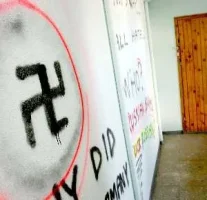
The picture concerning neo-fascism in Estonia. There is the writing under the swastika 'Why did not Germany win?' The photographer did not capture it completely.
 

Attachments

  • 20050405-14.webp
    20050405-14.webp
    15.3 KB · Views: 169
Japan_Observer said:
The difference, to me, is that the Japanese people are more reluctant to voice their opinions (unlike in the US, where people are expected to have and voice opinions regardless of how well informed those opinions are).

This to me makes some sense.
Different cultures emphasize different things.
I would not however, go as far as to say that a kingdom(dictatorship) is democratic-like because that seems to be what the people except. And at the same time it is the people of whatever land (country)'s own right to get rid of such dictators. How? Just don't sell the kings guns for one.


I don't want to waste my time on terminology discussion. As a Japanese living in Japan, I can't help feeling that ordinary Japanese citizens believe political process is out of touch.

The second line why so many people in the US are turned off by politics, or even just paying attention so the rats run from the light? Or maybe the corruption that permeates the US political system that is run by and for the corporations rather than real people.

The 1st line in bullet train's post I disagree with and think actually is important. Defining democracy.
You could have a land where the gov't does not treat the citizens harsh, lots of press and speech freedoms all with or without elections. And of course elections alone do not make a democracy. I have heard that the old Soviet Union held elections, but nobody calls that a democracy.

So if the US got rid of free speech or clamped down on the press (maybe making it so someone needed a license to conduct journalism, or call the requirement a journalism degree), and had gov't spying on political opposition and maybe got rid of "innocent until proven guilty" in a court of law with the right to see the evidence against you, in general started acting like the old Soviet Union, that sort of thing but still kept elections, that wouldn't necessarily mean the US is still a democracy. And of course, that's what the US is, without "democracy", the US is over. of, by, and for the people, or it's really just another banana republic.

I actually don't think the US has a culture of democracy any more than bullet train thinks Japan doesn't. Only about 1/2 of the eligible people vote and then that's the end of it for 4 years. Or they think the politics means only what the one political party masquarading as two is talking about. Or most people act out the title of one of war criminal Henry Kissinger's book "Does America Need a Foreign Policy?" Or read little or no history beyond high school patriotic indoctrination.

Corporate interference in the political process.
Corporations are legally constructed entities and those with interests in them have been seeking to sever the legal constraints that allow them to exist in the first place.

Then there's the whole matter of why where we spend a massive amount of our lives, our jobs, are not democratic. Why are the major decisions in our supposed democratic societies that affect so many of us left up to a few. CEOs decide how much pollution gets put into the air and what type of products should be made and if fewer people should get paid less amount of money (survival credits). Why don't we get to elect our bosses or managers?
etc....

Any such talk of democracy is dismissed as utopian or maybe even "slightly veiled marxism". Whatever. They can label it whatever they want in defense of their privilege, but the fact of the matter not even the center of empire (US) is democratic.


Back to Japan,
For years the US funneled money to the LDP helping make Japan a defacto one party state. One can only imagine how things might look different today if the US had not interferred with the internal politics of Japan (or numerous other countries).
 
Continuing on this thread, I failed to mention the obvious point that the only truly neo-fascist country -- insofar as a country can be "neo-fascist" (this strikes me as nothing more than a word used to describe someone or something as "objectionable," as Orwell described the word "fascist") --


i've been trying to figure out what the definition of the word "fascism" is for the past number of years. (even some time before Bushjr believe it or not).
after reading a number of articles and what-not I've seem to come not to an exact conclusion, but most of all it included:
the marriage of corporate and government interests, power for power's sake, jingoism or ultra-nationalism maybe even in the form of racism, and some other stuff.

The US has seemed to border the above in my life time, even beyond Bush.
 
Your mistake, however, is assuming that these features are unique to fascism. They're not, nor is the combination especially unique to fascism.

The word has been so warped over the intervening decades since the emergence of Italian fascism that it has become analytically useless. Using the word fascism essentially stops conversation, or at least steers discussion away from matters of substance and in the direction of semantic discussions of what fascism means. Because it means whatever the person using it wants it to mean, the less used the better.

Better to, I don't know, say what you mean to say and not hide behind a label. Pinning labels is intellectually lazy. (Hear that, Crazy Russian: if I was "pinning labels" on you, I wouldn't bother actually refuting your so-called arguments.)
In any case, for the time being I'm not going to get into problems with Sukotto's analysis of American democracy, but I will soon enough.
 
Last edited:
I can't tell, Crazy Russian, if you're joking by providing links to a bunch of news articles from the same site, a Russian site at that, showing how Estonia is akin to Nazi Germany.

Let's look at the problems here. First, they're all from the same source. I mentioned above in regard to surveys of freedom that one survey may suffer from bias but if a number of surveys reach the same conclusions it's substantially harder to dismiss them as biased. As such, you providing me with a bunch of links to one source does little to prove your point.

Second, Regnum is a "Russian federal news agency covering news from Russia and neighboring countries." Why are you sending me propaganda? Why are you sending me Russian sources in general, given that the Russian media is more or less propaganda due to government interference. (Don't believe me? Here's Reporters without Borders on press freedom in Russia: RSF). Next time I ask for support, send me something substantial -- a report from an international organization or NGO, an article(s) from internationally recognized newspapers -- something other than a bunch of articles released by a Russian propaganda outfit. As such, I had to do my own research into this problem.

Finally, the larger question of what this all means: does the presence of a nasty neo-Nazi streak within the Baltic republics make them neo-fascist? I still don't know what a neo-fascist country is, as you've failed to provide a definition. Is the presence of neo-Nazism -- and tolerance of neo-Nazism -- troubling? Absolutely. Does it make Estonia and Latvia neo-fascist? No. It means that Estonia and Latvia are hardly unique when it comes to questions of twentieth-century history. Nearly every country involved in the century's ideological struggles has skeletons in the closet that remain more or less hidden, and have direct bearing on contemporary international relations. (Hmm, Japan comes to mind.) As such, Estonia and Latvia have yet to come to terms with their cooperation with Nazism (to escape oppression by the USSR, hmmm). That's something to criticize, but it does not make them "neo-fascist." Neo-Nazism has appeared in Germany -- even in electoral politics -- but does that make the government in Berlin neo-fascist? No, of course not.

Back to the economic question, I mentioned unemployment and inflation as two other statistics you could have chosen at random and compared with the US to illustrate Russia's economic performance.

I appreciate the idea that the Soviet debt burden hindered Russian development, but as this -- Finance and Development -- IMF report from the beginning of Putin's government shows, it was just one problem among many. (And being a successor state is a pain, huh? Kind of a trade, Soviet debt for Security Council seat, G7 membership, etc.)
 
Crazy Russian
Your government should solve your own problem before
blaming others of neofascism
U1596P1T1D9194479F21DT20060224184649-1.webp

20060915131524acb31-1.webp


11959-1.webp
 
Those really seem more like kids. I live in Finland there are bounch of grazy people of course...but nobody takes them too seriously.
I dont know about latvia though. Do you think its serious ? I can understand though.
 
I don't think there's a country in the world -- certainly no developed country, anyway -- that doesn't have some kind of bizarre, frightening ultra-right fringe, which is why I find Crazy Russian's singling out of the Baltic countries bizarre.
 
Back
Top Bottom