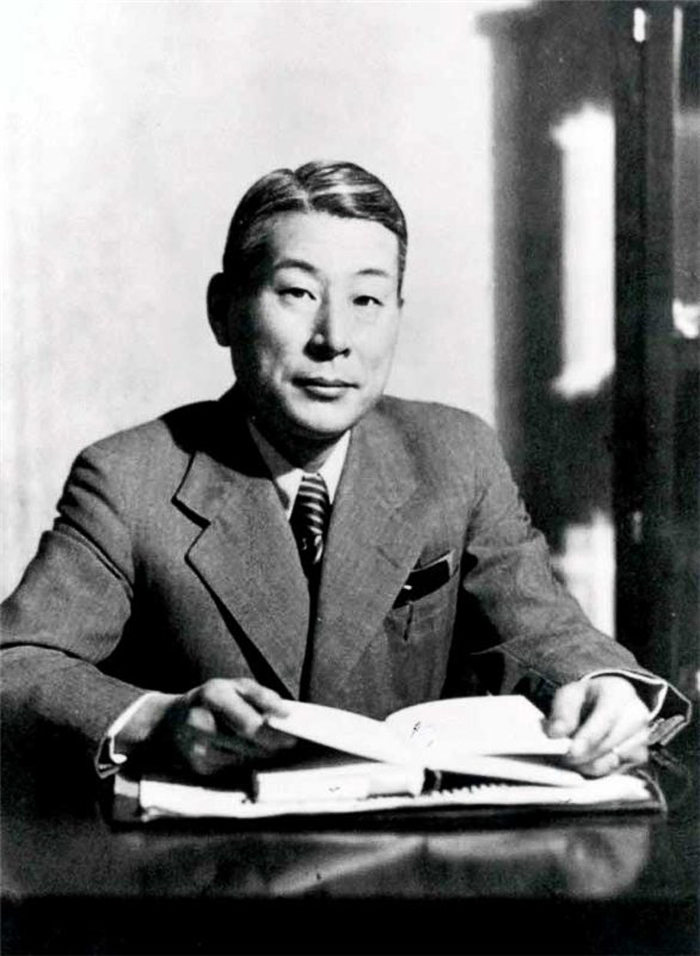
When hundreds of desperate men, women and children suddenly appeared at Chiune Sugihara's home, the Japanese diplomat faced a stark choice.
It was the summer of 1940 in Kaunas, Lithuania, and the crowd before him -- tired, dishevelled, frightened -- were mostly Polish Jews fleeing from the Nazis and almost certain death. The British, American and French consuls had already turned down their pleas for transit visas to escape via the Soviet Union. Under explicit orders to do the same, Sugihara was their last hope.
He agonised for two days before announcing to the waiting refugees: 'I'll issue visas to every one of you to the last. So please wait patiently.'
It was a defining moment. By defying his masters in Tokyo, Sugihara instigated one of the largest mass escapes of Jews in history. Yet even today, 16 years after his death, a bitter battle is raging over the reputation of the man now regarded as 'Japan's Schindler'. Last Thursday, the Tokyo District Court resumed a defamation case in which Sugihara's widow, Yukiko, is suing the Jewish historian responsible for the most in-depth study of her husband. She claims the book -- In Search Of Sugihara -- besmirches his reputation and contains hundreds of distortions and inaccuracies. Her daughter-in-law Michi says the contents were so terrible Yukiko was ill in bed for two months after reading it.
She is demanding 10 million (£52,000) in damages and wants sales of the Japanese version halted. The book is a positive account of Sugihara, whom the author, Professor Hillel Levine, places in the same class as figures such as Gandhi. 'Sugihara is so compassionate that he was able to make goodness itself contagious and bring out the best even in bad people,' says Levine.
He has also received the support of one of Sugihara's three sons, Nobiko, who has pledged to testify in court in his defence.
Sugihara's actions mirror the industrialist Oskar Schindler, who rescued more than 1,200 Jews from the death camps. But the number saved by Sugihara appears far greater.
As Japanese vice-consul, he spent August of 1940 hand-writing visas. After being forced to close the consulate by occupying Soviet authorities, he threw unsigned visas from a train window as it pulled away from the station.
Of the 2139 holders of his visas, the vast majority are believed to have made it along the Trans-Siberian railway to Japan. As they represented only household heads, up to 10,000 lives were saved.
Although Sugihara's achievement was astonishing, he died unrecognised in his own country. Yukiko, now 88, maintains her husband was forced to resign when he returned to Tokyo in 1947 because of his lifesaving actions in Lithuania. Working in a series of non-descript jobs, he lived out the rest of his days in shame.
But Levine, a professor of sociology and religion at Boston University, draws a different conclusion. For four years, he tried to find out why Sugihara took such a great personal risk, knowing he risked being killed if the Nazis found out he had given visas to Jews.
Levine pored over official archives worldwide and interviewed hundreds of people, including Yukiko and other Sugihara family members. His book paints a complex picture of a hero who was also ordinary and vulnerable. Levine relates an anecdote of how Sugihara once visited a brothel. He also reveals the existence of a first wife, a Russian woman who married and divorced Sugihara in his youth.
Rather than a career diplomat, Levine contends that Sugihara, fluent in several languages, was a spy distracted by the welfare of the desperate Jews. He believes Sugihara would have been executed immediately if his superiors had been dismayed by his actions. Instead, he was promoted before being asked to leave the service on his return to Tokyo in 1947 -- a fate that befell 90% of diplomats in an occupied country which suddenly had little requirement for overseas representation.
The family sorely disputes Levine's belief that Sugihara was a spy. Observers believe many other disputed points are more likely cultural misunderstandings than factual misrepresentations. In the book, Levine describes Sugihara's enormous capacity to 'drink but not get drunk' an ability he says was used with great aplomb to charm and befriend 'hardened Soviet commissars'.
It was this relationship, says Levine, which was essential to ensure the safe passage of the Jews through the Soviet Union to Japan. 'I am accused of slandering him as an alcoholic,' says Levine. 'I did no such thing. I represented his drinking in a very positive way.'
Yukiko's youngest son, Nobiko, says he has known the author for at least a decade and continues to regard him as an honest and hardworking historian.
In a letter to Yukiko and her supporters, Nobiko states: 'I know that the allegations made against him are false and that if law suits did not threaten him, he would be able to explain any of the questions that have come up about the facts and interpretations in his book.
'I know he would genuinely want to do this and is also pained by any hurt he may have unintentionally caused my mother in trying to tell the glorious story of Sugihara and his rescue efforts.
'I also know that my mother, who is very old, has been suffering from memory lapses. Under these circumstances, people have seriously exploited her to make statements that she would not have made had she been more lucid.'
The court case marks the latest chapter in a story that went largely unnoticed before Sugihara's death. Israel has named him 'one of the righteous among nations', an honour bestowed on individuals, including Oskar Schindler, for their help to Jews in escaping the Holocaust.
But it wasn't until 2000 that the Japanese government officially honoured him. The move only came about after sustained pressure from his family and Jewish groups and helped in their eyes to regain Sugihara's lost reputation.
It is a reputation that Yukiko and her supporters are now fighting to protect in court. Levine's work, first published in English in 1996 and translated into Japanese in 1998, has played a significant role in elevating Sugihara's achievement to the international stage.
He set out to discover how a seemingly ordinary man like Sugihara could become a great rescuer to solve the 'mystery of goodness'.
But he remains at a loss as to why he now finds himself in the dock and questions why his detractors took so long to launch the action.
'As a historian, my responsibility was to interpret Sugihara accurately,' he says. 'If this were happening in the United States, it would be laughed out of court. I'm very upset about it, but among my Japanese friends, colleagues, writers and academics worldwide, there is a clear understanding of the value of my work and its integrity.'
The case has been adjourned until January to consider written submissions.
01 December 2002