


- 14 Mar 2002
- 21,050
- 18,904
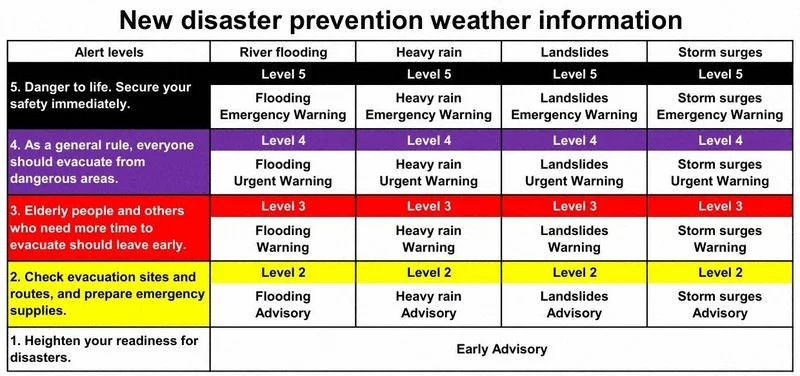
Japan began operating a new "disaster prevention weather information" system on 28 May, reorganising the country's warnings and advisories for natural hazards. Under the revised system, the government will use unified names and a common five-level risk scale for four types of disasters: river flooding, heavy rain, landslides and storm surges. Officials said the changes were intended to make emergency information easier to understand during severe weather events.
Provided by Mainichi.

 mainichi.jp
Provided by Mainichi.
Under the new system, level 5 for each type of disaster will be an "Emergency Warning," level 4 will be a newly created "Urgent Warning," level 3 will be a "Warning," and level 2 will be an "Advisory." Level 1 will be an "Early Advisory" issued when a warning-level phenomenon is forecast within the next five days. The numerical scale from 1 to 5 corresponds to the indicators local governments use when issuing evacuation information. Level 5 means there is danger to life and corresponds to "emergency safety assurance," in which people must immediately secure their safety. Level 4 corresponds to an "evacuation order," requiring everyone in dangerous areas to evacuate. Level 3 corresponds to "evacuation for the elderly and others," meaning people who need more time to evacuate should do so early. When disaster prevention weather information is issued, it will also include guidelines for necessary evacuation actions, but the system by which local governments decide whether to issue evacuation information will not change.
Japan weather alert names unified for flooding, heavy rain, landslides, storm surges - The Mainichi
TOKYO -- Operation of a new system of


