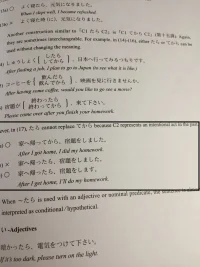
Having read your comments, I presume you are saying the example sentence 宿題をしました does not necessary refer to intention in the past, the author just took it as such in order to explain the topic. So is 弟がテレビを見ていました.. Is my understanding correct?
The key is that
the speaker's real past volitional action can't be used in the main clause of ~たら conditional. In other words,
someone else's real past volitional action, the speaker's
unreal past volitional action, the speaker's
future volitional action or the speaker's real past
non-volitional action are OK.
e.g.
someone else's real past volitional action
I already gave an example.
hypothetical contrary-to-fact event in the past
家に帰れたら/帰れていたら、宿題をしたのに。
If I could get home, I would do my homework.
(I actually couldn't get home, so I didn't do my homework.)
the speaker's
future volitional action
Your textbook already gave an example.
the speaker's real past
non-volitional action
I already gave an example.
Other combinations are also OK, needless to say.
e.g.
someone else's future non-volitional action
家に帰ったら、母は驚くでしょう。
When I get home, my mother will be surprised.
I understand ~と conditional is only for something of nature, or somethings always happen regardless, or discovery. That is something not controllable by the speaker, The two examples you gave doesn't seem to fit in with the criteria of using ~と conditional.
The brother's case is "discovery". The speaker found/realized that the brother was watching TV when he got home.
The functions of ~と conditional are not just only three you wrote. It can be used also for a one-shot event other than discovery as same as ~たら conditional. ~と sounds more formal, so it's often used in written language. ~たら sound more colloquial, as I already wrote.
島村は家に帰ると、須崎に電話をかけ、犬を見に来てくれと言った。
犬バカものがたり 近藤啓太郎著
家に帰るとすぐに、事件を目撃したという藤尾に電話をかけた。
鍵 東野圭吾著
フレデリックは家に帰ると、まっすぐに寄宿生の部屋に向かった。
小説ショパン ワルシャワ幻想曲 藤嶋美路著
家に帰ると、マイケルはビールの栓を抜いた。
スローワルツの川 ロバート・ジェームズ・ウォラー著 村松潔訳
家に帰ると、バドは袋を手で引き裂き、レザーのナップザックを取りだした。
バド・ウィギンズ氏のおかしな人生 下 ブルース・ワグナー著 柳下毅一郎訳
These are excerpts from novels found in a corpus. These are a one-shot event, and not a naturally-happened event, not a past habit or not discovery. The main clauses 言った, 電話をかけた, 部屋に向かった, 栓を抜いた, 袋を引き裂いた and ナップザックを取りだした are all the subject's volitional action, i.e., an action controllable by the subject.
~たら can be replaced with ~と when the sentence expresses a real past event, whether the main clause is the speaker's or someone else's action, or whether it's volitional or non-volitional action. In other words, ~たら can't be replaced with ~と when it's a future event or contrary-to-fact event.
I have once written that there's no problem to use two は in a single sentence in my reply. A member claimed that she had learned we could use only one は in a sentence from a textbook. That's wrong, of course.
Textbooks often don't explain all the usages of an expression/a sentence construction at one time. It's often the case that textbooks for beginner learners don't cover advanced usages. It's possible that there are other unmentioned functions of a sentence construction than the ones your textbook explains.