Need a Kanji Translated? Just ask!

It's not really Japanese kanji. Looks like someone took some kanji and added some bits onto them.
I mean, the first one kind of looks like 正 (truth, justice) with some extra strokes added to it. The second one kind of looks like 木 (tree) with an extra stroke added to it.

But adding strokes renders the kanji into something nonsensical.

Just like if you added a dot or a line to the letter "K".
It doesn't turn it into a new letter, it just turns it into a ridiculous-looking "K".
Thank You, Majestic!
That's why OCRs did not recognize it...
Cheers
Peter
 
Have you considered that it might be simplified Chinese characters, which are different than those used in Japan?

I would bet that it's actually the following, which would be incomprehensible from a Japanese context, as @Majestic has said.

巫术 wushu (wu1shu2) witchcraft, sorcery
 
Have you considered that it might be simplified Chinese characters, which are different than those used in Japan?

I would bet that it's actually the following, which would be incomprehensible from a Japanese context, as @Majestic has said.

巫术 wushu (wu1shu2) witchcraft, sorcery
That perfectly explain why a dot is on upper right of 木. I initially thought that it might be a Japanese surname 巫木 Kannagi.
 
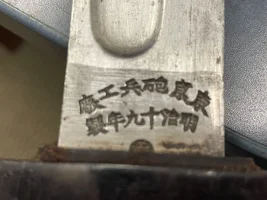
Greetings to all, I would very much appreciate if someone would be so kind to translate what is stamped into the World War I Artillery Short Sword in the picture. It was most likely carried in WW II as well.
 

Attachments

  • Arty Sword.webp
    Arty Sword.webp
    1.2 MB · Views: 226
Read Right to left on your item
東京砲兵工廠 Tōkyō artillery arsenal
明治十九年製 Made in Meiji 19 (1886)
 
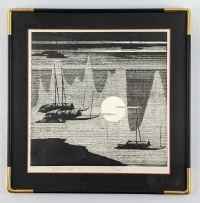
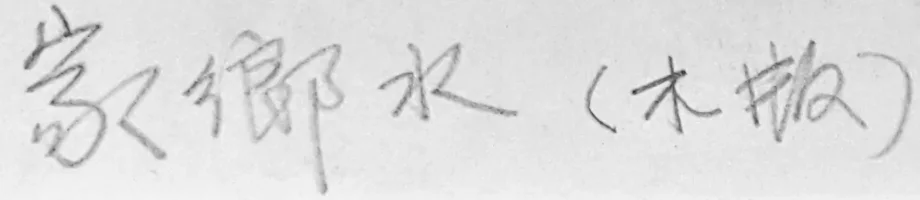
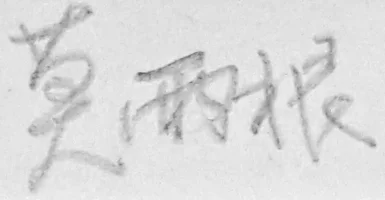
I recently received this beautiful block print, and was hoping to get some translation help. Google translated the first as "Home town water (wooden board" and the second as "Modugen". The title seems right, but is the name? Thank you!
 

Attachments

  • Boats.webp
    Boats.webp
    314.6 KB · Views: 171
  • Title.webp
    Title.webp
    36.3 KB · Views: 175
  • Artist.webp
    Artist.webp
    33.2 KB · Views: 184
Last edited:
水郷家 House on the water
木版 Woodblock print

Actually, I'm not so confident in the first, because even though it makes sense in Japanese, it should be written left to right (like 木版 is written). The writing on your print is right to left, which would normally be OK in an old print, it doesn't match the direction of the next phrase 木版 (mokuhan - woodblock print).

I can't get the artist name.
 
Last edited:
The order would be 家郷水 "hometown's water/water in hometown". The second one is a Chinese name.
Interesting, that may explain a bit about the piece. It appears to be of Chinese sampan boats and karst mountains reflecting in the water, most likely a scene of the Li River in China. A label on the back says it was framed in Tokyo, so perhaps the artist was of Chinese descent and living in Japan.
Thank you all for the help!
Marius
 
Is the label "Kato Gallery"?
They were a famous picture framer in Tokyo, who used that style of gold-cornered frames. They went out of business about 10 years ago. They did very good work.
 
Probably they wanted to say "Love yourself first" or "First, love yourself." They should have used 愛 instead of 恋 I think.

I deliberately avoided speculating on the deeper meaning of the sentence, assuming it must be meaningful if etched into human skin.
 
I dunno the context, but it literally says, "Eat the Dragon King's sword!" Sounds like something out of manga or an anime.
 
くらう(喰らう)also means to "take a punch", to "take a hit".
True. I look at the sentence above as something akin to "Eat my fist!" One says 'eat' but doesn't literally mean it that way.
 
True. I look at the sentence above as something akin to "Eat my fist!" One says 'eat' but doesn't literally mean it that way.
I think what it roughly is supposed to translate to is "Enemy devouring Dragon"
 
Back
Top Bottom