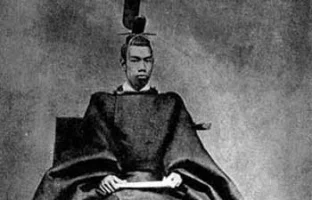
The Meiji period (明治時代), which lasted from 1868 to 1912, marked one of the most transformative eras in Japanese history, coinciding with the collapse of the Tokugawa shogunate (徳川幕府) and the radical political, institutional, and social reforms collectively known as the Meiji Restoration (明治維新). The period was named by the 16-year-old Emperor Mutsuhito (睦仁, 1852–1912) in October 1868, when he selected the term "Meiji" (明治), meaning "Enlightened Rule," by lot. The era name was applied retroactively to the start of that year, aligning it with the imperial court's proclamation of the restoration of imperial authority in January. A decree issued in October 1868 established the precedent that all future era names (年号 Nengō) would correspond to the reign of a single emperor, thereby linking Mutsuhito's 45-year reign inseparably with the process of modern nation-building and state centralisation that defined the period.
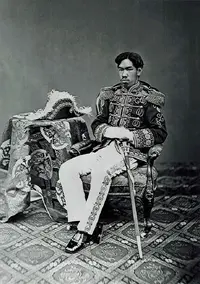
Emperor Meiji in 1873
The new government sought to reinforce the emperor's symbolic role as the source of unity and legitimacy. To this end, Emperor Meiji was dispatched on official tours across the country, imperial rescripts were issued in his name, his birthday was declared a national holiday, and his image was prominently displayed in public schools, where it became nearly sacred. Although modernising reforms were carried out in the emperor's name, Mutsuhito himself, especially in his youth, was deeply influenced by traditional teachings. He was tutored by the conservative Confucian scholar Motoda Nagazane (元田永孚, 1818-1891), who emphasised classical virtues and moral restraint. This contrast between modernisation and tradition reflected the broader tensions felt by the Japanese people as they transitioned into a modern state.
Despite these tensions, Emperor Meiji matured into an active participant in the policy-making processes, although one shaped and guided by the oligarchic leadership that had installed him as the symbolic head of state. These leaders created the ideological and legal foundations of the modern Japanese state. Key state documents, though formally issued in the emperor's name, were born out of intense debate among this ruling elite. These included the Charter Oath (五箇条の御誓文 Gokajōnogoseimon) of 1868, the Imperial Rescript to Soldiers and Sailors (軍人勅諭 Gunjinchokuyu) of 1882, the Constitution of 1889, and the Imperial Rescript on Education (教育勅語 Kyōiku chokugo) of 1890. Each of these proclamations struck a balance between conservative and progressive impulses. While initially seen as innovative, they gradually ossified into orthodox pillars of state ideology, circumscribing the further development of modern thought and governance.
As Japan rapidly industrialised and militarised, Emperor Meiji came to embody the perceived unity, strength, and success of the new nation. His reign was marked by several notable military achievements, including Japan's 1895 victory over Qing China during the First Sino-Japanese War and its 1905 victory over Russia in the Russo-Japanese War. These victories contributed to Japan's international standing and culminated in the formal annexation of Korea in 1910. Over time, the emperor came to be seen not only as the guarantor of Japan's emergence as a great power but also as a paternal figure—stoic, conservative, and nationalistic—whose personal image reinforced the legitimacy of the sweeping reforms of the Meiji era.
Emperor Meiji died on 30 July 1912, bringing the period to a close. Yet the era he named would live on in both historical memory and national myth as the crucible in which modern Japan was forged.
References:
- Beasley, W. G., The Meiji Restoration, Stanford University Press, 1972
- Brunton, Richard Henry, Building Japan 1868-1876, Japan Library 1991
- Craig, Albert M., Choshu in the Meiji Restoration, Lexington 2000
- Cunningham, Mark E., The End of the Shoguns and the Birth of Modern Japan, Minneapolis 2009
- Irokawa, Daikichi, The Culture of the Meiji Period, Princeton 1988
- Jansen, Marius B., The Emergence of Meiji Japan, Cambridge University Press 1995
- Keene, Donald, Emperor of Japan: Meiji and His World, 1852-1912, Columbia University Press, 2005
- Lone, Stuart, Army, Empire, and Politics in Meiji Japan, Palgrave Macmillan 2000
- Nussbaum, Louis-Frédéric, Japan Encyclopedia, Harvard University Press 2005
- Swale, Alistair, The Meiji Restoration: Monarchism, Mass Communication and Conservative Revolution, Palgrave Macmillan 2009
Emperor Meiji (Mutsuhito, 明治天皇) in full ornate.