

Kuroda Yoshitaka (黒田孝高, 1546–1604), also widely known as Kuroda Kanbei (黒田官兵衛) and later by his monastic name Kuroda Josui (黒田如水), was a samurai strategist and daimyō active from the late Sengoku period into the early Edo period . Born in Himeji in Harima Province (播磨国), he served as a close adviser to Toyotomi Hideyoshi , holding both military and diplomatic positions. His career spans the consolidation of Oda Nobunaga 's (織田信長, 1534–1582) power, the Toyotomi unification of Japan, and the political realignment that followed the Battle of Sekigahara (1600).
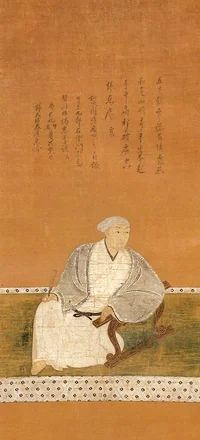
Portrait of Josui Koji (如水居士像) aka Kuroda Yoshitaka (黒田孝高 or Kuroda Kanbei / Kuroda Josui).
In his early career, Yoshitaka served the Kodera as both administrator and field commander. He demonstrated tactical skill during local conflicts in Harima, including engagements against rival warlords and shifting alliances that characterised the region. By the 1570s, he had come into contact with Hashiba Hideyoshi (羽柴秀吉), then advancing westward under Nobunaga's authority. Recognising Nobunaga's growing power, Yoshitaka urged his lord to submit to the Oda, and he himself entered Hideyoshi's service as a strategist.
From 1577 onward, Yoshitaka played a central role in the Chūgoku campaign against the Mōri (毛利氏). He is often paired with Takenaka Shigeharu (竹中重治, 1544–1579), known as Hanbei (半兵衛), as one of Hideyoshi's key advisers; later generations referred to them collectively as the "two Kanbei" (ryō-bei). Yoshitaka's responsibilities went beyond battlefield planning: he handled negotiations, coordinated alliances, and carried out intelligence work among neighbouring daimyō.
In 1578, his career took a sharp turn. Araki Murashige (荒木村重), lord of Arioka Castle (有岡城), rebelled against Nobunaga. Yoshitaka went to the castle to try to persuade him to return to loyalty, but was instead imprisoned for more than a year. During this time, Nobunaga suspected him of betrayal and ordered the execution of his son, Yoshitaka's son, Shōjumaru (松寿丸, later Kuroda Nagamasa), who was saved only through Takenaka Hanbei's intervention. When Yoshitaka was freed after the fall of Arioka in 1579, he was in poor condition, with lasting damage to his leg and, according to later accounts, the loss of sight in one eye.
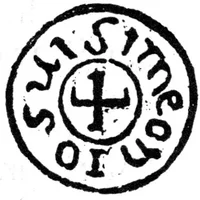
Seal of Yoshitaka under his Christian name "Simeon".
Around the mid-1580s, Yoshitaka converted to Christianity, influenced by figures such as Takayama Ukon (高山右近, 1552–1615), and took the baptismal name Simeon (シメオン). This came at a time when Christianity was spreading in Kyūshū . After Hideyoshi's 1587 edict ordering missionaries out, Yoshitaka gave up the faith and took Buddhist tonsure, adopting the name Josui ("like water"). The name is often associated with the phrase jōzen mizu no gotoshi (上善如水), which suggests flexibility and restraint, while also reflecting the naming style used by Christians at the time.
Fuji tomoe (藤巴), a crest (家紋) of the Kuroda family. Also called "Kuroda-fuji" (黒田藤), it dates to a time when the Kuroda served the Kodera clan (小寺氏) in Harima Province (播磨国). The Kodera gave the design, but the Kuroda used a simpler version of their lord's crest, following the custom of not using the same design. It reflects their service under the Kodera and the time's rank structure.
Yoshitaka's relationship with Hideyoshi has been interpreted in different ways. Some Edo-period accounts suggest that Hideyoshi was wary of his intelligence and even feared his ambition. Earlier evidence points to a more mixed picture: Yoshitaka was trusted and often relied on, but he did not hold the same level of political authority as figures such as Toyotomi Hidenaga (豊臣秀長) or Sen no Rikyū (千利休, 1522–1591).
After Hideyoshi died in 1598, Yoshitaka anticipated further conflict among the leading daimyō. When tensions led to the Sekigahara campaign in 1600, he and his son sided with Tokugawa Ieyasu (徳川家康, 1543–1616). While Nagamasa fought in the main battle in the east, Yoshitaka stayed in Kyūshū, raised a force of several thousand, and carried out his own operations. He defeated Ōtomo Yoshimune (大友義統) at the Battle of Ishigakibaru (石垣原の戦い) and took several strongholds. Some accounts suggest he aimed to seize control of Kyūshū during the upheaval, though he backed down after Tokugawa's victory.
In the aftermath, the Kuroda were rewarded with a major increase in holdings. Nagamasa was transferred to Chikuzen Province (筑前国) with an income exceeding 500,000 koku, thereby establishing the Fukuoka domain (福岡藩). Yoshitaka declined further rewards and retired from active politics, spending his final years between Kyōto and Kyūshū. He maintained cultural interests, including tea ceremony and poetry, and cultivated ties with religious institutions.
Yoshitaka died on 19 April 1604 (Keichō 9.3.20) at his residence in Fushimi. His death reflects the dual religious identity he had carried: he left instructions involving Christian rites and donations to Jesuit institutions, yet his son later conducted Buddhist memorial services. His remains were interred near Hakata, and memorial structures were later established, including Ryūkō-in (龍光院) at Daitoku-ji (大徳寺) in Kyōto.
Yoshitaka is remembered as a highly versatile strategist, combining military planning with diplomacy and administration. His later reputation as a "shadow adviser" to Hideyoshi reflects, in part, how his career brought together warfare, negotiation, and governance during one of the most unsettled periods in Japanese history.
Utagawa Yoshiiku (歌川芳幾) created this woodblock print in 1867 as part of his renowned series titled Taiheiki Eiyuden (太平記英勇傳), which translates to Biographies of Heroes from the Chronicles of Great Peace. The artwork depicts the famous Sengoku-era strategist Kuroda Kanbei. However, he is identified here by the pseudonym Murota Kanyūshigetsugi Takataka (室田 勘由次官 孝高) to comply with the period's censorship laws regarding the depiction of historical figures. The composition shows the warrior in a dynamic seated position over a bearskin rug, dressed in ornate armour and a striking red-and-white patterned surcoat, while looking back with a piercing gaze. The extensive text above the figure, provided by the writer Sansantei Arindo (山々亭 有人), details the subject's legendary tactical brilliance and his service as a key advisor during Japan's unification. This piece is a quintessential example of musha-e (武者絵), or warrior prints, showcasing the intricate detail and dramatic storytelling characteristic of ukiyo-e from the late Edo and early Meiji eras.

Kuroda Kanbei is depicted as one of Hideyoshi's generals. Warrior print (武者絵 musha-e) of unknown authorship.
Links
- Kuroda Kanbei (黒田孝高). From Japanese Wikipedia.
- The History of Kuroda Kanbei (黒田官兵衛の歴史). From Touken World.
References:
- Arnesen, Peter. "The Christian Daimyo of Kyūshū." Monumenta Nipponica 29, no. 1 (1974): 1–33.
- Berry, Mary Elizabeth. Hideyoshi. Cambridge, MA: Harvard University Press, 1982.
- Berry, Mary Elizabeth (trans.). The Chronicle of Lord Nobunaga (Shinchō kōki). Leiden: Brill, 2011.
- Boxer, C. R. The Christian Century in Japan 1549–1650. Berkeley: University of California Press, 1951.
- Bryant, Anthony J. Sekigahara 1600. Oxford: Osprey, 1995.
- Elisonas, Jurgis. "Christianity and the Daimyo." In The Cambridge History of Japan, Vol. 4: Early Modern Japan, edited by John Whitney Hall. Cambridge: Cambridge University Press, 1991.
- Frois, Luís (trans. Richard A. Cooper). History of Japan (Historia de Iapam). 3 vols. London: Hakluyt Society, 2014.
- Sansom, George. A History of Japan, 1334–1615. Stanford: Stanford University Press, 1961.
- Totman, Conrad. Early Modern Japan. Berkeley: University of California Press, 1993.
- Turnbull, Stephen. The Battle of Sekigahara 1600: The Final Struggle for Power. Oxford: Osprey, 2005.

