

Ashikaga Yoshiaki (足利義昭, 1537-1597), the fifteenth and last shōgun of the Ashikaga bakufu , was born on 5 December 1537 as the third son of Ashikaga Yoshiharu (足利義晴, 1511-1550), the twelfth shōgun, and younger brother to Ashikaga Yoshiteru (足利義輝, 1536-1565), the thirteenth. His childhood was marked by the turbulence of a declining Muromachi shogunate . This government had once ruled Japan since 1336, but by his birth had lost most of its authority beyond the capital.
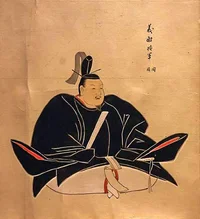
Ashikaga Yoshiaki (足利義昭, 1537-1597)
That bloody episode was infamous. Yoshiteru, besieged in Nijō Palace, fought desperately before committing seppuku . His page Odachidono killed himself in a dramatic display of loyalty that a Jesuit missionary, Luís Fróis, later recorded with admiration. In the aftermath, Yoshiaki's other brother, Shukō, a monk at Kokuon-ji in Kyōto , was executed on Matsunaga's orders. Yoshiaki narrowly escaped a similar fate, slipping away with the help of Hosokawa Fujitaka (細川藤孝, 1534-1610) to Ōmi Province, where he was sheltered by Sasaki Yoshitaka (佐々木義隆, 1527-1596).
Abandoning the priesthood, he took the name Yoshiaki in 1565 and began seeking support to claim the shogunate. He found only fleeting refuge: first with Asakura Yoshikage (朝倉義景, 1533-1573) in Echizen, then in 1567 at An'yō-ji in Ichijōdani. The Asakura, however, proved unwilling to march on Kyōto for him. It was then that Yoshiaki turned to Oda Nobunaga (織田信長, 1534-1582), an ambitious daimyō of Owari who was looking for an excuse to seize the capital.

Yoshiaki's standard, a white hata-jirushi (旗印) emblazoned with gold lettering and a red sun, his banner bearing the invocation "Hachiman Dai Bosatsu" (八幡大菩薩); replica.
Tensions emerged quickly. In January 1569, Nobunaga presented Yoshiaki with the Denchu on'okite, nine articles limiting the shōgun's independent authority, followed by another seven in 1570. While initially deferential — once even calling Nobunaga "my father Oda Danjō no Chū"* in a letter — Yoshiaki began intriguing against his patron, corresponding with other great lords such as Takeda Shingen (武田信玄, 1521-1573) and the militant monks of the Hongan-ji to form the so-called Nobunaga Encirclement (Shin'naga hōi-mō, 信長包囲網).
By 1573, open conflict had broken out. Nobunaga responded with characteristic ruthlessness, even setting fire to much of Kyōto. Yoshiaki fortified himself at Makishima Castle, rallying the Azai, Asakura, Matsunaga, and Miyoshi clans, but the death of Takeda Shingen crippled the coalition. On 15 August 1573, Nobunaga stormed Makishima, forcing Yoshiaki into exile. Historians traditionally date this as the end of the Muromachi shogunate, though Yoshiaki himself never relinquished the title.
His wanderings thereafter took him to Sakai, to the protection of Miyoshi Yoshitsugu (三好義継, 1549-1573), and then to Wakae in Kawachi Province, where he briefly took monastic vows under the name Shōzan. Nobunaga continued to pressure him, destroying Yoshitsugu's holdings and driving Yoshiaki further into obscurity. In 1576, he re-emerged under the patronage of Mōri Terumoto (毛利 輝元, 1553-1625), establishing a "government-in-exile" at Tomo-no-Ura in Bingo Province, from where he issued orders as if still shōgun.
Even after Nobunaga died in the Honnō-ji Incident of 1582, Yoshiaki could not regain his old position. Aligning at times with Shibata Katsuie (柴田勝家, 1522-1583) and at others with the Mōri, he found his ambitions blocked by Toyotomi Hideyoshi (豊臣秀吉, 1537-1598), whose rise to power made any Ashikaga restoration unrealistic. By 1588, Yoshiaki formally resigned the office of Seii Taishōgun (征夷大将軍) and accepted from Hideyoshi a fief of 10,000 koku and the honorary court rank of Jusangū (准三宮), which entitled him to ceremonial treatment on par with imperial princes.
In his later years, he lived quietly in Kyōto, more a relic of a vanished age than a player in politics. The man who had once been the nominal head of a 240-year-old military government died on 19 October 1597, aged sixty-one, a survivor of an era when shōgun could be both monarchs and pawns. His standard had been a white hata-jirushi (旗印) emblazoned with gold lettering and a red sun, his banner bearing the invocation "Hachiman Dai Bosatsu" (八幡大菩薩). In the end, his long struggle was less a quest for power than a stubborn refusal to let the Ashikaga legacy vanish quietly into history.
* "Danjō no Chū" (弾正忠) was a title, specifically a court title, held by some high-ranking officials in Japan during the Sengoku period and beyond. It was a hereditary title within certain families. The most famous holder of this title was Oda Nobunaga.
Wooden statue of Ashikaga Yoshiaki at Reikoden Hall of Tōji-in
Utagawa Toyonobu (歌川豊宣, 1859-1886), Ashikaga Yoshiaki escapes with the help of Wada Koremasa, ukiyo-e , 1884.
References:
- Hall, John Whitney, Toyoda Takeshi. Japan in the Muromachi Age. Cornell East Asia Series 2001.
- Keene, Donald. Yoshimasa and the Silver Pavilion: The Creation of the Soul of Japan. Columbia University Press, 2003.
- Mason Richard H.P., Caiger John Godwin, A History of Japan, Revised Edition, Tuttle Publishing 1997
- Nussbaum, Louis-Frédéric. Japan Encyclopedia. Harvard University Press, 2005.
- Papinot, Edmonde; Historical and Geographical Dictionary of Japan, Tuttle 1972
- Sansom, George. A History of Japan 1334-1615. Stanford University Press, 1961.
- Totman, Conrad; A History of Japan, Wiley-Blackwell; second edition 2005.
- Turnbull, Stephen, Samurai Sourcebook, London 1998.
- Turnbull, Stephen, War in Japan: 1467-1615, Oxford 2002.

