Nature The Japanese brown and black bear thread

thomas

Unswerving cyclist
Admin
Joined
14 Mar 2002
Messages
21,051
Reaction score
18,903
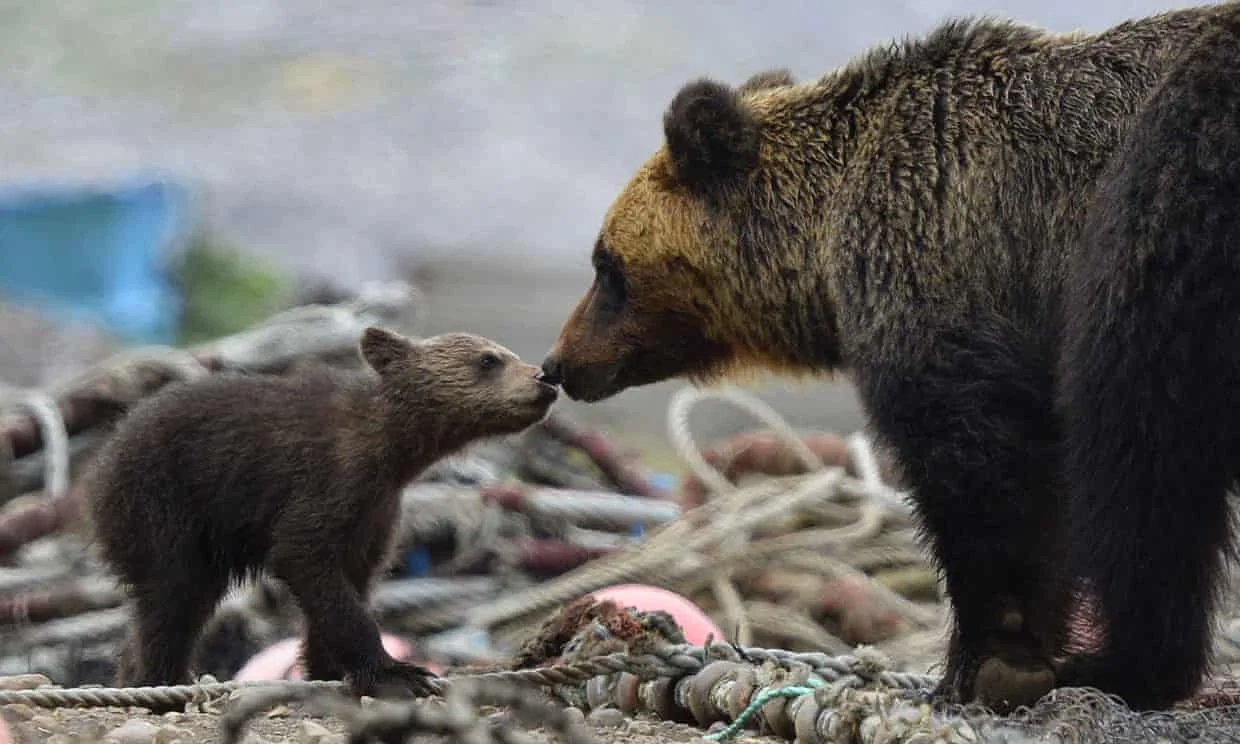
Another heartbreaking repercussion of climate change: it is estimated that 8 out of 10 brown bear cubs in Japan die of starvation amid a shortage of salmon and acorn. :(

Bear starvation

Photo credit: Newscom/Alamy

As many as eight in 10 brown bear cubs born this year in a remote part of northern Japan have died amid a shortage of salmon, with experts blaming rising sea temperatures caused by the climate crisis. Along with acorns, pink salmon are an important source of food for the estimated 500 brown bears living along Hokkaido's Shiretoko peninsula, a Unesco world heritage site known for its dramatic coastline and wild animals. Local officials reacted with alarm after a tour boat operator spotted a starving bear cub desperately searching for food on the peninsula's eastern coast this month. The bear was reportedly turning over rocks and rummaging through piles of beached seaweed in search of food.

 
I have changed the thread title to cover all topics related to Japanese bears and their interaction with humans.

The article below deals with bears no longer scared to enter urban areas.

1b6f336d3f7853cd4f14d0523b188a67.jpg


In the 2000s, such sightings became common, even in central districts of urban areas. In the past, only certain individual bears made repeated appearances. Now, multiple groups are making their presence known across a range of districts in Sapporo, often simultaneously. This may be due to the fact that they grow up close to adjacent suburbs. Hokkaido is home to a shrinking population of farmers and hunters due to declining resident numbers and the advancing aging of society. That may explain the growing boldness of the animals as they expand their habitat into zones near residential districts. Sapporo has entered a phase of population decline like other rural parts of Hokkaido and is no longer immune to the bear problem. "Brown bears are adapting to human society," Sato warned.


This summer, JAL started issuing bear warnings to passengers travelling to Sapporo.

Last week, the Environment Ministry urged people planning to go to the mountains this fall tourist season to take safety precautions against bears.


This summer, a tourist association in western Fukushima urged us not to use the local hiking paths, particularly when walking dogs. The week before, bears attacked hikers on our planned trail.
 
I've only seen one bear, pretty long ago. Cycling, out in the mountains, on a long uphill, I looked up and saw a bear cross the road, maybe 30-40m in front of me. Easy to see that it was tsukiwa-kuma. Shoulder height like a big Lab, black with the neck mark,but of course bigger/rounder, and I could see claws--white claws. I didn't know what to do--turn around and go down, or wait and try to continue, which would be slow going on up (lowest gear), and no way I could sprint away on an uphill.

After a couple minutes of indecision a van came up, I motioned, they stopped, and I explained. So I continued up along side the van for the next couple hundred meters, and then waved them on.

Needless to say, for the rest of the ride any time I heard a noise like birds fluttering in the brush on either side, it was an automatic shot of adrenaline and I hit the pedals hard.
 
Not a day goes by without reports of bear attacks--this year has seen a record high.

NHK had a piece on how to stay safe when attacked:

Rakuno Gakuen University Professor Sato Yoshikazu, an expert on bear ecology, advises people to be aware of areas that are inhabited by bears and places nearby. He says in such locations, people should avoid entering forests or mountains alone. When they do go into such places, they should make noises while walking with items like whistles and even carry bear spray.

Watch the videos of bear attack scenarios and how to respond:


Here's an overview of this year's incidents by the Guardian:


Last Monday, a man in Hokkaido fended off a bear with a knife:

Two men in their 40s suffered minor injuries including scratches on their sides and necks, as well as bites on the legs inflicted by the 1.7-meter-tall bear, but all three descended the mountain under their own power. According to the Hokkaido Prefectural Government's brown bear countermeasures office, the three men all reside in Hokkaido. The last person walking in a single file line was attacked by the animal at around 9:30 a.m. -- some 2 1/2 hours after the three left the trailhead. Another person drove off the bear but two sustained injuries.

 
"I am determined to have a gun", and an application rush "is the greatest in history", and bear damage ... veteran hunter adheres to a hunting license examination (November 17, 2023).


  • ■As for the damage number of people, 180 people are updating the most in history in the whole country
    The damage due to the bear occurs successively in the whole country.
    50 generations and a man in his 70s were attacked during work to cut the tree of persimmon in Toyama-shi on 16th by a bear. It is a serious wound such as injuring a face. I have not known the whereabouts of the bear yet.
    According to Ministry of the Environment, the damage number of people from April to October is 180 in the whole country. Since statistics start, I continue updating the most in history.
■The university student who challenges readiness ... hunting license examination to a bear encounter
The applicants to a hunting license examination are flooding in now in Hokkaido where the haunting of the bear occurs successively. An examination of this year included more than 1200 application and increased to 1.6 times before the corona evil.
Because it became the capacity over in some venues, I carried out a lottery, but, for 137 people who leaked in the lottery in a hurry, I set a new examination day in the next year and decided that I could receive an examination.
University student (23) which just took a hunting license examination of Kanagawa tells, "I was interested to catch an animal by oneself, and to want to eat" last week.
About a bear and the thing meeting with, the university student tells, "it seems to be said that therefore I want to enter the mountain with a gun as the beast harm extermination and is thinking in a workplace being a company of Gunma" and is prepared for it.
 
Maybe someone can clarify?

My (mis?)understanding is that most guns used by hunters here are shotguns, and that rifles are rare, and probably even more tightly controlled.

But for bear hunting--if I were out bear hunting--I'd want a rifle. (tho in the above video, it certainly looks like the hunters have rifles, so good on them)
 
Here's a guide on how to acquire hunting rifles in Japan:


I think what is practically impossible to acquire in Japan is handguns.


According to Asahi, 2023 was the worst year in Japan for bear attacks, with six people dead. And how many bears?

The year now coming to a close was the worst since 2006 for bear attacks in Japan. The Environment Ministry, citing preliminary figures, said Dec. 1 there were 193 attacks between April and November that left 212 casualties, including six people dead. Based on records kept since fiscal 2006, this was the worst year for bear attacks, the ministry added. Bears usually go into hibernation from late November to December. But there have been cases of bears causing damage from December to March.

 
I see stories about shooting bears with a handgun here in the US, but I would not want to try it. A wounded bear often manages to kill the hunter still. I would want the most powerful rifle I could handle and shoot accurately to hunt a bear.

200.gif
 
The Japanese government is considering paying for the capture of bears in some prefectures. The number of bear attacks and deaths in Japan was the highest recorded in April to November. A ministry official said bear distributions have been growing in 34 prefectures, apart from Shikoku , with many seeing an increase in estimated populations. According to the meeting, bear attacks in the northeastern Tohoku region have notably increased, but those in other regions have not seen dramatic upticks. Some prefectures want the government to help them capture bears, while others want to save them. The government already pays to catch deer and boars.


Sadly, thousands of bears are being shot in Japan each year as they become more and more of a problem.

On average over the past five years, 4,895 have been killed each year, according to figures from the Environment Ministry. As of November 30, 6,287 have died in this fiscal year (to March), around 2,000 of them in November alone. Usually, they are shot.

😳 😥

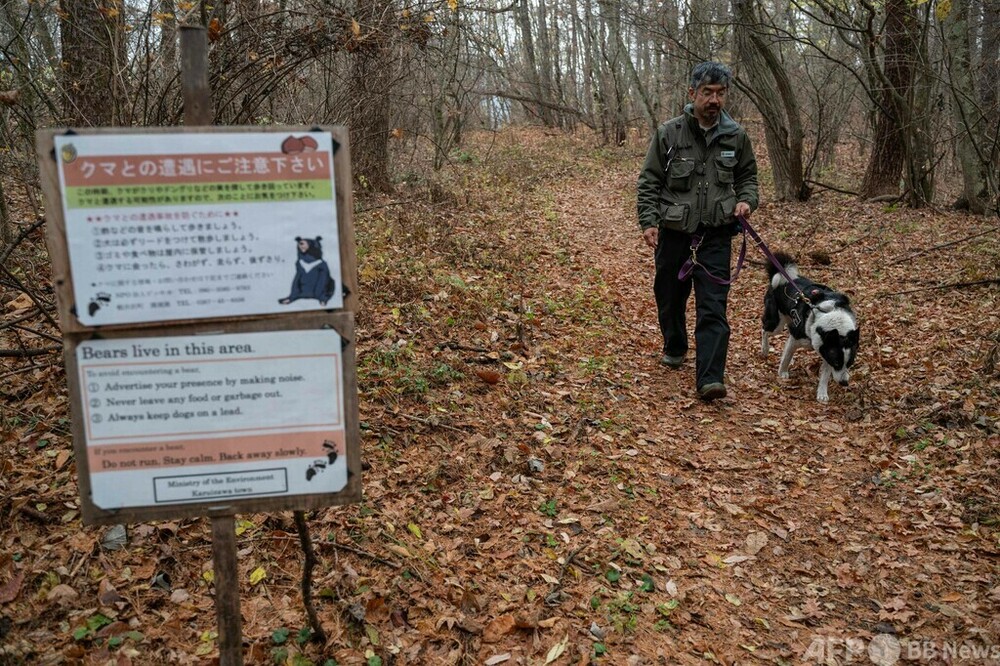
However, Junpei Tanaka and his dog Rela, straining at her leash in the woods, have a kinder, more thoughtful way.

Tanaka says his project in Karuizawa, a town surrounded by woods in the shadow of a volcano 90 minutes from Tokyo by bullet train, is a "forerunner" of what can be done without resorting to killing the bears. In the dead of night -- when the bears are most active -- Tanaka demonstrates the methods used by his organisation, which he says keeps both humans and bears safe. He and his team set barrel traps, with honey inside, to capture any bears that start to lose their fear of humans. They are fitted with a radio collar and released, far away. The town has also installed bear-proof rubbish collection points -- the slot for the door handle is too small for a paw -- and appealed to locals to be more aware. But the key component in the non-lethal efforts is Tanaka's amber-eyed, keen-nosed canine Rela and the rest of the team of specially trained Karelian Bear Dogs, a sturdy and fearless breed originally from Finland.

 
I'm afraid this new "policy" spells more trouble for bears:

The Japanese government on Tuesday added bears to the list of animals that can be culled with the help of government subsidies, after a record number of attacks was reported in the country. The Environment Ministry's panel of experts urged local governments in February to create clear land zoning to divide the animals' habitat from areas where people reside to help maintain the size of the bear population at a healthy level.


Yuko Murotani, chief of the Japan Bear and Forest Society, said the government should focus on measures to separate the habitat of bears from that of humans, instead of culling the animals. The environment group based in Hyogo Prefecture collected 14,749 signatures from people opposed to the policy and submitted them to the ministry in February.
 
The bear's second hit seems to have cracked the windshield.

Does that sound like a kei engine to you/anyone?
 
I think there's some saying like, if black, fight back, if brown, lay down...

 
Funny , bear attacks in Maine are almost unheard of , they are so rare. Yet , it seems every child has a fear of bears when in the woods. I started going to camp at age 5 and was constantly looking out for a bear to eat me. Also strange we all had a "teddy bear" back then and yet were terrified of the real thing. I spent over 60 years roaming the Maine woods and only spotted 2 bear cubs who ran away in fear. Even when I know there was no danger , I always carried a handgun , even when I went to the outhouse , LOL.
 
While official Japan has placed its bets on a full-blown culling program, subsidising hunters and paying bounties, Tanaka Junpei's Karelian Bear Dog project (he's already been mentioned in this thread) draws nationwide attention as a more humane alternative to keep bears away from human settlements.

Tanaka Junpei

Photo credit: SBS / Dateline


In Karuizawa, located 150 kilometres west of Tokyo, the Picchio Wildlife Research Center has implemented a pioneering bear dog initiative, initially established by the Wind Bear Institute in the U.S. This program is designed to promote peaceful cohabitation between bears and humans by delineating their respective habitats. The strategy involves monitoring bear activity and deploying dogs to deter bears from encroaching on human areas through barking.

Junpei Tanaka, a dog handler at the centre, explains that the proximity of human and bear habitats necessitates a clear demarcation of territories to ensure coexistence. Tanaka partners with Tama, a Karelian Bear Dog from Finland, renowned for its prowess in tracking and hunting brown bears. The dogs play a crucial role in conditioning bears to perceive humans as a threat, encouraging them to maintain a distance from human settlements.

Since the program's launch in 2004, it has reported an extraordinary reduction in the damages and incidents involving bears. There have been no bear attacks in town for over a decade, according to Amelia Hiorns, a researcher from Picchio. "Our management system involves a variety of mitigation techniques. So, the bear dogs, electric fences, bear-proof bins, and a community engagement program so that people can understand how to kind of interact and coexist with nature as well," Hiorns said. "We have to accept the bears as much as we can. And obviously [bears] have to accept humans to an extent as well.


Minor article in this morning's paper. The 俵町 studio is where my wife's music group practices (a repurposed school), so I'm sure she'll be alert when out there. On the other hand, 別所町 is kind of just over the hill from us, and I used to commute thru there, both car and bike. It's also known for its takenoko, tho that season is over. Too bad nothing on dash cam.

IMG_4376.JPG
 
The article does not seem to mention what happened to the bears.
 
Back
Top Bottom