It would used as 普段通りでいる/過ごす; "to do/live/work as usual".
I see, that makes sense. Thank you.

Follow along with the video below to see how to install our site as a web app on your home screen.
Note: This feature may not be available in some browsers.

It would used as 普段通りでいる/過ごす; "to do/live/work as usual".

Yeah, bodily function is like "身体機能, 体の機能 .... " I don't know of any case it is interchangeable with operation.I see, that makes sense. Thank you.
This may or may not be historically important or straightforward- but anyone have an idea what the '80 is for ?Could anyone please translate some or all of
ザ・忠臣蔵'80


完璧に: perfectly本番までゆっくり休んでかぜを完璧に治すこと そしてみんなで本番を迎えること (rest up until the performance and make yourself feel better, and then we will all perform together)
What is the function of ni here? "To cure ______ perfect cold?"
こと is a nominalizer, and is used to make the sentence aWhat is the function of koto?
 advise/suggestion form here.
"The -te form of verbs/i-adjectives + も" is a conditional clause.梓: いやです。やっぱりいやです。このまま唯先輩抜きで演奏しても意味ないです。(there is no point in performing without Yui sempai)
What is mo doing here? As far as I know mo generally means also. Is it something like "there is also no meaning without performing with Yui???"
夢中 is actually a na-adjective.和: 夢中なことがあると、唯はそれだけしか見えないってこと。(what I'm saying is that once yui has her heart on something she
goes all out)
Lost. Here is how it is translating in my head.
muchuu-trance (right word)?
na- ???? (can't understand how na is connecting with the expression koto ga aru. I know of na adjectives, but...)
Koto ga aru- something has occured
唯: Yuitada- mere???
だけ emphasizes しか. Don't you use, for instance, "just" and "only" at the same time in English, even when it's enough to use just/only one of them?;-)soredake- only that/that alone???
shika- only??? (why are they using only again?)
見えない: can't seemienai- to not see???
more likely ということだ.tte koto- is this the contraction of to iu koto ka
You misquoted the sentence. There is no "no koto mo" in your quotation.;-)あの浴衣の防寒バージョンを作っていたのです (after considering the cold, I upgraded the yukata with cold protection)
no koto mo- can someone break this part down


Hello,
* チームに加わりたくば、厳しい訓練をクリアせよ!
Is the ば= if ? If you joined the team, you will succeed in the difficult training ?
* 時間をおいてからミッションを実行するのだ。
おいてから= ??
おいて+から or 時間をおう maybe ?
=> carry out the mission after... time ?
* 変わり身の木 : is it a tree that change of form? A sort of disguise?
* 2本の山賊刀: I think it may be two special katana but I don't understand the 山賊.
I'm quite lost...

That's 気分が乗ってくると; when I feel uplifted.There are a couple of things in this excerpt from my friend's e-mail that I don't quite understand:
小説は、乗ってくると、書けるんだよ
In my understanding, notte (to ride) and kuruto (to come?) is like saying "come aboard". But what does this mean in the context that he is talking about his novel?
~てもらう is a humble expression.昔書いたやつは、実家のパソコンにあるから、一ヶ月ほど待ってもらえれば、出せるよ.
Here, I don't understand what moraereba means. I tried searching the net but nothing comes up.
Yes, except the reading daseru.;-)Also, is my understanding of yaseru correct? Does it mean he will try to "take out"/"retrieve" the novel for me?
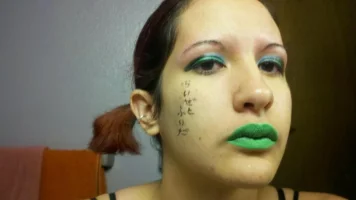
The hiragana on the face doesn't make sense as a word/phrase/sentence at all.I am sorry if this seems really basic. I have been learning romaji, but my grasp on on the symbolic scripts are basically just enough to tell Hiragan, Katakana, and Kanji apart from each other and being able to pick out certain symbols.
Anyways, I was shown a picture and asked what something in the picture meant, and I was able to tell right away it was written in Hiragana but I am having trouble translating it as like I said, my grasp on Hiragana is almost non-existant at the moment though I am working on it.
What I think I have so far is:
ra
i
ze
hu - ?
ri
ta
I would like to know if I got the character correct to begin with and how to go from there to the actual translation if possible.
伝承の地 would be the the plural here.* 伝承の地を辿る
I have problems with 辿る : I found to follow, to pursue but it doesn't mean anything with "legendary place" (or I made mistakes with "legendary place")...
I assume that that sentence is an explanation regarding an animal, monster, or like that. The subjects of 警戒心が強く and 恐ろしく俊敏 is the animal/monster.* 警戒心が強く、しかも恐ろしく俊敏なため見つかれば最後だ!
For this one, I'm totally lost.
Is it, something like :
Wariness is strong, moreover if awfully keen things are found, it will be the end !
 I just joined, and I've taken Japanese 101 and 102 at my college. However, I am getting in over my head with some stuff.
I think you should listen to your teacher and stick to keeping a regular journal.Hey everyone.
(For the curious, my 先生 said to practice my 日本語 by keeping a journal. I dislike keeping journals, so I'm making a book of lyrics for Japanese rock songs I'm learning to sing, instead. But, 先生 suggested a 2-3 sentence intro (for added practice), and that's where I'm stuck!)
What I want to say:
This book contains the lyrics to songs I want to learn. Certain lyrics here mean a lot to me, while others are just from songs that are fun to sing. In any case, enjoy!
((or something to that effect))
What I wrote (so far):
この本は、私が習いたい曲の歌詞が含まれています。
^^ Only one sentence in and I'm already having issues! I don't know a few of those words, so without help, I can't verify the correct usage of them. This should also be informal, and I know it's not, I just keep having issues with making it so (for some reason - I bet it's just me being stupid/forgetting my Japanese).
Well, I used online dictionaries and got it to a point where Google Translate has that sentence meaning something (vaguely!) CLOSE to what I wanted, but I'm sure we all know how reliable that is.
So maybe you guys can help? I'd appreciate it.