Kalan:
I like her.彼女が好きです。
'Cause I like/love her.彼女が好きだからです。
Clarity:
友達は午後3時に
->友達には午後3時に or
->午後3時に友達に
昼ご飯ゐたてから
->昼ご飯を食べてから
詰らない日
->つまらない日 We usually use hiragana.
いま、何もしないこと。
->いま、何もしていません。
Thanks for the help

Follow along with the video below to see how to install our site as a web app on your home screen.
Note: This feature may not be available in some browsers.

Kalan:
I like her.彼女が好きです。
'Cause I like/love her.彼女が好きだからです。
Clarity:
友達は午後3時に
->友達には午後3時に or
->午後3時に友達に
昼ご飯ゐたてから
->昼ご飯を食べてから
詰らない日
->つまらない日 We usually use hiragana.
いま、何もしないこと。
->いま、何もしていません。


It's a shortened いて.
So ちょっと待ってて is a short form of ちょっと待っていて.
It's not too different than just saying ちょっと待って, but the nuance would be more of a continuous action. "Wait there (and stay)" sort of.


Could you please help me? I can't figure out how to write New York in kanji.
Thank you

It's written as 紐約 in Chinese. If you're going for overall recognition and you have to use Chinese characters, you should probably go with this, as it's at least still used in Chinese.You can use 紐育, but it is EXTREMELY outdated and almost nobody will know what it means. Don't use it for a tattoo.
As the poster above mentioned, it's commonly written as ニューヨーク in katakana.

I think so too. But does anyone really use ぜ anymore ? Maybe it is when men get together in casual conversation, or to sound patronizing to a subordinate, but I don't come across it nearly as much as ぞ...> Any idea on ぜ and ぞ?
When used at the end of an utterance to sound "cool" or "masculine", I'm pretty sure they're interchangeable.

ニューヨーク is how you write New York in katakana. There is no kanji for it.
orochi;549785 said:You can use 紐育, but it is EXTREMELY outdated and almost nobody will know what it means. Don't use it for a tattoo.
As the poster above mentioned, it's commonly written as ニューヨーク in katakana.
It's written as 紐約 in Chinese. If you're going for overall recognition and you have to use Chinese characters, you should probably go with this, as it's at least still used in Chinese.

kameron:
I translated it and have just posted as comment on your blog.
Really ? Why? If anything, I think 好きだから is probably more natural. Or maybe I should say more assertive/affirmative sounding because 好きなんです could be interpreted as an indirectly defensive plea ("Because I like her -- that's why").As a response to an inquiry like this, I would think it more natural to say something like 好きなんです。Where the なん presents the preceding clause as some kind of explanation
Anyone have any updates on the current uses of せ?I think so too. But does anyone really use ぜ anymore ? Maybe it is when men get together in casual conversation, or to sound patronizing to a subordinate, but I don't come across it nearly as much as ぞ...
or 好きだからなんです, which is not to say it is anything like すきなんだから。。。好きなんで is more similar than 好きなんです to 好きだから.
「何で一緒にいるの?」「好きなんで……」

checho:
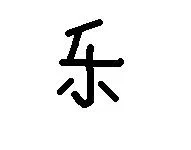
It is Chinese character only used in China means 'joyful'.
We Japanese use ナ?y instead of it.
Ordinary Japanese never know of the character.
http://www.jx.xinhuanet.com/yiwen/2004-02/19/xin_1a998943bb764bac9f481e9dea24ce4e_bkmu309154.jpg