Tech Japan's first fuel-cell train presented to public

News stories related to technology and innovation.

thomas

Unswerving cyclist
Admin
Joined
14 Mar 2002
Messages
21,053
Reaction score
18,908
Last week, JR East presented Japan's first train powered by fuel cells. It will enter service in 2030 and will be tested on JR Tsurumi and Nambu lines from late March.
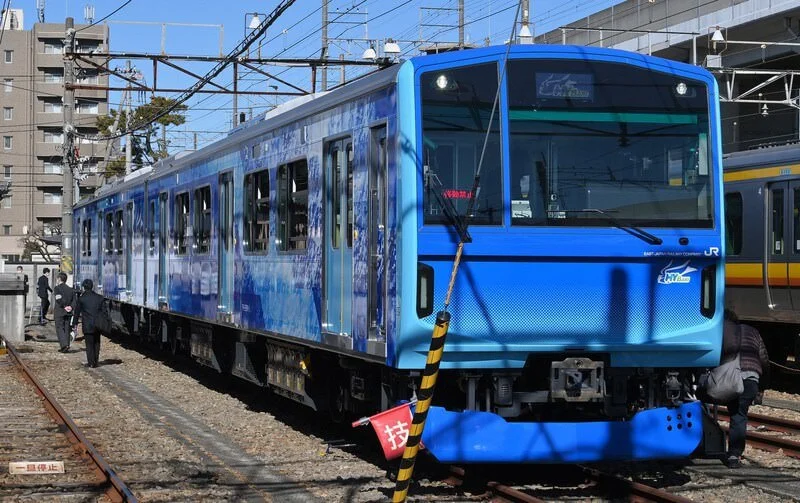
hybari-train.webp

The "Hybari" train was developed by JR East, Hitachi Ltd. and Toyota Motor Corp. Hydrogen in the tank above the train car roof is sent to fuel cells under the floor, and generates electricity through a chemical reaction with oxygen in the air. JR East intends to use the technology in the next generation of train cars as part of its goal to emit effectively zero CO2 in fiscal 2050. The blue test car exterior features a water splash design, which references the water formed in the chemical reaction. To confirm the system's performance and energy efficiency, tests will be conducted at night, about once a week, without passengers. Shoichi Oizumi, director of the JR East research and development center, said, "It uses clean energy, and will have a role in the coming age."


I'm curious what the point of this is though? Is it for lines that don't have overhead electric? Also, that service date is so far out that I feel like something far better will be available by then and not have the issues of having to refuel and do so with a very explosive gas. Also the waste water has to be considered, it will not be a great fit for colder climents.

Don't get me wrong I am not anti-fuel cell per say, I just see better options being presented.
 
I'm curious what the point of this is though? Is it for lines that don't have overhead electric? Also, that service date is so far out that I feel like something far better will be available by then and not have the issues of having to refuel and do so with a very explosive gas. Also the waste water has to be considered, it will not be a great fit for colder climents.

Don't get me wrong I am not anti-fuel cell per say, I just see better options being presented.
At least for cars, hydrogen is safer than tanks of gasoline.

I imagine this would first be targeted at the routes that still use diesel.
 
At least for cars, hydrogen is safer than tanks of gasoline.

I imagine this would first be targeted at the routes that still use diesel.
Yet diesel is not explosive. So it is introducing some danger. If there is a leak it will just go straight up, as it is lighter than air, which is probably a good thing.
 
If you are going by fires (which won't happen that often) sure it may possibly go up like this video
We have had a hydrogen stations and plants that seem to blow up for now. I knew a guy who used this station (while testing) a few days before it went: Norway: Explosion at hydrogen filling station - electrive.com

explosions can be felt some distance away


I am sure that is solvable as this is early days.

Then there is how is the hydrogen produced vs say biodiesel which comes into play on which is more green for those diesel routes.
 
Back
Top Bottom