Dropping certain vowels in Japanese

thesuker

先輩
Joined
20 May 2014
Messages
242
Reaction score
3
Hi, yesterday while checking out my textbook vocab and listening to it on the CD, I noticed that besides the obvious non-pronunciation of u in です, it can also happen with other syllables in other positions of the word. For example, I noticed in がくせい we don't pronounce the 'u' in 'ku'. Going back to other words, I also noticed it happens with はじめまして, where you don't pronounce the 'i' in 'shi'. Doing some research on the internets (my book just says it can happen, but doesn't give a detailed explanation of it) I read that 'In standard Japanese the vowels i and u are not usually voiced when they occur between voiceless consonants (k, s, sh, t, ch, h, f, b, p)', which is easy to understand. It also says we don't pronounce the 'u' in です/ます, but doesn't comment on words ending in く, for example だいがく, where it isn't pronounced (at least the guy on my listening exercise doesn't). All in all, I'm pretty confused as to when I have to drop the vowels.

Is there a general rule for the dropping the vowels in Japanese? Should I just learn them as I go, by listening to my CDs?
 
I dont think there is a certain rule, its like in english we just drop off a bunch of noises, and some people in particular drop off other noises but we still recognize the word because weve heard it in a million different contexts and we know what they are saying, I think the only way to learn this is to keep listening to your CD's in your workbook and you will learn as you go along, thats what happened for me atleast.
 
Hi, yesterday while checking out my textbook vocab and listening to it on the CD, I noticed that besides the obvious non-pronunciation of u in です, it can also happen with other syllables in other positions of the word. For example, I noticed in がくせい we don't pronounce the 'u' in 'ku'. Going back to other words, I also noticed it happens with はじめまして, where you don't pronounce the 'i' in 'shi'. Doing some research on the internets (my book just says it can happen, but doesn't give a detailed explanation of it) I read that 'In standard Japanese the vowels i and u are not usually voiced when they occur between voiceless consonants (k, s, sh, t, ch, h, f, b, p)', which is easy to understand. It also says we don't pronounce the 'u' in です/ます, but doesn't comment on words ending in く, for example だいがく, where it isn't pronounced (at least the guy on my listening exercise doesn't). All in all, I'm pretty confused as to when I have to drop the vowels.

Is there a general rule for the dropping the vowels in Japanese? Should I just learn them as I go, by listening to my CDs?
The following thread would be helpful.

...su...ending question?
 
どもありがとう、とりとべさん。 The thread has been very helpful. I'll do a combination of both, listening to the words as I learn them, but always taking into account then possibility of dropping vowels when reading or speaking Japanese.
 
You seem to have a habit of dropping the う in どうも....
 
あっ,わかりませんでした (^_^;) どうもありがとう
 
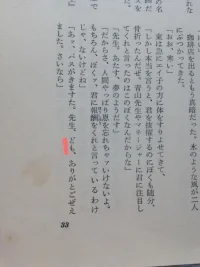
Just by coincidence, I spotted this in a novel I'm currently re-reading and thought you might take heart from it:

ImageUploadedByTapatalk1407998353.811477.webp
 
Back
Top Bottom