Legal Death penalty in Japan

A Japanese court on Friday dismissed a lawsuit filed by three death-row inmates seeking to stop executions by hanging, ruling that the method does not violate international rules banning cruel punishment. The Osaka District Court also rejected their request for a total of ¥33 million in compensation, which they said was owed for the psychological distress caused by years of uncertainty over when their executions would take place. The three inmates, whose identities have not been disclosed, have each spent more than a decade on death row.

Presiding Judge Noriko Yokota said the plaintiffs cannot request a court ruling on the legality of an execution in an administrative lawsuit because doing so would contradict criminal judgments that finalized their death sentences. As for rejecting their demands for damages, Yokota said the judicial precedent has been established that a death sentence does not violate the Constitution's Article 36, which forbids "cruel punishments" by public officers. Yokota added that there have been no illegalities with the public officers involved in works to execute death sentences, such as not exercising due care. The plaintiffs argued that the method of hanging, stipulated as the sole means to execute death-row inmates under Japan's Penal Code, is inhumane as it causes more pain than necessary and violates the International Covenant on Civil and Political Rights that bans "cruel, inhuman or degrading" punishment.

 
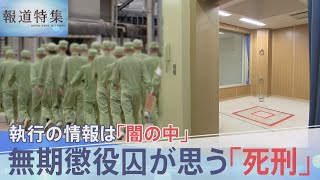
TBS News Dig recently aired a feature on the death penalty and life imprisonment in Japan, where around 1,700 inmates are serving life sentences, many of them living with the awareness that they were once considered candidates for execution.


In Tokyo, a massive concrete structure across the Arakawa River houses the Tokyo Detention House, where executions are carried out in a basement chamber known only to a limited number of staff. Officials receive notice from the Justice Ministry a week before an execution and conduct rehearsals using weighted mannequins. The condemned is informed only on the morning of the execution and escorted without delay to the chamber, where some reportedly struggle to walk due to fear. The warden offers final words, and after a brief religious ceremony, the prisoner is moved to the execution room. Bound at the feet and neck, the prisoner stands on a trapdoor. Three buttons control the mechanism, and it is unclear which officer's press triggers the drop. Staff members with pregnant family members or serious personal circumstances are excluded from the role. The body falls about four meters and stops midair. After about 15 minutes, a doctor confirms death.

The secrecy surrounding executions and the criteria for deciding the order of executions remain unclear, even to the Minister of Justice:

Executions are announced by the justice minister at press conferences, but details are rarely disclosed. One former minister, who attended an execution for the first time in office, described being stunned by the silence and gravity of the process, calling it a deeply cruel act even while carrying out official duties. He had previously opposed capital punishment but said he ultimately could do nothing to halt the system.


At least one Japanese justice minister has openly opposed capital punishment, refusing to sign execution orders on personal grounds:
Sugiura Seiken (杉浦正健) refused to sign execution orders because of his religious and personal beliefs, effectively opposing the death penalty while in office. In Japan, the justice minister must formally approve executions, and such refusals have temporarily paused them in the past.

Source:
 
Back
Top Bottom