My stories (in japanese)

DeathSpank

後輩
Joined
14 Jul 2014
Messages
6
Reaction score
1
Hello!
I'm new here so I'm gonna start by introducing myself. My name is Louis, I'm a student in art and I've wanted to learn Japanese for a long time. This summer I thought I would do it for real :) I've learned Hiragana, Katakana and basic grammar (particles and stuff like that), and I am in the process of learning Kanji using the RTK book + app.
I thought I'd start a blog where I write a (very) little story everyday using a bunch of new words I learned. The point is mainly to get familiar with the Japanese grammatical structure by using it everyday, so that it eventually (and hopefully) becomes second nature. Here's the link to the blog.
Every now and then, I'll post a story here and I would really appreciate it if some of you guys could take a few moments to tell me if I made a grammatical mistake or if my Japanese sounds unnatural to you. I'm teaching myself, so this is my only real way to get feedback from people that know what they're doing :)
I'm really interested in Japanese and Japanese culture so I'm hoping to learn a lot about Japan using this forum!
Here's my very first post. Thanks in advance!
こんにちわ。私は、ルイスです。日本語をならたい。日 本語は毎日ことあたらしい語でストーリをかたい。
そうなんにのてください。:)どうもありがとう。
(and here's what I was thinking in my head when I wrote this)
Hello. As for me, I am Louis. I want to learn Japanese. As for Japanese, I want to write a story everyday by means of using new words. Please give me your advice. :) Thank you very much.
 
I admire your effort and dedication and wish you every success in learning Japanese, so please don't take this the wrong way....

There is so much wrong there that it would involve us typing up about a third of a textbook just to explain it to you....and textbooks already exist. Please consider purchasing one and going through it instead of following this misguided hodgepodge plan which is going to give very poor results no matter how much time and effort you put into it. And lay the RTK aside for a while, at least until you learn some basic grammar (such as verb conjugation....you blew all of them). Don't be one of the multitude in a mad rush to learn kanji mistakenly thinking that equals learning the language.
 
Welcome to the forums! You'll find quite a bit of help here, as the community is very active. I've also wanted to do something similar to what you are doing,but everytime I try to, I discover my proficiency isn't really in a suitable level yet.

On topic, yours seems good so far :D However, I would like to point out that in your introduction, you probably meant 習いたい(ならたい), not ならたい。

I will have to take a look at your blog tomorrow. It sounds interesting, but I am on a tablet, so I can't type or read much. I'd like to hear from Toritoribe in this thread; you can usually trust him in grammar fixing and help like for this.
 
For curses sake, Mike! I knew you would post in this thread! His paragraph might sound wrong but at least be a bit encouraging! Instead of instantly asking him to get a textbook, which is good advice but not a proper reply to his question, at least perhaps point out some mistakes that he has made. Just to start off before we can refer him to some maerial he can consult for quick help.
 
For curses sake, Mike! I knew you would post in this thread! His paragraph might sound wrong but at least be a bit encouraging! Instead of instantly asking him to get a textbook, which is good advice but not a proper reply to his question, at least perhaps point out some mistakes that he has made. Just to start off before we can refer him to some maerial he can consult for quick help.

You could go ahead and correct it for him; you're not a beginner.
 
Sorry for my previous bluntness. I still get very angry if somebody becomes so pushy towards somebody who has only joined; your reply gave me an impression of hostility even though it's not actually worded in a hostile way. Also, as to your sarcasm, as I said before, I would like to see Toritoribe give a reply; I know that I can't be trusted too much, so I'd like to see somebody who is willing to spend a little time to give some advice. However, at the first look, it did seem like OP had a better grasp of grammar than me, so, yeah.

"こんにちわ。私は、ルイスです。日本語をならたい。日 本語は毎日ことあたらしい語でストーリをかたい。
そうなんにのてください。:)どうもありがとう。"

I'm on my computer now, so I'm just going to comment on these few introductory sentences. Although it's not bad for a start, as Mike said, it has a few ripples of mistakes. For example, こんにちわ should be こんにちは. Treat the "wa" at the end as a particle. I also do not see the purpose of a comma in between 私は and ルイスです, although for some reason my mind just kinda ignored that comma. As I said before, you likely meant ならいたい, which is the -tai form of 習う, "to learn".

Those are some fairly simple mistakes, and not really critical, but you might want to review them for a while. Also, "毎日こと" isn't exactly proper, I believe; I may be wrong, but that doesn't quite make sense to me. Remove the こと for now; that is used for verbs. In the meanwhile, perhaps add a に in front of 毎日, as that indicates that you are learning new words "IN" everyday.

語 is valid, but when I read that sentence, I thought you meant "new words", so you'll want to use 新しい言葉(あたらしいことば). Sounds more proper to me. BTW if you watch anime or read manga, you'll probably see "物語" a lot. That's one of the words for "story". You also meant 書きたい(かきたい), not かたい (which means "hard"). I understood どうもありがとう but not そうなんにのてください; you'll have to ask someone else about that.

*ahem*

Lengthy "corrections" (quotation because although I used my grammar book as a reference, I don't exactly trust myself too much in fixing grammar) aside, I don't see a big percentage of problems in one category; I understood your statements just fine, but a little refinements in nouns and verb conjugations will most certainly help.

As Mike said, you will want to consider buying another book if you have the money. Although learning Kanji is important in the long run, people will much more appreciate a Romaji user with insane grammar skills; grammar will be much more important in the beginning run. Many books and paragraphs have been written almost without any form of Kanji, and they're still well-made because of their proper grammar.

If you can't dish out the money for another reference material, I have a grammar book here that isn't a textbook but serves quite well as a reference tool so far. It has verb conjugations and definitions, amongst some other fancy stuff, so feel free to send me a private message and I'll try to give you a quick lookup output as soon as possible.

I'm not a bot, and neither are the people at these forums. As much as we'd love helping you out, we'd also love if you could help yourself a bit. So try not to ask "translate this" or "fix this" kind of questions but instead ask questions regarding concepts that you are confused about.

That aside, feel free to bomb away. I hope you feel welcome in the site :D There's also a cool random picture viewer at the front page, and it really helps in giving you some images to drool over. Also, you might want to take a look at the rules (They are in the FAQ).

*EDIT* @OP You are new, right? This won't help much, will likely be too advanced or might even demotivate you a bit, but take a look at 動画ニュース連続再生 - NetTV-News on the Web. It's a site that grabs random latest Youtube videos from news channels in Japan and places them in a playlist. The point here is not to comprehend what they are saying (that's for a much later level), but feel free to try to get a hang of the way Japanese people speak, such as the speed and some really common wordings. Another bonus is improving your skill of finding out what is going on simply through visual aid; I can often tell what is going on in the video through the recognition of pretty much 2 words and the video itself, so it's good to know what's going on in Japan, such as the strong typhoon that already wrecked a few places, and also a bunch of car accidents (the other day 6 people died in a single car accident in the highway...really sad...as I remember they were going to the beach, I believe; outing went wrong).
 
I strongly resent your repeated claims of hostility on my part. No reasonable person could possibly read my reply to the OP and find hostility in it.

I'm not going to trouble myself to correct your erroneous corrections, but I'll tell you that そうなんにのて was one typo and one conjugation error.... そうだんにのって is what it should have been.
 
I'm on my computer now, so I'm just going to comment on these few introductory sentences. Although it's not bad for a start, as Mike said, it has a few ripples of mistakes. For example, こんにちわ should be こんにちは. Treat the "wa" at the end as a particle. I also do not see the purpose of a comma in between 私は and ルイスです, although for some reason my mind just kinda ignored that comma. As I said before, you likely meant ならいたい, which is the -tai form of 習う, "to learn".

Those are some fairly simple mistakes, and not really critical, but you might want to review them for a while. Also, "毎日こと" isn't exactly proper, I believe; I may be wrong, but that doesn't quite make sense to me. Remove the こと for now; that is used for verbs. In the meanwhile, perhaps add a に in front of 毎日, as that indicates that you are learning new words "IN" everyday.

語 is valid, but when I read that sentence, I thought you meant "new words", so you'll want to use 新しい言葉(あたらしいことば). Sounds more proper to me. BTW if you watch anime or read manga, you'll probably see "物語" a lot. That's one of the words for "story". You also meant 書きたい(かきたい), not かたい (which means "hard").

Nice try!

I would like to add few points:
→書きます should be used here in place of 書きたい. (OP said 'I will write')
→新しい単語 seems good.
→You do not generally use に particle with regular interval period like '毎日'.
→こんにちわ is not completely wrong, it is more like a slang & you might see some Japanese people writing in this way on Facebook or some other place.(still, it's better if we stick to こんにちは).
 
Hi guys! Thanks for the answers!

SusuKacangSoya, I can't thank you enough for the lengthy answer! I was not expecting such generosity. I took note on the things I should work on :) the idea of listening to the Japanese newscast seems great!

Mike Cash, thank you for your honesty. I did not take offense to any of it. Believe me, grammar is my number one priority. I'm doing Kanji on the side and they don't interfere with each other (the only reason there is Kanji in my text is that the computer automatically translates my Hiragana). I have been reading and learning about grammar, but I am aware that I will make mistakes as I am still unfamiliar with it. I've read and took notes on basic grammar using this website. If you're familiar with it, is it good or junk? I'm also using "Human Japanese". Again, if you're familiar with those, I'd like if you could take two seconds to tell me what you think. If you don't know them, I'm not expecting you to look it up :) I'd be happy to hear anyone's opinion on those.

I understand I have to come here with precise questions. My problem is, I don't always realize that I don't understand something. Here for example, using my grammar guide as reference, I thought my paragraph was correct. I don't know what I don't know. I am not going to post in this thread all the time asking for people to read my stuff. I just wanted to throw a link to my blog so that those who feel like helping once in a while know where to look. :)

Again, thank you all for your answers and advice! It helped me see what I need to work on :) I will work on it and try to apply it next time.
 
using this website. If you're familiar with it, is it good or junk?
Tae kim's site is good, the only problem is that it doesn't has enough exercises to cope with the large amount of vocabularies he introduces in every chapter.
You should try to supplement it by creating self exercises for practice and try some other textbooks/workbooks as well.

I'm also using "Human Japanese"
Sorry, no idea.
 
Ok, yeah textbooks with answers at the back would be useful. I don't have anything like that so I write stories instead lol. I couldn't find anything for free so I guess I'll have to buy something, eventually.

In any case, what you guys said actually pointed out to me some things I misunderstood. The main mistake was I didn't realize that when removing the stems of a u-verb to add ーたい etc, I had to replace the "u" sound by the equivalent "i" sound. I also didn't realize I had to use the て form of verbs to use "please". So thanks :) I'll do better next time. I posted a correction if anyone's interested.

Cheers,

Louis
 
@DeathSpank: use きょう instead of はんじつ for today and おしい for tasty not おしい.
If you are going to blog daily then you should try lang-8 for writing practice :)
 
@DeathSpank: use きょう instead of はんじつ for today and おしい for tasty not おしい.
If you are going to blog daily then you should try lang-8 for writing practice :)

Thanks for the correction, and thank you so much for the link! This is exactly what I wanted! :D
 
ほんじつ…not はんじつ

Japanese has a rather limited palette of sounds, especially vowels, making it important to be careful to get them right lest you find yourself having unintentionally written a completely different word.

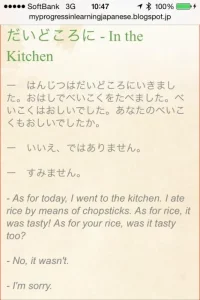
Your blog says you ate America (べいこく) for breakfast. That's quite a feat.

The past tense of おいしい is おいしかった, not おいしいでした

The answer to the question should be either いいえ、おいしくなかった or いいえ、おいしくありませんでした

すみません is only "I'm sorry" in the apology sense, not the sympathy sense.

You'll make much more productive use of your time if you complete at least the first volume of a beginners level textbook before you attempt something like this.

(And note that despite the best of intentions, your fellow beginning learners....who are the ones most likely to drop by and help with "corrections"....failed to note those very basic glaring errors, so relying on them to polish your skills by giving you feedback isn't an entirely wise approach to the task).

ImageUploadedByTapatalk1405475272.080996.webp
 
Thank you for your feedback Mike. In the dictionary it says that べいこく means america as well as rice... weird. I didn't know it was possible for a word in any language to share those meanings lol. I guess I'll find another word for rice :p

Very interesting what you said about すみません。 English does not make a distinction :)

I am now using lang-8 where I get feedback from natives (and where I got exactly the same feedback that you just gave me). I appreciate everyone's help! I understand what you say about completing a grammar textbook. I have read a book on basic grammar and took loads of notes, but it doesn't have exercises in it, so doing this and getting feedback is the only way I have to practice.

I guess in the future I'll buy a workbook, but for now that's my only option. :)
 
You have either the world's worst dictionary or you misread it. Wasn't what actually happened that you saw the entry for 米 and failed to carefully read the entry?

At the beginning stages, reference books, such as the one you picked up grammar points from, are not only useless, they're false friends who will give you the impression you're learning something when you're actually mostly sowing the seeds of your own future frustration. Start with a textbook and maximize the chances you'll actually achieve a measure of success that will encourage you to continue...rather than a level of frustration that will lead you to quit.

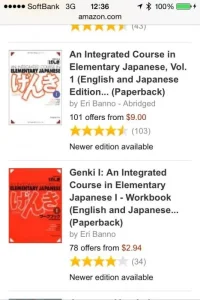
Copies of Genki I and the accompanying workbook can be had used from Amazon for about the price of a trip to McDonalds.

ImageUploadedByTapatalk1405478321.583878.webp
 
Last edited:
I think the issue here is that you probably saw べいこく = 米穀. Which is a word but written differently from 米国 and not one you'd normally use for talking about what you're eating (ご飯 is best for the plain cooked stuff), hence why seeing it in kana provokes the "you ate America?" reaction. A good dictionary should show you examples of the words in use, so you can make a decent choice. To some extent, an English-Japanese beginners dictionary would be your best bet - you're probably using something online and free that uses the EDICT database. Which is very good considering it's 100% free but:

1) It is really Japanese-English, not meant for English-Japanese, and there is a difference.
2) There is no real splitting by type of usage, obscurity, etc.
3) Multiple senses of a word return multiple independent entries with no linkage in the meaning, even for closely related terms (rice, white rice, brown rice, fried rice...).

This is meant for native Japanese speakers but you get the gist of how it works.

The headwords - two meanings split out and then additional examples
1: "米;ご飯" (the stuff you cook and then eat)
Followed by examples of related terms, like "brown rice", "rice cooker" etc.
2: "稲;稲もみ" (one step back - the stuff on the farm)
With related terms like "rice crop".

Then, at the end, a couple of side notes - stuff like "English doesn't differentiate between 米・ご飯・稲, it's all 「rice」". You see how it has a much better structure. (And 米穀 doesn't even warrant a mention).

Bit of history: the kanji used in kanji compounds for countries mostly come from phonetic renderings. So France = フランス = 仏蘭西 shortened to 仏. アメリカ was 亜米利加. But 亜 was already in use for Asia (アジア・亜細亜). So 米 was used instead.

Note that you don't normally use 米 by itself when you want the meaning アメリカ or 米国 (same goes for the other country kanji). But you will see it in compounds related to the US: 米軍、日米 etc, and you might see occasionally people using them to list off countries like "英・米・仏・露".

It is just as I can use "bat" to mean something you use for sports, or a flying mammal associated with vampire stories. Who'd think those two meanings could share a word? Pen - a thing you put animals in, or a thing you write with? Lead - a heavy metal, the inner bit in a pencil, or another word for a leash. A pile of wood, a stately pile, and carpet pile. (Hey, there's even a country vs. foodstuff example: Turkey). In any language, you will find weird overlaps like that.

Don't overthink it - I can't imagine a single context where you'd see 米 somewhere in a sentence and genuinely couldn't figure out whether "rice" or "America" was meant, the same way that if I said my brother was out back swinging his bat around you'd probably guess he's into baseball before you'd report him for potential animal cruelty. Those multiple meanings really aren't an issue when you're actually reading.
 
Back
Top Bottom