Need a word or phrase translated?

「あおいで」 の意味は

暑い夏の季節にあおいで涼をとるのに用いらねるほか、友情、敬意、好意を示す縁起物とされ、結納の際、両家で交換する贈り物の1つになっています。

talking about 扇子
 
Last edited:
「あおいで」 の意味は

暑い夏の季節にあおいで涼をとるのに用いらねるほか、友情、敬意、好意を示す縁起物とされ、結納の際、両家で交換する贈り物の1つになっています。

talking about 扇子

It's a conjugated form of the verb あおぐ(扇ぐ), to fan.
 
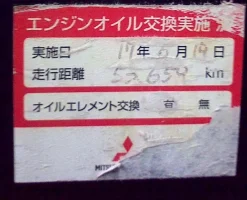
Ok. I am not sure this is the right place but can some one help me figure out what this markings says?

Thanks in advance!
 

Attachments

  • markings.webp
    markings.webp
    75.8 KB · Views: 201
Ok. I am not sure this is the right place but can some one help me figure out what this markings says?

The label shows the date when the engine oil change was done last time.

The date is 19th June (or May... it is a bit blurred) 2005*
Milage (travelling distance of the vehicle) at that time was 53,659km
Oil Element Change : Yes

*17 means Heisei 17 which is Japanese traditional era name, which is 2005.
(Heisei started in 1989)
 
The label shows the date when the engine oil change was done last time.
The date is 19th June (or May... it is a bit blurred) 2005*
Milage (travelling distance of the vehicle) at that time was 53,659km
Oil Element Change : Yes
*17 means Heisei 17 which is Japanese traditional era name, which is 2005.
(Heisei started in 1989)

Many thanka undrentide! now I know I must do a timing belt replacement.

Thanks again!

You helped me very much
 
都会の典型的な日本家屋は、小さく、木造、瓦ぶきです。
what is the meaning of ぶき? pretty sure it does not mean roof tile weapon. grammatical function?
家の主人または女主人は深々とお辞儀として出迎え、心の困った歓迎の挨拶をします。
the latter part of the sentence mean "welcome greet from a troubled heart"?
mpは歩けば回復するが、時間がかかる。セーブクリスタルを発見したら欠かさず回復しておくんだ。
欠かさず の 意味は?
 
都会の典型的な日本家屋は、小さく、木造、瓦ぶきです。
what is the meaning of ぶき? pretty sure it does not mean roof tile weapon. grammatical function?
家の主人または女主人は深々とお辞儀として出迎え、心の困った歓迎の挨拶をします。
the latter part of the sentence mean "welcome greet from a troubled heart"?
mpは歩けば回復するが、時間がかかる。セーブクリスタルを発見したら欠かさず回復しておくんだ。
欠かさず の 意味は?

ぶき=ふき, nominalized form of the verb 葺く(ふく).
葺く = to cover the roof with something.
藁ぶきの屋根 : thatched roof (roof covered with straw)
瓦葺(かわらぶき): tiled (roof)

欠かさず: without fail (literal translation is "without missing")
 
家の主人または女主人は深々とお辞儀として出迎え、心の困った歓迎の挨拶をします。
the latter part of the sentence mean "welcome greet from a troubled heart"?
I suppose it must be 心のこった, not 困った.
Ah, plus, isn't it お辞儀して出迎え?;-)
 
ぶき=ふき, nominalized form of the verb 葺く(ふく).
葺く = to cover the roof with something.
藁ぶきの屋根 : thatched roof (roof covered with straw)
瓦葺(かわらぶき): tiled (roof)

欠かさず: without fail (literal translation is "without missing")

Thanks undrentide, so by adding あず to verbs, the verb becomes negative?

Tori: you're right, my mistakes, I'll be more careful next time when reading.
 
So by adding あず to verbs, the verb becomes negative?
Right. ず is the archaic auxiliary verb to make verbs/adjectives negative. It's same as ない in modern Japanese.

欠かさず(に) = 欠かさないで
 
Thanks tori.

I came across this word 恥ずべき I looked up on jisho.com, now here's the thing, it says it's adj-f, it's the first time i came across such classification, usually it's either adj i or na adj.
 
I came across this word 恥ずべき I looked up on jisho.com, now here's the thing, it says it's adj-f, it's the first time I came across such classification, usually it's either adj i or na adj.
That's the adjectival-form of the archaic auxiliary verb べし to mean "must/ought to."

恥ずべき = 恥ずかしく思わなければならない: shameful
 
「入試事とか考えたくねーよ」
「あー ゲームしてー」

「考えたくね」と「考えたくない」は同じですか?
「入試事とか考えたくねーよ」ってどう言う意味ですか?

Also, 「数学のノート学校に忘れた。 ノートなんてなくても勉強できるけど、 あれは明日の朝まで学校においておきたくない」 I left my math notebook at school. I can study without it but i dont want to leave it there till tomorrow morning.
I get the gist of the sentence but i dont understand the grammar of the
「なんてなくても」And the 「おいておきたくない」Arent they both 置く?

One more thing
「何してんだ?学年1位を守るため早く帰って勉強しなくていいのかよ」
What are you doing?To guard your first place in class return home quickly and studyしなくていいのかよ
What does いいのかよ mean?

Sorry for all the questions!
 
Last edited:
Vte + おく
do something in advance for future convenience?
I think both are 置く, but the second one is usually in kana.
 
「入試事とか考えたくねーよ」
「あー ゲームしてー」

「考えたくね」と「考えたくない」は同じですか?
「入試事とか考えたくねーよ」ってどう言う意味ですか?

「考えたくね」と「考えたくない」は同じ意味です。「考えたくないよ」のくだけた言い方だと思ってください。

「入試事」は「入試の事」の間違いだと思います。
「入試の事とか考えたくないよ」 I don't want to think about stuff like the entrance exam.

Also, 「数学のノート学校に忘れた。 ノートなんてなくても勉強できるけど、 あれは明日の朝まで学校においておきたくない」 I left my math notebook at school. I can study without it but i dont want to leave it there till tomorrow morning.
I get the gist of the sentence but i dont understand the grammar of the
「なんてなくても」And the 「おいておきたくない」Arent they both 置く?

See warakawa's explanation above. I will give a couple of examples.

「高速道路に乗るとしばらくは止まれないから、ここでトイレに行っておいた方がいいよ。」
We won't be able to make a stop for a while once we get on the express way, so you'd better go use the bathroom here.

「あなたぁ~! 今夜わたし帰りが遅くなるから、あなたの夕食の準備して冷蔵庫に入れておきますねぇ~!」
Honey! I'm not gonna be home until late tonight, so I will fix your dinner and leave it in the fridge, OK?

One more thing
「何してんだ?学年1位を守るため早く帰って勉強しなくていいのかよ」
What are you doing?To guard your first place in class return home quickly and studyしなくていいのかよ
What does いいのかよ mean?

It is a colloquial way of saying いいのですか. Something a young male student might say. A typical "GUY" talk. If the speaker were a girl, she'd probably say 勉強しなくていいの?
 
ありがとうございましたashikagaサン、Warakawaサン。
In this manga I'm reading they use a LOT of ねー's instead of the ない's that I'm used to.
 
「数学のノート学校に忘れた。 ノートなんてなくても勉強できるけど、 あれは明日の朝まで学校においておきたくない」 I left my math notebook at school. I can study without it but i dont want to leave it there till tomorrow morning.
I get the gist of the sentence but i dont understand the grammar of the
「なんてなくても」
なんて: "such/something like"
なくて: te-form of the i-adjective ない
te-form of verbs/adjectives + も: an adversative conjunction in a conditional clause, "even if"
So ノートなんてなくても literally means "even if I don't have/use such the notebook."

And the 「おいておきたくない」Arent they both 置く?
"Te-form of a verb + the auxiliary verb おく" can also be used for simply "to leave doing/to keep in the state of ~." 置いておく in that sentense would be in this case, thus, simply means "to leave it (being) there," as Luke-san correctly interpreted.:-)
 
「ああでもないこうでもない」 の 意味は?

唯一の肉親であった兄の命を奪ったも同然の憎き仇ともいえる存在である。
 
Last edited:
Japanese-English, English-Japanese Dictionaries

Hello kids,

I am wondering if any of youare learning Japanese such as myself have any helpful and wonderul online tools like Japanese-English and English-Japanese translating dictionaries.

Google translator just does not cut it because I could not find most of the words or if I did, the search result would show up as how the Japanese words sound in English.

If you know any great online great tools for me to master Japanese, it will be great!

P.S. My grandmom is Japanese but she never taught me when I was growing up. My mom speaks Japanese with my grandma though but generally we don't communicate with Japanese. :(
 
Hello kids,
I am wondering if any of youare learning Japanese such as myself have any helpful and wonderul online tools like Japanese-English and English-Japanese translating dictionaries.
Google translator just does not cut it because I could not find most of the words or if I did, the search result would show up as how the Japanese words sound in English.
If you know any great online great tools for me to master Japanese, it will be great!
P.S. My grandmom is Japanese but she never taught me when I was growing up. My mom speaks Japanese with my grandma though but generally we don't communicate with Japanese. :(

jisho.com

and yes you should master Japanese and especially the honorific form so you would not address other members as "kids" in the future.
 
ありがとうToritoribe先生!:P

One more question
気分悪いので2時間目まで保健室で休んでていいですか
2時間目?And 休んでていいですか? Shouldn't it be 休んでいいですか? or 休んでもいいですか?

Warakawa: No need to get too angry, i dont think Akie meant that to be offensive.
 
Last edited:
Kids did not mean "kids" literally. It is a figure of speech like how one would refer a group of people "hey guys" when there are actually females in that group.

Too quick to jump down my throat! Anyway, thanks for the reply but the site you provided actually generates spyware sites.

P.S. Thanks for defending me LukeSettle. :-)
 
Last edited:
気分悪いので2時間目まで保健室で休んでていいですか
2時間目?
second period/class

2限目 can be used, too. Also, especially in college, 2講目/2コマ目 is used as well.

And 休んでていいですか? Shouldn't it be 休んでいいですか? or 休んでもいいですか?
休んでて is the contraction of 休んでいて, thus, has a nuance of "to be staying (in rest)/to be being in bed." 休んで/休んでも simply means "to be off/to take a rest."
 
Back
Top Bottom