Politics Japan’s opposition parties seek to align policies to form new government

thomas

Unswerving cyclist
Admin
Joined
14 Mar 2002
Messages
21,050
Reaction score
18,903
After Komeito ended its 26-year-long cooperation with the scandal-hit, fizzling LDP last week, Japan's opposition parties face a historic chance to form a coalition government, provided they can overcome their policy differences.

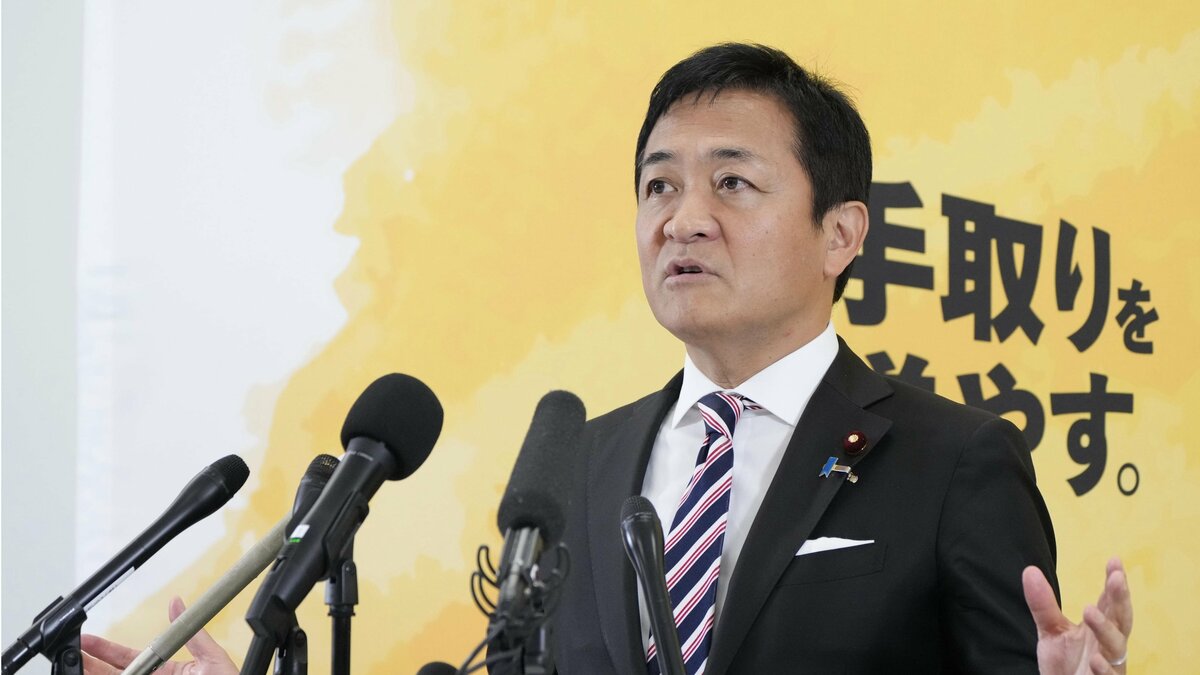
Today, Tamaki Yuichiro, head of the Democratic Party for the People, urged rival opposition groups to find common ground on key policies to form an alternative government, amid speculation that the ruling party's grip on power may be weakening. Tamaki indicated that he might soon hold talks with Noda Yoshihiko, who leads the most significant opposition bloc, the Constitutional Democratic Party of Japan. The CDPJ seeks to coordinate with other parties in selecting the next prime minister through parliamentary procedures. Forging an agreement on core policy areas would be essential if the opposition hoped to present itself as a credible governing force. He also pointed to longstanding divisions, particularly over national security and energy policy.

Paywall alert:


Last weekend, Mainichi explained the complex relationship between Japan's opposition parties:
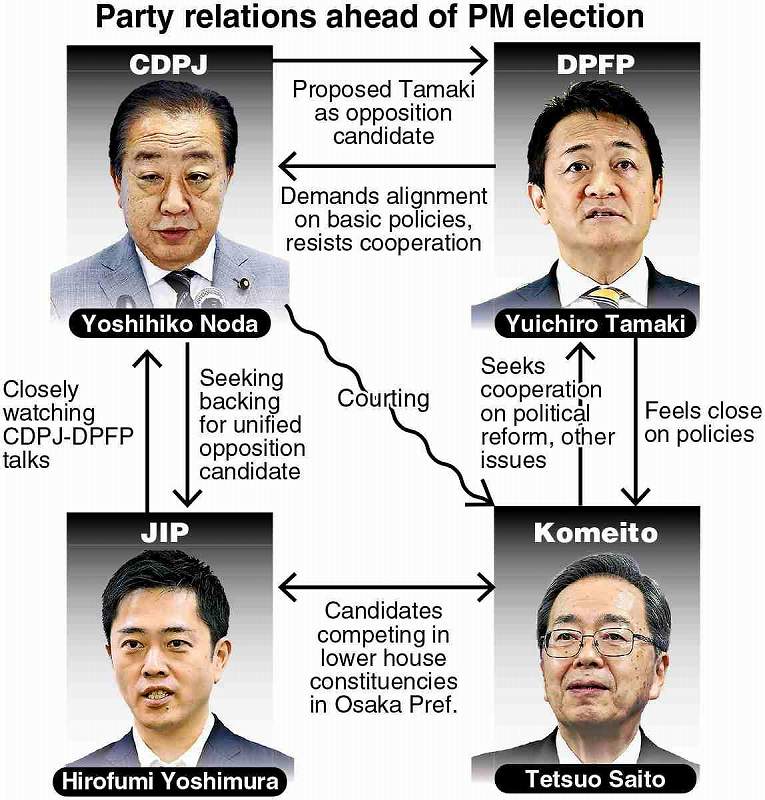
WEB_13Fro%E9%A6%96%E7%9B%B8%E6%8C%87%E5%90%8D%E9%87%8E%E5%85%9A%E8%84%87.jpg


Tobias Harris takes a closer look at whether the opposition parties can cooperate:


Interesting days ahead!
 
Everything is in a state of fluctuation. The latest key developments:


The heads of Japan's opposition parties

The heads of Japan's opposition parties.
 
Takaichi's meeting with Ishin no Kai's parliamentary leader, Fujita Fumitake, and his co-leader, Yoshimura Hirofumi, seemed to have been quite promising.

Ishin no Kai delivered a list of policy demands – most prominently its demand for establishing "auxiliary capital" functions in Osaka, elevating it to a metropolis in the process – and is committed to continuing discussions with the LDP. Ishin no Kai is emerging as the key player in the race between the LDP and the Constitutional Democratic Party (CDP) to form a government; if the LDP can convince Ishin no Kai to vote for Takaichi, it will be difficult for the opposition to top Takaichi's vote.

Ishin no Kai seemed receptive to Takaichi's appeal, though it is of course also continuing its discussions with other opposition parties. The LDP may also be able to offer electoral coordination in some form. Whereas bridging policy differences is the key issue in the opposition talks, the question for Ishin no Kai in the negotiations with the LDP is whether it wants to take on the potential political baggage of cooperating with the LDP. If Ishin no Kai joins a coalition government – or even agrees to provide external support for a Takaichi government – it would stabilise the LDP-led government.

 
Another chance missed for Japan's opposition parties. LDP and Ishin no Kai leaders will form a coalition government after two days of negotiations.

The negotiations have not been without friction. Ishin no Kai has had to accept that the LDP will not commit to reducing the consumption tax on foodstuffs to zero, a pledge from Ishin no Kai's upper house manifesto. The party has also had to yield on its demand for a ban on corporate political donations, which would be virtually impossible for the LDP to accept after it parted ways with Kōmeitō over its more modest proposal for restricting political contributions. However, Ishin no Kai has instead demanded that the LDP accept its longstanding proposal for a ten-per cent reduction in the number of Diet members and commit to moving it through the Diet during the forthcoming session. Of course, the party also expects that the LDP will support its "auxiliary capital" plan and a proposal to reduce social insurance premiums. The demand for the reduction in the number of legislators has been met with scepticism from within the LDP, but was accepted by the party leadership. However, hammering out the details could be contentious. Meanwhile, the LDP's Osaka chapter is anxious about the implications of a coalition with Ishin no Kai for its electoral fortunes, though there have been no details about whether and how the two parties will coordinate electorally; LDP Secretary-General Suzuki Shunichi sought to provide reassurance when he met with Matsukawa Rui, the acting head of the Osaka LDP, on Friday. Nevertheless, despite Ishin no Kai's misgivings – and its own leaders' warnings that a coalition could prove fatal to the party – there appears to be little standing in the way of the two parties concluding a coalition agreement before the Diet votes next week on the next prime minister. The parties are aiming to finalise an agreement on Monday, 20 October.


According to reports from the Kyodo news agency, the Liberal Democratic Party and Nippon Ishin no Kai had reached a broad understanding to form a coalition government, paving the way for Japan to have its first woman prime minister. The agreement was said to be nearing completion between Sanae Takaichi, the conservative leader of the LDP, and Hirofumi Yoshimura, who heads the smaller right-leaning Nippon Ishin. They were expected to formalise the pact on Monday.

When contacted outside business hours, neither party's headquarters responded to requests for comment. Earlier, Nippon Ishin's co-leader Fumitake Fujita had hinted that the talks were moving swiftly towards a conclusion, saying that significant progress had been made.

Lawmakers from Nippon Ishin were expected to back Takaichi in the upcoming parliamentary vote to decide the next prime minister. However, the party reportedly intended to remain outside the Cabinet, at least for the time being. The arrangement would represent a looser partnership than the one the LDP had long maintained with Kōmeitō, whose recent withdrawal from the coalition had already cast uncertainty over the government's stability.

 
I'm not sure if this is technically a missed opportunity by the opposition. I assume that, as the largest party, the LDP gets the first choice to form a government. That's how it works in the UK, but I could be wrong with Japan.
 
I'm not sure if this is technically a missed opportunity by the opposition. I assume that, as the largest party, the LDP gets the first choice to form a government. That's how it works in the UK, but I could be wrong with Japan.

My statement was based more on arithmetic than political reality. The three main opposition parties (CDP, DPP, Ishin) hold 209 seats. If Komeito had joined, they could have mustered 233 seats. Had they agreed on a unified candidate (Noda or Tamaki), the LDP and Takaichi would have been out.

Instead, we will most likely have an unpopular right-wing prime-ministrix without a stable majority and case-by-case cooperation for passing legislation.
 
Back
Top Bottom