Apologising in Japanese

thomas

Unswerving cyclist
Admin
Joined
14 Mar 2002
Messages
21,051
Reaction score
18,904
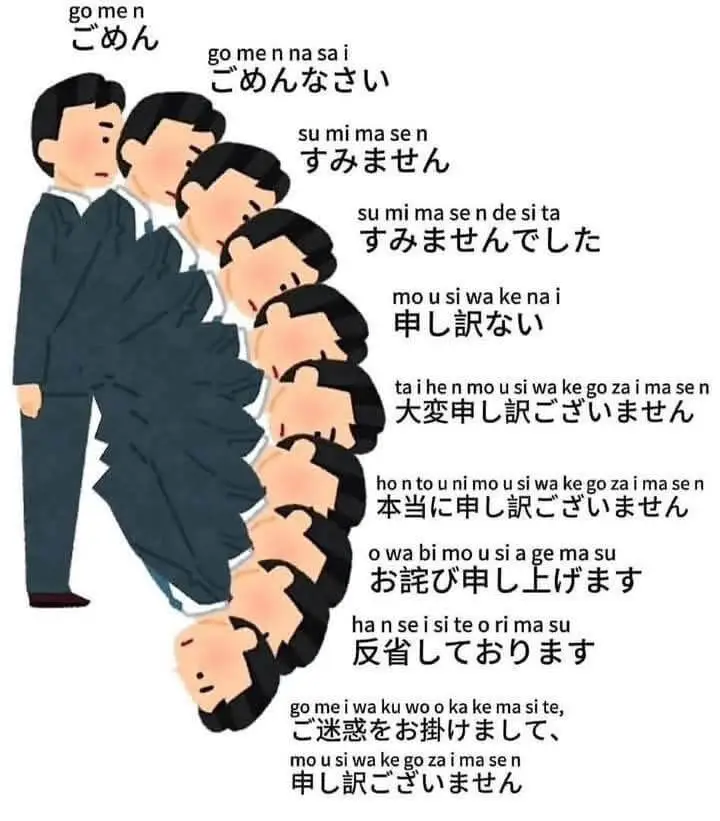
I found this on FB. I admit I wasn't familiar with all of these forms and possible combinations.
apologise-in-japanese.webp


  • ごめん (gomen, "I'm sorry")
  • ごめんなさい (gomennasai)
  • すみません (sumimasen)
  • すみませんでした (sumimasen deshita, slightly more formal than "sumimasen")
  • 申し訳ない (mōshiwakenai, "my apologies")
  • 大変申し訳ございません (taihen mōshiwake gozaimasen, "I am terribly sorry")
  • 本当に申し訳ございません (hontō ni mōshiwake gozaimasen, "I am truly sorry")
  • お詫び申し上げます (owabi mōshi agemasu, "I sincerely apologise," more formal and sincere than "sumimasen")
  • 反省しております (hansei shite orimasu, heartfelt and polite apology)
  • 反省・後悔しております (hansei kōkai shite orimasu, "I regret what I have done")
  • ご迷惑をおかけて (gomeiwaku wo okakeshite, "I'm sorry for the trouble/inconvenience")

Other apologies not covered in the graphic:
  • 本当に申し訳ない (hontō ni mōshiwakenai, less formal than "hontō ni mōshiwake gozaimasen")
  • 失礼します (shitsurei shimasu, "excuse me")
  • 失礼しました (shitsurei shimashita, "that was rude of me")
  • 許してください (yurushite kudasai, "please forgive me")
  • お邪魔します (ojamashimasu, "forgive the intrusion")

I am sure there is more. :)
 
A navy lesson in 1970 I always remember. Our first week in Japan we had a two week session about our time in Japan. We were told if , in an accident, if we killed or seriously injured a Japanese citizen , we were to take 2 cartons of American cigarettes and a bottle of good American whiskey to the family and to apologize. I was shocked to think that was a good thing to do.
 
In Japan, the ultimate form of apology is '土下座(dogeza),' where one kneels and bows deeply, touching their head to the ground.

The Japanese Tradition " Dogeza"

I have attended the online etiquette lessons run by the Ogasawara Ryu (and subsequently bought their DVD) which covers all aspects of good manner including the types and depths of bow for a given situation. Its very interesting indeed.
 
Yes that's the one. The online courses are orientated toward practitioners of Kyudo, whereas the DVD is more useful in its generality. For example, I had no idea that there's a particular, polite order in which the dishes should be eaten during a meal! Previously I just tipped everything into a bucket, dumped a fried egg on top, stuck my head in and gobbled it all up. No wonder I got funny looks; a fried egg for goodness sake ☺️
 
I'd love to know more about "samurai table manners" and "how to move while kneeling." :LOL:
It's very interesting, honestly. A very old 8th Dan Hanshi swordsman once gave me a few tips on eating that aren't on the DVD; when placing food into your mouth with hashi, do not have the tips pointing into your mouth as most people do lest an unknown enemy eating with you, whacks the ends of them, forcing the hashi into your oropharynx causing you to retch, splutter and become sufficiently distracted so he can place a blade into your body! Instead have the tips of the hashi pointing to you left, placing the food into your mouth with then orientated sideways on.

When holding a bowl up to your mouth to eat from it, hook your thumb over the rim to hold it securely so a fellow enemy/guest can't tip the contents into your lap, possibly scolding you but definitely distracting you long enough to place a blade into your body!

He also suggested how to sit on a Western toilet most defensively, which I'm not sure is that effective. 🤔

The knee walking is mesmerizing to watch and requires thighs of steel! I doubt many non-gym attending Westerners would have the leg strength to do it!
 
Thank you, this is most interesting! I'm actually surprised that they were allowed to wine and dine with blades on their sides. Sadly, all the vigilance was in vain when your food was poisoned - not uncommon in those days.
 
Thank you, this is most interesting! I'm actually surprised that they were allowed to wine and dine with blades on their sides.
Katana would've definitely been placed away on a kake at the entrance but not necessarily their wakizashi. But almost definitely a tantō would've been secreted somewhere upon their person.
Sadly, all the vigilance was in vain when your food was poisoned - not uncommon in those days.
Like most eateries here in the UK 🤢
 
It's very interesting, honestly. A very old 8th Dan Hanshi swordsman once gave me a few tips on eating that aren't on the DVD; when placing food into your mouth with hashi, do not have the tips pointing into your mouth as most people do lest an unknown enemy eating with you, whacks the ends of them, forcing the hashi into your oropharynx causing you to retch, splutter and become sufficiently distracted so he can place a blade into your body! Instead have the tips of the hashi pointing to you left, placing the food into your mouth with then orientated sideways on.

When holding a bowl up to your mouth to eat from it, hook your thumb over the rim to hold it securely so a fellow enemy/guest can't tip the contents into your lap, possibly scolding you but definitely distracting you long enough to place a blade into your body!

He also suggested how to sit on a Western toilet most defensively, which I'm not sure is that effective. 🤔

The knee walking is mesmerizing to watch and requires thighs of steel! I doubt many non-gym attending Westerners would have the leg strength to do it!
Fascinating insights into martial awareness applied to daily habits are both amusing and thought-provoking. Those etiquette tips really highlight how mindset extends beyond the dojo.
 
Fascinating insights into martial awareness applied to daily habits are both amusing and thought-provoking. Those etiquette tips really highlight how mindset extends beyond the dojo.
It makes one wonder if bushi were truly living in hazardous times or were paranoid! I adopted these habits but now can't unconsciously undo them. It must look like a strange affectation! I don't sit on the loo with the ankle of right leg resting on the knee of my left, however!
 
I found this on FB. I admit I wasn't familiar with all of these forms and possible combinations.


  • ごめん (gomen, "I'm sorry")
  • ごめんなさい (gomennasai)
  • すみません (sumimasen)
  • すみませんでした (sumimasen deshita, slightly more formal than "sumimasen")
  • 申し訳ない (mōshiwakenai, "my apologies")
  • 大変申し訳ございません (taihen mōshiwake gozaimasen, "I am terribly sorry")
  • 本当に申し訳ございません (hontō ni mōshiwake gozaimasen, "I am truly sorry")
  • お詫び申し上げます (owabi mōshi agemasu, "I sincerely apologise," more formal and sincere than "sumimasen")
  • 反省しております (hansei shite orimasu, heartfelt and polite apology)
  • 反省・後悔しております (hansei kōkai shite orimasu, "I regret what I have done")
  • ご迷惑をおかけて (gomeiwaku wo okakeshite, "I'm sorry for the trouble/inconvenience")

Other apologies not covered in the graphic:
  • 本当に申し訳ない (hontō ni mōshiwakenai, less formal than "hontō ni mōshiwake gozaimasen")
  • 失礼します (shitsurei shimasu, "excuse me")
  • 失礼しました (shitsurei shimashita, "that was rude of me")
  • 許してください (yurushite kudasai, "please forgive me")
  • お邪魔します (ojamashimasu, "forgive the intrusion")

I am sure there is more. :)

This list really highlights how nuanced apologies in Japanese can be, especially once you move beyond the basic phrases and start dealing with formality and intent. Keeping track of when and why to use each expression can feel overwhelming, particularly if you are studying the language seriously or juggling it alongside other academic work, which is why services like https://mysupergeеk.com/аssignment-hеlp-sеrvice can be useful as a paid support option rather than a learning guide. It is more about getting professional help with managing workload and understanding complex material than being handed answers. Having that kind of backup can free up time to focus on actually learning things like cultural context and proper usage. Posts like this are great reference points, but support systems matter too when things pile up.
From my point of view, Japanese apologies are less about the exact words and more about attitude. I'd focus first on tone, timing, and body language rather than memorizing every phrase. Even a simple apology sounds "right" if it's said humbly. That helped me understand why native speakers switch phrases so naturally.
 
Last edited:
It seems that Japan's "sliding dogeza" is becoming a hot topic.

Japanese volleyballer takes sorry to extremes with headfirst sliding apolog

In a moment of chivalry, Japanese volleyball player Yuji Nishida displayed majestic sliding skills as he took a traditional apology to extremes after inadvertently striking a courtside judge with the ball at the weekend.
The 26-year-old, who was taking part in a half-time serving challenge at a volleyball all-star event in Kobe, looked horrified as his left-handed serve veered off the court and struck the female judge squarely on her back.

By the time the uninjured judge had regained her composure, Nishida's 186cm frame was sliding quickly along the ground towards her, his nose down and his hands by his side, triggering laughter and applause among the spectators and his teammates.
 
So was it a sincere apology or a bit of a laugh? After making an apology one should be left feeling slightly bereft of a small amount bit of one's honour; you did something wrong so you take a bit of a hit for it. Here, the player received laughter and a bit of admiration from the crowd, no doubt. He benefited from a net increase in his 'coolamundo' factor. This isn't right. However, he did make recompense by sitting in seiza and apologising properly, so I'm happy(ish) with his behaviour.

However, in feudal times, I'd've still expected seppuku from him 😑😉 Or at least popped his volleyball in front of him 😤
 
Back
Top Bottom