News Two Chinese aircraft carriers spotted in Japan's EEZ

thomas

Unswerving cyclist
Admin
Joined
14 Mar 2002
Messages
21,050
Reaction score
18,904
Japan has, for the first time, officially confirmed that two Chinese aircraft carriers are active simultaneously in the Pacific. On Monday, the government reported sighting the Shandong near Okinotori, Japan's southernmost island, intensifying worries about Beijing's military operations.

This confirmation came shortly after the Defence Ministry announced on Sunday that the Chinese carrier Liaoning had been monitored near Minamitori Island, Japan's easternmost point, for two consecutive days beginning on Saturday. This represents the first verified occasion of a Chinese carrier operating in those waters.
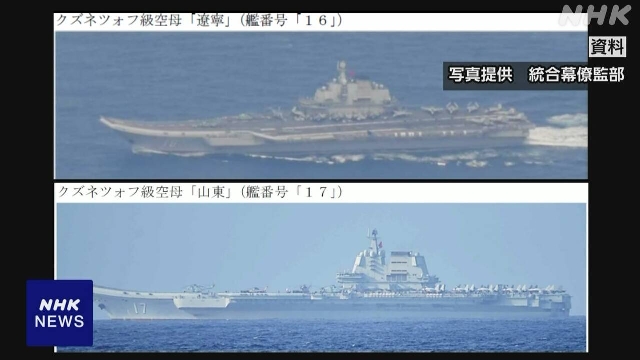

20250610_01_1534866_L.jpg

Photo credit: Japanese Defence Ministry's Joint Staff via NHK


On Monday, the Shandong, commissioned in 2019 as China's second aircraft carrier, conducted landing and takeoff drills involving its fighter jets and helicopters north of the Okinotori, some 1,700 km south of Tokyo, within Japan's exclusive economic zone, the ministry said. Meanwhile, the Liaoning, along with two destroyers and another vessel, was spotted in waters approximately 300 km southwest of Minamitori, which is located around 1,900 km southeast of Tokyo, at around 6 p.m. Saturday, according to the ministry. The area lies within Japan's Exclusive Economic Zone (EEZ). The Liaoning then moved southwest and conducted landing and takeoff drills with its fighter jets and helicopters on Sunday outside the Exclusive Economic Zone (EEZ). The Liaoning was observed beyond what is known as the "second island chain", stretching from Japan's Izu Islands to Guam, a Japanese government official said. China considers the chain its defence line.


Chinese fighter jets came dangerously close to a JMSDF surveillance aircraft over the Pacific Ocean twice over the weekend, prompting Japan's Defence Ministry to label the incidents as "abnormal approaches" due to the risk of collision. A P-3C patrol aircraft monitoring the Chinese aircraft carrier Shandong was shadowed by a J-15 fighter jet that had taken off from the carrier. The Chinese jet reportedly followed the MSDF plane for around 40 minutes on Saturday and roughly 80 minutes on Sunday.

A Chinese J-15 fighter jet flies close to a JMDF P-3C

A Chinese J-15 fighter jet flies close to a JMDF P-3C (via Jiji)


During Saturday's encounter, the armed J-15 flew as close as 45 metres alongside the P-3C. This dangerously short distance posed a serious collision risk. On Sunday, another J-15 crossed about 900 metres in front of the Japanese aircraft's path, a gap that could be closed in mere seconds. Japan's chief cabinet secretary declined to comment on China's motives but warned that such "unusual close approaches" by Chinese military aircraft carried a real danger of accidental crashes.

This was the third time since 2014 that Chinese aircraft had made such close approaches to Self-Defence Forces planes. The two previous incidents — when Chinese fighters came within 30 meters of Japanese patrol planes — occurred over the East China Sea, near the disputed Senkaku Islands, which are controlled by Japan and claimed by China. The public disclosure of the latest incidents was delayed for several days to allow for an interview with the P-3C's crew and analysis of the flight data, media reports citing ministry officials said. The incidents came as China's two operating aircraft carriers — the Shandong and Liaoning — were spotted conducting simultaneous operations in the Pacific for the first time, the ministry announced earlier in the week.


My US Navy sites say all the activity from China is a practice exercise for taking Taiwan back. Having 2 aircraft carriers out at the same time is unusual for them. Kind of a show of force to say "be afraid" we are unstoppable.
 
Japan's Defence Ministry has made public the navigation routes taken by two Chinese aircraft carriers that operated in waters surrounding the country from last month through to this month. The announcement, issued on Tuesday, is notable, as it is highly unusual for the ministry to release such detailed information about the movements of foreign military vessels.

This disclosure followed the simultaneous sighting of the carriers Liaoning and Shandong in the Pacific Ocean earlier in June—an event that drew particular attention. According to the ministry, on 7 and 8 June, fighter aircraft launched from Shandong flew dangerously close to a Japanese Maritime Self-Defence Force patrol aircraft. The ministry voiced strong concern over what it described as a highly provocative action. The ministry also reported that the Liaoning had passed through the waters between Okinawa 's main island and Miyakojima in late May before proceeding southward to an area located to the east of the Philippines.

Liaoning and Shandong

Red course: Liaoning, blue course: Shandong


The aircraft carrier then changed course to the northeast and entered Japan's exclusive economic zone on 7 June near Minamitorishima, the nation's easternmost island. The Liaoning moved on, turning westward. On Monday, it was spotted navigating in waters southwest of Okinotorishima Island. During this period, fighter jets and helicopters from the carrier reportedly took off and landed around 550 times. Regarding the Shandong, the ministry said that the vessel was heading eastward in waters southeast of Miyakojima Island on 7 June. It then sailed clockwise within or around Japan's Exclusive Economic Zone (EEZ) near Okinotorishima Island. On Monday, the ship was spotted moving westward southeast of Miyakojima Island. In that time frame, a total of around 230 take-offs and landings of carrier-based aircraft were reportedly confirmed. As of Tuesday, the two Chinese vessels were in the Pacific, en route to China.


Back
Top Bottom