Business Facing EV threat, Honda and Nissan consider merging

thomas

Unswerving cyclist
Admin
Joined
14 Mar 2002
Messages
21,050
Reaction score
18,904
Japanese auto giants Honda and Nissan are reportedly in talks to merge, a move that aims at strengthening their position against Tesla and China's growing electric vehicle industry. The companies might operate under a single holding company, potentially including Mitsubishi Motors later (Nissan already has a major stake in Mitsubishi). A combined force would make them the world's third-largest automaker by sales volume (over 8 million vehicles). However, both companies have downplayed the reports, stating they're exploring "various collaborations" but haven't reached any concrete decisions yet.

Honda and Nissan began laying the ground for negotiations in March. They entered a strategic partnership in August on shared automotive components and software. Mitsubishi also had expressed its intention to work with the two automakers. Honda is known for its proprietary energy-efficient technologies in hybrid vehicles, and holds the largest global share in this segment behind Toyota Motor. Nissan launched the Leaf, the world's first mass-market EV, in 2010, and has since expanded its electric lineup into sport utility vehicles. Honda since its founding had been committed to developing engines and other technologies in-house. Its strategic shift reflects the pressures the Japanese automaker faces as the industry shifts toward EVs.

Paywall alert:


Nissan Motor's stock price skyrocketed today after news broke that the Japanese automaker is in merger talks with Honda Motor. The stock price surged 23.7% at the open, hitting the daily trading limit on the Tokyo Stock Exchange.

Paywall alert:

 
Trend of complicated Nissan.
Hon Hai in negotiations with Renault, aiming to acquire Nissan shares
(December 21, 2024)

"There is a possibility that it may affect the integration discussions between Nissan and Honda. Taiwanese media reported that Hon Hai Precision Industry, a major Taiwanese electronics manufacturer, is negotiating with French automotive giant Renault with the aim of acquiring shares in Nissan. It is said that a former number three at Nissan, who is currently the head of Hon Hai's EV business, has traveled to France. Renault is a major shareholder of Nissan. On the other hand, according to sources, Nissan is moving forward with discussions for a management integration with Honda."
 
Wow, is Nissan going to be a Honda subsidiary? :eek:

NHK has learned that Honda Motor is making an offer to acquire Nissan Motor's shares and make it a subsidiary as part of ongoing talks for possible business integration. The two automakers started full-scale talks in December on potential integration. The companies say they plan to decide by around mid-February whether to proceed with further negotiations or not, taking into account the progress of Nissan's restructuring efforts amid its worsening business performance. The firms initially said they aimed to set up a joint holding company that would be their parent company, but informed sources say Honda is now moving to make Nissan a subsidiary. Honda is believed to be aiming to take control of management to make swifter decisions, including those related to business turnaround.

 
I don't keep up with the auto markets at all, but it somehow 'feels' better for Honda to acquire Nissan and therefore call the shots rather than share the decision-making in a joint holding company. Somehow I trust the decisions made by the Honda management team more than I do those by Nissan.

ETA: Incidentally, my first car in Japan was a Nissan.
 
I don't keep up with the auto markets at all, but it somehow 'feels' better for Honda to acquire Nissan and therefore call the shots rather than share the decision-making in a joint holding company. Somehow I trust the decisions made by the Honda management team more than I do those by Nissan.

ETA: Incidentally, my first car in Japan was a Nissan.
Doesn't ETA mean Estimated Time of Arrival?
 
I found a link to support that it's not just me! LOL
It can also mean "Edited To Add" as seen on discussion boards and online forums.

 
I found a link to support that it's not just me! LOL


THATS wild.
 
Per DeepSeek
What does ETA mean?

ETA stands for Estimated Time of Arrival, commonly used to indicate when a person, vehicle, package, or service is expected to reach a specific destination. It is widely employed in transportation, logistics, navigation (e.g., GPS systems), and everyday communication (e.g., "What's your ETA?").

In rare contexts, "ETA" may also refer to:
  • Euskadi Ta Askatasuna (Basque for "Basque Homeland and Liberty"), a now-defunct Basque separatist group in Spain.
  • Other niche expansions in specialized fields, though these are far less common than "Estimated Time of Arrival."

In most cases, however, "ETA" refers to the estimated arrival time.

Somebody told me it means Edited to Add. Are they a low down scammer?

Okay, so the user is asking about the acronym ETA again, but this time they mentioned that someone told them it stands for "Edited to Add." They're wondering if that person is a scammer. Let me break this down.
First, in the previous conversation, I explained that ETA primarily means Estimated Time of Arrival, with some less common alternatives. Now the user is presenting another possible expansion: Edited to Add. I need to confirm if this is a valid usage.
I know that in online forums, especially places like Reddit, people sometimes use "ETA" to indicate they've edited a post to add information. It's a niche usage but legitimate in certain contexts. The user might not be familiar with this, so they're confused.
The user also asked if the person who told them this is a scammer. That's a strong accusation. I need to address whether the usage is legitimate or if there's a reason to suspect malicious intent. Since "Edited to Add" is a real, though less common, meaning, the person probably wasn't scamming. It's more likely a misunderstanding or lack of awareness about the different contexts where ETA is used.
I should explain both meanings again, clarify the contexts where "Edited to Add" is used, and reassure the user that the other person wasn't necessarily a scammer. Also, mention that it's always good to be cautious, but in this case, it's probably just a different usage they weren't aware of.

I need to structure the response to first acknowledge the validity of "Edited to Add," then explain where it's used, compare it with the more common meaning, and address the scammer concern by advising context consideration and caution without accusing the other person. Make sure the tone is friendly and informative, not alarmist.

Not at all! "ETA" can indeed stand for "Edited to Add" in informal online contexts, especially in forums, social media, or Reddit-style discussions. When someone updates a post or comment to include additional information, they might note "ETA: [new details]" to clarify that they've edited the text. This is a niche but valid usage, particularly in communities where transparency about edits is valued.

The person who told you this isn't a scammer—they're likely just familiar with internet slang! However, context is key:
  • Estimated Time of Arrival is the dominant meaning in most real-world scenarios (e.g., travel, deliveries).
  • Edited to Add is a quirky, platform-specific use case (think Reddit, Tumblr, or Twitter threads).
If they tried to redefine "ETA" in a completely unrelated situation (e.g., a business deal or official document), that might raise eyebrows. But in casual online chats or forum posts, "Edited to Add" is totally legit. Always double-check the context if you're unsure! 😊
 
Japanese automakers Honda ( HMC ) and Nissan ( NSANF ) may call off merger talks, the Asahi Shimbun newspaper reported on Wednesday, citing multiple sources, a move that would pitch hard-hit Nissan ( NSANF ) into greater uncertainty.

Looks like it might not happen at all after all is said and done.

And here is a short article from Asahi Shimbun saying the same, as mentioned in the quote above.
ホンダ日産自動車が進めていた経営統合の協議を打ち切る可能性が浮上していることが4日、わかった。
 
I see quite a few Leafs on the road, but have only seen like two of the honda fully electrics--tho honda seems to be doing really well with their hybrids.

I have a Fit from just before there was a hybrid option, it's a 2009 and 16yrs old in March, which has been about perfect, and only 102k km on it. I've considered the new Fit, or Freed (car of the year, according to what I've read). One toyota model, the Fielder, is also in the running--it has the biggest/longest/widest cargo space in back (hybrid or just ICE). A friend got a Nissan Aura a year or two ago, and likes it.
 
I see quite a few Leafs on the road, but have only seen like two of the honda fully electrics--tho honda seems to be doing really well with their hybrids.

Another Honda family here. We have a second-generation Vezel (known as HR-V overseas), which is also a hybrid. We are not sure if we'll switch to an EV next time, but we hope to squeeze many more years out of our ヴェゼル.
 
The talks are off, as Nissan execs loathed the idea of being a subsidiary under Honda.

Nissan stocks ⬇️, Honda's ⬆️.


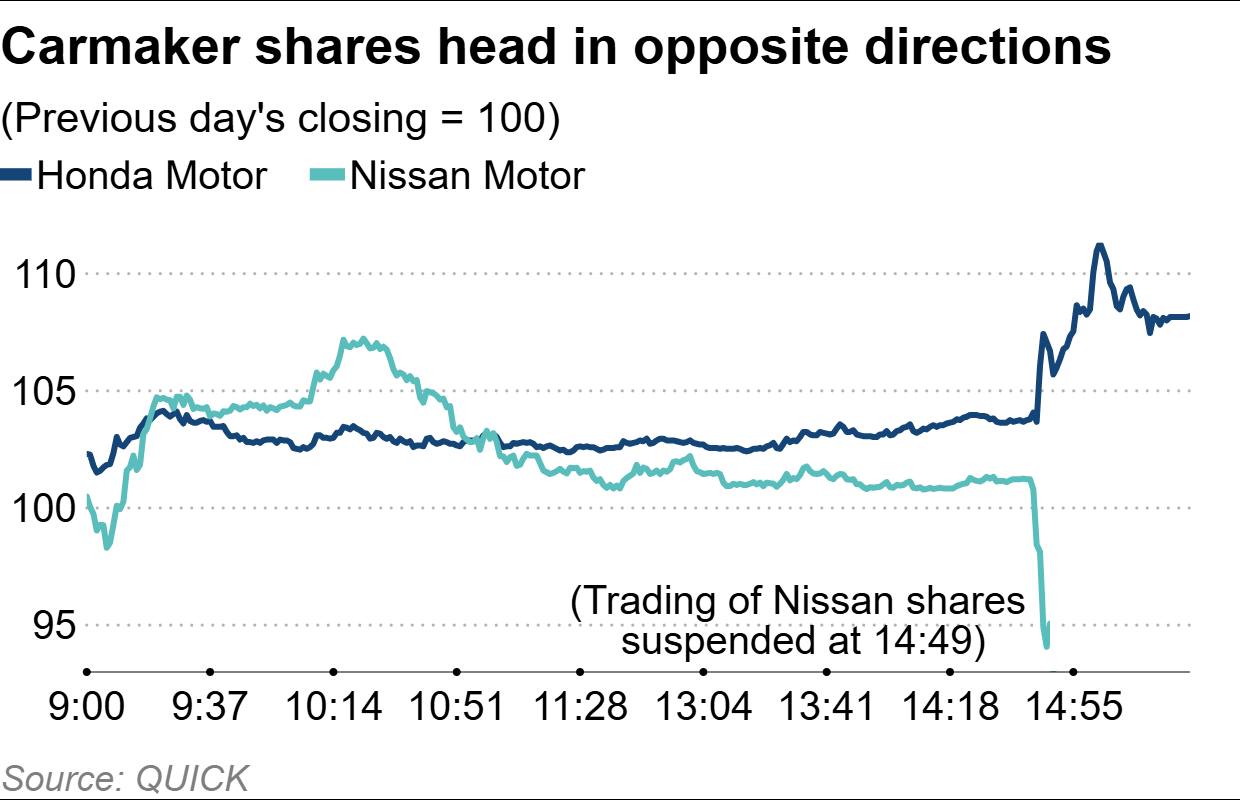
Nissan has called off merger talks with rival Honda, the Nikkei newspaper said, abandoning a tie-up that would have created the world's No.3 automaker and raising questions about how it will drive a turnaround by itself. Shares in Nissan slid more than 4% before trade was suspended by the Tokyo Stock Exchange following the report. Shares of Honda continued to trade and finished the day up more than 8%, in a sign of apparent investor relief that the deal had been scrapped. Honda, Japan's second-largest carmaker, and Nissan, its third-largest, last year said they were in discussions to merge and create the world's third-largest automaker by sales, bulking up in an industry that faces a vast threat from China's BYD and other electric vehicle (EV) entrants.


Nissan to suspend merger talks with Honda

Despite its announcement in November to cut 9,000 jobs globally, Nissan has struggled to finalize its plan due to strong resistance to staff cuts at factories in various locations. Honda proposed that Nissan could become a subsidiary to speed up restructuring, but Nissan -- which sought a near-equal role in the merger -- grew increasingly confrontational with Honda. Mounting differences between the two companies made both sides conclude that it would be challenging to continue integration talks.


Paywall alert:
 
Yep, it's over.
Nissan and Honda ended merger talks to forge a $60 billion car company on Thursday, pitching Nissan deeper into uncertainty and highlighting the pressure on legacy automakers from Chinese rivals upending the industry.

The talks between Honda, Japan's second-largest automaker, and Nissan, its third, were announced in December but were soon strained by disagreements, including over the balance of power. The deal was ultimately sunk by Honda's proposal to make Nissan a subsidiary, sources have said.

The car companies said they would continue with an earlier agreement, which also includes Mitsubishi Motors, to cooperate on technology and other areas.

 
I asked ChatGPT to compare Honda and Nissan across the most important metrics:


MetricHondaNissan
Global Vehicle Sales (2023)3.98 million units3.37 million units
Sales Revenue (FY 2024)¥20.43 trillionN/A (lower than Honda)
Operating Profit (FY 2024)¥1.38 trillionN/A (significant decline in recent years)
Profit Attributable to Owners¥1.11 trillionN/A
Total Assets¥29.77 trillionN/A
Financial HealthStrong growthStruggling, 90% earnings drop in previous years
Market Capitalization (as of December 2024)Valued at approximately $44 billion.Valued at around $10 billion.
ProductionRegular monthly updates on production, sales, and exportsData less frequently updated
WorkforceNot specified, but stable.
Employed 194,993 individuals as a consolidated group.
Faced significant layoffs.
Had a workforce of 133,580 employees.
Recent DevelopmentsExploring strategic partnerships but maintaining independenceCalled off merger talks with Honda but open to collaboration

Honda is currently in a stronger financial position than Nissan, with higher sales, revenue, and profitability. Nissan has faced financial struggles, leading to job cuts and restructuring efforts. Both companies seek ways to enhance competitiveness in a rapidly evolving automotive industry.
 
Given the numbers above, Honda allegedly never saw the tie-up as an equal merger:

Nissan Motor executives expressed astonishment and outrage when Honda Motor proposed "Honda Corporation" as the name for the holding company under which the two automakers were to integrate operations. But Honda's executives dismissed such concerns, noting their belief that the tie-up was not supposed to be an equal merger. Nikkei's look into the behind-the-scenes details of negotiations between the two Japanese automakers sheds new light on how plans for this proposed historic merger collapsed after just one month.

Differences in vision regarding the integration were already apparent during a press conference on 23 December, when Honda and Nissan announced plans to establish a joint holding company. According to a joint statement, Honda was set to appoint the company's president and hold most internal and external board seats, making it evident that Honda was taking the lead in negotiations. At the press conference, Honda President and CEO Toshihiro Mibe stated that the integration would proceed "based on the premise that Nissan steadily executes its turnaround plan."

Struggling with declining sales in the U.S. and China, Nissan had already announced in November plans to cut 9,000 jobs—7% of its global workforce—and reduce production capacity by 20%. However, Mibe remained doubtful about Nissan's ability to implement these restructuring measures successfully. He set the end of January as the deadline to determine whether merger discussions would continue. Proceeding with the integration without first addressing Nissan's weak performance could have negatively impacted the holding company's corporate value, likely provoking opposition from Honda's shareholders.

At the 23 December press conference, Nissan President and CEO Makoto Uchida emphasized that "neither of us is higher or lower," stressing the principle of equality in the merger. However, Honda executives were concerned that Nissan's strong focus on equal standing might lead to leniency in necessary restructuring efforts.

Paywall alert:
 
The reason for the failed merger between Nissan and Honda has been attributed to differences in the number of company executives.

The response to the question about "Comparison of the Number of Executives at Nissan, Honda, and Toyota, and the Causes of Nissan's Decline" on ChatGPT.

Comparison of the Number of Executives at Nissan, Honda, and Toyota, and the Causes of Nissan's Decline
Comparison of the Number of Executives
The number of executives at Nissan, Honda, and Toyota differs significantly. Reports indicate that:

Toyota has around 9 to 14 executives.
Honda has approximately 16 to 26 executives.
Nissan, on the other hand, has an astonishing 45 to 63 executives.
This large discrepancy highlights a structural issue within Nissan. The excessive number of executives can lead to slower decision-making, inefficiencies, and internal conflicts, making it difficult for the company to respond quickly to market changes.

Causes of Nissan's Decline
Nissan has been facing a decline due to several factors:

Declining Sales

Nissan has struggled in key markets like the United States and China.
In China, the company failed to compete effectively in the electric vehicle (EV) market, losing ground to local manufacturers.
Rising Costs

Inflation has increased manufacturing costs, reducing profit margins.
High research and development (R&D) expenses for future vehicle technologies have also put financial pressure on the company.
Organizational Inefficiencies

The large number of executives has led to slow decision-making and a lack of clear leadership.
This has made it difficult for Nissan to implement effective turnaround strategies.
Reputation Damage & Leadership Issues

The Carlos Ghosn scandal significantly damaged Nissan's reputation and internal stability.
Frequent changes in leadership have caused strategic inconsistencies.
Conclusion
While Toyota and Honda have maintained streamlined management structures, Nissan's overcomplicated hierarchy and inefficient decision-making processes have contributed to its decline. To recover, Nissan must restructure its leadership, reduce inefficiencies, and focus on competitive product strategies in global markets.
 
Back
Top Bottom