We have added chapters on general customs, table manners, and bathing and will continue to expand this section. Feel free to comment on this page on the Japan Forum or in the comments box below.
General customs
- Shoes: upon entering a house or a Japanese inn (旅館 ryokan), take off your shoes in the entryway (玄関 genkan). You will usually be provided with slippers. Slippers must be removed when stepping on tatami floor, though. In ryokan and sometimes in private homes, you will be provided with toilet slippers, which are only to be used inside the toilet. A lot of Japanese restaurants (居酒屋 izakaya) also request their guests to take off their shoes. You will be offered a shoe locker to store your shoes.
- Bowing: Japanese people do not shake hands when greeting each other but bow (お辞儀 o-jigi). The way of bowing reflects each person's social status and position towards one another, resulting in bows of up to 90 degrees in angle when very respectful to a slight nod when greeting someone of lower social standing or junior rank. While women fold their hands slightly in front of their bodies when bowing, men's hands rest on their flanks. Foreigners are usually not expected to bow and will be readily welcomed with a handshake.
- Blowing your nose: most Japanese travel guides emphasise the fact that it is considered very rude to blow your nose in public. Don't be mistaken: if you – as a matter of general courtesy that applies to countries other than Japan as well – blow your nose discreetly, no one will mind, even in a crowded restaurant. However, you will find many Japanese people loudly sniffling and snorting on trains or in other public spaces, a behaviour considered quite rude in most Western countries.
Table manners
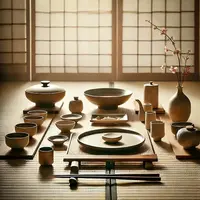
Chopsticks: while most restaurants in Japan do offer Western-style cutlery, you might encounter situations where you have no choice but to use chopsticks (箸 hashi or お手元 otemoto). The pointed ends of the chopsticks are often placed on chopstick rests (箸置き hashioki), where you place them when interrupting your meal. Chopsticks are never to be stuck into food vertically or crossed on the table, as this is only done when food is offered to the dead. When handling food from a dish shared with others, many Japanese turn their chopsticks to hand out portions, which – according to some – is not considered proper etiquette. It is best to use a new set of chopsticks for that purpose. Needless to say, you should never use your chopsticks to point at people or objects. Whether disposable chopsticks (割箸 waribashi) made of splittable wood should be placed back into their paper wrappers after a formal meal remains a controversial issue.
Please refer to our feature on Japanese chopstick manners.
Eating habits: start your meal by stating the phrase "itadakimasu" (いただきます, lit. "I humbly receive", "bon appetit") to show your gratitude to whoever contributed to your meal by hunting, fishing, cultivating and preparing it, conclude it with "gochisōsama deshita (ごちそうさまでした, "Thanks for a good meal"). Contrary to other Asian nations, it is considered rude to belch at the table. On the other hand, slurping Japanese noodles is socially accepted and often expected. However, Italian pasta, such as spaghetti, should not be slurped. It is also a polite custom to clear your plates down to the last grain of rice and put the dishes back in the same position they were initially served. Sushi should be eaten in one piece; soup is consumed by holding the bowl with both hands and drinking from it, while other ingredients can be picked up with your chopsticks. Some dishes, such as Japanese curry or fried rice, are eaten with spoons.
Which dishes can be lifted at the table and which shouldn't?
Japanese meals typically consist of rice, soup, and three side dishes. When dining, it is essential to be mindful of which utensils to lift and which to leave on the table. Lifting bowls of rice or soup while eating is considered good etiquette. However, determining whether to lift other containers can be less straightforward. The size of the container is a crucial factor. Smaller containers, such as those for pickles or soy sauce, can be lifted.
On the other hand, larger containers, like those for main dishes, should remain on the table. Exceptions to this rule include bowls containing single servings of rice or soup, such as katsudon, seafood bowls, or eel rice bowls. Leaning forward to eat from these bowls without lifting them is considered poor etiquette.
Items that can be lifted: tea bowls, soup bowls, rice bowls, small plates, and soy sauce plates.
Items that do not need to be lifted: medium plates and bowls for main dishes, large bowls for several people, large bowls for hot noodles, etc.
If eating on a large plate is difficult, transferring the food to a serving plate and holding it in your hand before eating is a good idea. Lifting bowls while eating is deeply rooted in Japan's cultural history, particularly its tatami mat culture. In traditional Japanese homes, meals were often enjoyed on low tables, making it challenging to manoeuvre chopsticks without spilling food. Lifting the bowl to chest level provided a more convenient and efficient eating method. This practice contrasts with Western dining customs, where food is typically served on tables and eaten with utensils like knives and forks, eliminating the need to lift dishes.
Traditionally, Japanese meals are served with rice on the left and the main dish on the right. This arrangement is designed to optimize the dining experience. The rice bowl is placed on the left to facilitate easy handling with the right hand, typically used for chopsticks. The main dish on the back right minimizes the need to lift bowls. Side dishes, like pickles and ohitashi (お浸し), are positioned in the middle for convenient access. While modern dining practices may deviate from these traditional customs, understanding their cultural significance can elevate everyday meals. By appreciating the historical context of these manners, we can enhance our dining experience and connect with Japan's rich culinary heritage.
Japanese meals typically consist of rice, soup, and three side dishes. When dining, it is essential to be mindful of which utensils to lift and which to leave on the table. Lifting bowls of rice or soup while eating is considered good etiquette. However, determining whether to lift other containers can be less straightforward. The size of the container is a crucial factor. Smaller containers, such as those for pickles or soy sauce, can be lifted.
On the other hand, larger containers, like those for main dishes, should remain on the table. Exceptions to this rule include bowls containing single servings of rice or soup, such as katsudon, seafood bowls, or eel rice bowls. Leaning forward to eat from these bowls without lifting them is considered poor etiquette.
Items that can be lifted: tea bowls, soup bowls, rice bowls, small plates, and soy sauce plates.
Items that do not need to be lifted: medium plates and bowls for main dishes, large bowls for several people, large bowls for hot noodles, etc.
If eating on a large plate is difficult, transferring the food to a serving plate and holding it in your hand before eating is a good idea. Lifting bowls while eating is deeply rooted in Japan's cultural history, particularly its tatami mat culture. In traditional Japanese homes, meals were often enjoyed on low tables, making it challenging to manoeuvre chopsticks without spilling food. Lifting the bowl to chest level provided a more convenient and efficient eating method. This practice contrasts with Western dining customs, where food is typically served on tables and eaten with utensils like knives and forks, eliminating the need to lift dishes.
Traditionally, Japanese meals are served with rice on the left and the main dish on the right. This arrangement is designed to optimize the dining experience. The rice bowl is placed on the left to facilitate easy handling with the right hand, typically used for chopsticks. The main dish on the back right minimizes the need to lift bowls. Side dishes, like pickles and ohitashi (お浸し), are positioned in the middle for convenient access. While modern dining practices may deviate from these traditional customs, understanding their cultural significance can elevate everyday meals. By appreciating the historical context of these manners, we can enhance our dining experience and connect with Japan's rich culinary heritage.
Drinking manners: never pour alcoholic beverages for yourself, always share with others and serve according to seniority. If you have poured for others, another guest will also pour for you. On formal occasions, it is customary for female or junior attendants to pour the drinks. The first drink is traditionally consumed together, so wait until everyone has their glasses filled. You then toast each other by using the phrase "kampai" (乾杯 or 乾盃). Under no circumstances should you use the Italian word "chin chin" to toast, as the term is colloquially used to describe the private male parts in Japanese.

Read more on Japanese cuisine and beverages.
Japanese bathrooms
- Bathing habits: the Japanese are pretty passionate about taking baths (風呂 furo or polite お風呂 ofuro). Despite the introduction of Western-style bathrooms equipped with showers, it is still customary for a Japanese family to take a bath at night in winter and on sultry summer nights. Bathing is not only a matter of bodily hygiene but physical and mental repose.
- Shower first: when taking a bath in a private Japanese home or the shared bath of a ryokan or a hotel, you will need to take a shower first. Japanese inns, hotels, as well as hot springs (温泉 onsen), offer communal shower facilities satisfying all imaginable needs of body hygiene, often providing even shavers and toothbrushes. Private bathrooms are usually furnished with tiny small plastic stools and wash bowls. Once sponged and scrubbed, make sure to rinse your body thoroughly before stepping into the bath! After soaking, shower your body once again. It is quite common for Japanese families to share the same bath, one after another, usually with the paterfamilias in the lead. Guests will often be honoured to be first to enjoy the tub. Make sure not to empty the tub after you have soaked; the rest of the family will still use your water.