

Minamoto no Yoshitsuna (源義綱, c.1042–1134), remembered in his youth as Kamo Jirō (鴨次郎), was born at the Kawachi Genji residence at Tsuboi in Ishikawa District, Kawachi Province, the stronghold of his father, Minamoto no Yoriyoshi (源頼義 , 988–1075). His mother was a daughter of Taira no Naokata. He shared the same parents as his celebrated elder brother, Minamoto no Yoshiie (源義家, 1039–1106), later known as Hachiman Tarō, and his younger brother, Minamoto no Yoshimitsu (源義光, 1045–1127), the founder of the Shinano–Kai branch. He underwent his coming-of-age ceremony at the Kamo Shrine in Kyōto , which earned him the nickname "Kamo Jirō".
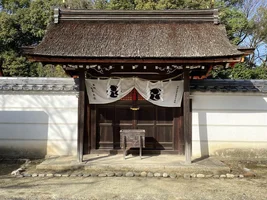
Tsuboi Hachiman-gū (壺井八幡宮) in Habikino, О̄saka
Through the 1090s, Yoshitsuna was frequently employed in ceremonial escort duties for the regent's household, a sign that he still moved in the highest political circles. His own standing rose sharply: in October 1093, he became Mutsu no kami, following father and brother before him. That same year, a violent incident in Dewa, in which the governor Shinmei was killed by Taira no Shimyō and his son, led to Yoshitsuna receiving the order to suppress the rebels. He sent retainers ahead, and by March 1094, the uprising had been crushed. For this, Yoshitsuna was promoted to Junior Fourth Rank, Lower Grade, matching Yoshiie's earlier rank, and soon after transferred to the prestigious post of Mino no kami. For a brief moment, Yoshitsuna's influence appeared to surpass even that of his illustrious elder brother.
His rise, however, was short-lived. In 1095, while reclaiming Enryaku-ji estate lands in Mino under an imperial decree, a monk was killed by an arrow during a scuffle. Enryaku-ji and Hiyoshi Shrine mounted their first major gōso (強訴), parading the Hiyoshi mikoshi into Kyōto, and arrows striking the sacred palanquin were later blamed for the sudden death in 1099 of the regent Fujiwara no Moromichi. With Moromichi gone, Retired Emperor Shirakawa tightened his influence over politics, and Yoshitsuna's fortunes waned. He was never again appointed to a provincial governorship, while Yoshiie cultivated favour at court, rose to Senior Fourth Rank, and enjoyed renewed authority under insei (院政).
When Yoshiie died on 1 July 1106, leadership of the Kawachi Minamoto passed to Yoshiie's fourth son, Minamoto no Yoshitada (源義忠, 1075–1109). Three years later, on the night of 3 February 1109, Yoshitada was attacked by his own retainers and died two days later. A Mino branch warrior, Minamoto no Shigemi, was arrested, but the investigation quickly widened. Suspicion fell upon Yoshitsuna's third son, Minamoto no Yoshiaki, and upon Yoshiaki's guardian, Fujiwara no Sukekata. Both were killed by pursuing officers, and the court began to look more closely at Yoshitsuna's entire household.
Outraged by the deaths of Yoshiaki and Sukekata, Yoshitsuna, his eldest son, Minamoto no Yoshihiro, and several younger sons left Kyōto in protest and withdrew eastward, taking refuge at Mount Kōka (甲賀山) in Ōmi. Their action amounted to defiance of the court. The new Minamoto heir, Minamoto no Tameyoshi (源為義, 1096–1156), assisted by Minamoto no Mitsunobu of the Mino branch, received a formal command from Retired Emperor Shirakawa to put down the rebellion. Fighting broke out in several locations; Yoshitsuna's followers were defeated repeatedly, and Yoshitsuna himself began to argue for surrender.
His sons refused. In a tragic sequence that became one of the darkest episodes in Minamoto family history, Yoshitsuna's sons chose suicide rather than capitulation. Yoshihiro climbed a tall tree and cast himself into a ravine. His brother Yoshitoshi followed. Yoshiaki died earlier while resisting arrest; another brother, Yoshinaka, died by fire; Yoshinori and Gikō killed themselves by sword. By the time resistance collapsed, Yoshitsuna stood alone.
Yoshitsuna surrendered, shaved his head, and became a monk, accepting exile to Sado Island for leaving the capital without permission. Later chronicles suggest that the true instigator of Yoshitada's murder was not Yoshitsuna's household at all but his own younger brother, Minamoto no Yoshimitsu, though the matter remains unresolved.
Some sources claim Yoshitsuna was pardoned and briefly returned to Kyōto; others record that he remained in exile until the end. In the early 1130s, either in 1132 or 1134, Minamoto no Tameyoshi once again pursued him in Sado. Realising there was no escape, Yoshitsuna took his own life. The quiet end of a once-formidable warrior marked the final chapter of a life shaped by battles, shifting court politics, and rivalries within the Minamoto themselves. In death, he was enshrined at Tsuboi Hachiman-gū alongside his grandfather Yorishige, father Yoriyoshi, brother Yoshiie, and brother Yoshimitsu, forming part of the ancestral cult of the Kawachi Minamoto (河内源氏).
Tsuboi Hachiman-gū and Minamoto no Yoshitsuna
Tsuboi Hachiman-gū (壺井八幡宮) in Habikino, О̄saka, served as the principal ujigami shrine of the Kawachi Minamoto from the eleventh century onward. Founded by Minamoto no Yoriyoshi shortly after the Former Nine Years' War, it became the ritual centre for the lineage into which Minamoto no Yoshitsuna was born.Yoshitsuna's connection to the shrine is structural rather than anecdotal. His birthplace was nearby at Tsuboi, and the shrine served as the ceremonial centre for his family during his youth and early military career. Later chronicles list him among the members of the Kawachi Genji enshrined there, along with Yoriyoshi, Yoshiie and Yoshimitsu.
Yoshitsuna's mausoleum (加茂次郎源義綱公 廟所) in Kamo, Niigata.
References:
- Nussbaum, Louis-Frédéric. Japan Encyclopedia. Harvard University Press, 2005.
- Papinot, Edmond. Historical and Geographical Dictionary of Japan. Tuttle, third printing 1988.
- Sansom, George. History of Japan to 1334. Stanford University Press, 1965.
- Sansom, George. A History of Japan 1334-1615. Stanford University Press, 1961.
- Sato, Hiroaki. Legends of the Samurai . Overlook Duckworth, 1995.
- Totman, Conrad. A History of Japan. Wiley-Blackwell; second edition 2005.


