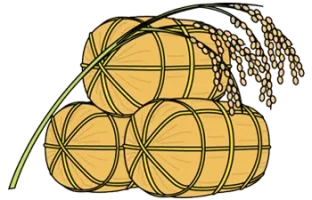
The kokudaka (石高) was the tax base calculated in rice.
The kokudaka (石高) system was the foundation of land assessment, taxation and political authority in early modern Japan. Introduced nationwide by Toyotomi Hideyoshi (豊臣秀吉, 1537–1598) during his cadastral surveys between 1582 and 1596, it estimated the productive capacity of farmland in terms of rice rather than its physical size. The system remained the basis of taxation and domain administration throughout the Edo period (1603–1868) until it was replaced by the Land Tax Reform of 1873.
Rather than measuring the amount of rice actually harvested each year, kokudaka represented the assessed annual yield of farmland expressed in koku (石), the traditional unit used to measure rice. It served as the basis for land taxation, the assessment of village obligations, the stipends of samurai , and the wealth and political standing of daimyō . The Tokugawa shogunate also relied on kokudaka when determining the military and administrative duties expected of each domain.
The koku (石)
The koku was a traditional Japanese unit of volume derived from an older Chinese measure. In Japan, it was used primarily as a dry measure for rice and other grains, although it could also be applied to liquids. One koku was equivalent to ten to (斗), 100 shō (升), or 1,000 gō (合). The familiar plastic measuring cup supplied with modern Japanese rice cookers holds one gō, or one-thousandth of a koku.During the Edo period, one koku was standardised as 180.39 litres (0.18 cubic metres), equivalent to about 40 imperial gallons, 48 US gallons, or approximately 5.12 US bushels. A koku of rice weighed roughly 150 kilograms and was conventionally regarded as enough to feed one adult for an entire year. This practical benchmark made it an ideal unit for measuring agricultural productivity and, by extension, economic and political power.
The amount of rice assessed in koku became the standard by which the size and status of a feudal domain (han ) were judged. A lord generally required an assessed income of at least 10,000 koku before being recognised as a daimyō. Samurai stipends were likewise expressed in koku, as were the official revenues of domains.
The unit had other uses as well. In measuring timber or ship capacity, one koku represented ten cubic shaku, or approximately 0.28 cubic metres (10 cubic feet).
Although the koku had existed since at least the seventh century, its capacity varied over time. The standard adopted during Hideyoshi's reforms was more than twice the size of the earliest koku. The modern legal definition continues to follow the Edo-period standard. Under the Japanese Weights and Measures Act of 1891, one shō was defined as the capacity of the standard kyō-masu measuring box, itself equal to 64,827 cubic bu in the traditional shakkanhō system. Since one koku equals 100 shō, the modern koku is therefore fixed at 240,100⁄1331 litres, or precisely 180.39 litres.
The same legislation also standardised the shaku as 10⁄33 of a metre. This was based on the so-called setchū-shaku ("compromise shaku"), measuring 302.97 millimetres, which represented a middle ground between the earlier kane-jaku standards. Later research suggested that the newer (shin) kyō-masu measuring boxes ideally should have been based on the slightly longer take-jaku, differing by about 0.2 per cent. In practice, however, the measuring boxes actually in circulation did not fully conform to the take-jaku standard. When the Ministry of Finance examined measuring boxes collected from the masu-za (measuring-box guilds) of both eastern and western Japan, it found that their dimensions were generally close to the average between the take-jaku and kane-jaku standards.
The koku itself ultimately derived from a Chinese unit of capacity. Its closest equivalent was the shi or dan (石), also known as hu (斛). The modern Chinese unit is approximately 103 litres, although historically it measured only about 59.44 litres.
Assessing land
The kokudaka assessment was based on the estimated productivity of farmland rather than its acreage alone. Since soil quality and water availability directly affected harvests, paddy fields were classified into four grades according to their expected annual yield, known as 石盛 (kokumori). Average productivity ranged from 1.1 to 1.5 koku per tan of land, roughly 0.1 hectare (0.25 acre). Multiplying the kokumori rating by the number of tan produced the kokudaka of an individual field. Dry fields were assessed using comparable methods.The figures for individual fields were then combined to establish the assessed yield of each village. Annual land tax (年貢 nengu) was levied as a proportion of the village's total kokudaka, while the Tokugawa shogunate used each domain's total assessment to determine the military service, labour obligations and other contributions required of its daimyō.
Because official reassessments were carried out only infrequently, the figures often remained unchanged for many years. Farmers and domain governments, therefore, had every incentive to improve cultivation, reclaim land and increase actual agricultural production while continuing to be taxed according to older assessments. Agricultural output rose considerably during the Edo period, meaning that official kokudaka increasingly understated the amount of food actually produced. It should therefore be understood as an administrative assessment rather than a record of real harvests.
Economic significance
The kokudaka system replaced the earlier kandaka system used during the Kamakura and Muromachi periods, under which taxes were assessed in monetary terms. By calculating taxes in rice rather than cash, the shogunate could adjust the tax rate without altering the underlying assessment. More importantly, the system protected cultivators from fluctuations in rice prices as Japan's economy became increasingly monetised. The burden of price changes instead fell largely upon the daimyō.Although conceived as a taxation system, kokudaka eventually became the principal measure of territorial value and political status in Tokugawa Japan. Official assessments did not always reflect a domain's real wealth, since commercial activity, mining, and other sources of income could generate considerable revenue beyond rice cultivation. Nevertheless, throughout the Edo period, kokudaka remained the standard by which domains were ranked, and their place within the Tokugawa order was determined.
Major daimyō houses around 1664 ranked by kokudama
| - | Daimyō house | Domain | Type | Castle town | Kokudaka |
|---|---|---|---|---|---|
| 1 | Maeda (前田)* | Kanazawa (Kaga) | T | Kanazawa | 1,022,700 |
| 2 | Shimazu (島津) | Satsuma | T | Kagoshima | 770,000 |
| 3 | Date (伊達) | Sendai | T | Sendai | 625,600 |
| 4 | Tokugawa (徳川) | Owari (Nagoya) | S | Nagoya | 619,500 |
| 5 | Tokugawa (徳川) | Kii (Wakayama) | S | Wakayama | 555,000 |
| 6 | Hosokawa (細川) | Kumamoto | T | Kumamoto | 540,000 |
| 7 | Matsudaira (松平) | Fukui (Echizen) | S | Fukui | 447,000 |
| 8 | Kuroda (黒田) | Fukuoka | T | Fukuoka | 430,000 |
| 9 | Asano (淺野) | Hiroshima (Aki) | T | Hiroshima | 426,000 |
| 10 | Mōri (毛利)* | Chōshū (Hagi) | T | Hagi | 369,000 |
| 11 | Tōdō (藤堂)* | Anotsu (Tsu) | T | Tsu | 323,900 |
| 12 | Ikeda (池田) | Tottori | T | Tottori | 320,000 |
| 13 | Ikeda (池田) | Okayama | T | Okayama | 315,000 |
| 14 | Ii (井伊) | Hikone | F | Hikone | 300,000 |
| 15 | Tokugawa (徳川) | Mito | S | Mito | 280,000 |
| 16 | Hachisuka (蜂須賀) | Tokushima | T | Tokushima | 257,900 |
| 17 | Yamanouchi (山ノ内) | Tosa (Kōchi) | T | Kōchi | 200,000 |
Alternative domain names in parentheses.
* House name, sometimes also used as a domain name.
S: shinpan; F: fudai, T: tozama
References:
- Totman, Conrad; A History of Japan, Wiley-Blackwell; second edition 2005
- Nussbaum, Louis-Frédéric, Japan Encyclopedia, Harvard University Press 2005
- Luke Roberts, Mercantilism in a Japanese Domain: The Merchant Origins of Economic Nationalism in 18th-Century Tosa, Cambridge University Press 1998
- Mark Ravina, Land and Lordship in Early Modern Japan, Stanford University Press 1999
- Wakita Osamu, The Kokudaka System: A Device for Unification, The Journal of Japanese Studies, Vol. 1, No. 2 (Spring, 1975), pp. 297-320