

The Sōtō school (曹洞宗 Sōtō-shū) is one of the two central Zen (禅) sects of Japan, alongside Rinzai (臨済). It traces its roots to the Chinese Caodong (曹洞) lineage of Chan (禅) Buddhism, founded by Dongshan Liangjie (洞山良价, 807–869) and his disciple Caoshan Benji (曹山本寂, 840–901). The name "Sōtō" itself derives from the combination of their names. The school emphasises a meditative practice known as mokushō Zen (黙照禅, "silent illumination"), or shikantaza (只管打坐, "just sitting"), a form of meditation free from conceptual or object-centred focus.
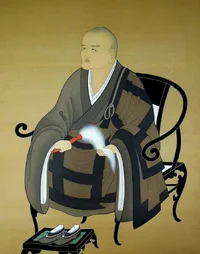
Dōgen Kigen (道元希玄, 1200–1253)
Dōgen, ordained initially as a Tendai (天台) monk on Mount Hiei (比叡山), entered the order at thirteen. Troubled by the Tendai doctrine that all beings inherently possess Buddha-nature (仏性), he sought to understand why, if this were true, Buddhist practice was necessary at all. To resolve this question, he studied under Eisai's successor, Myōzen (明全, d. 1225), and later travelled with him to Song China in 1223. There he met Tiantong Rujing (天童如浄, 1163–1228), a strict Caodong master known for his disciplined approach to meditation. Under Rujing's guidance, Dōgen experienced profound awakening and absorbed the essence of "just sitting." He later referred to Rujing and Myōzen as his only true teachers (先師 senshi).
Returning to Japan in 1227, Dōgen first resided at Kennin-ji (建仁寺), a Rinzai temple in Kyōto. Discontent with the temple's fusion of Zen and esoteric (密教 mikkyō) practices, he withdrew to Fukakusa (深草), south of the capital, where he founded Kōshō-ji (興聖寺) in 1233. This temple, built in the Chinese Song style, became the first in Japan devoted purely to Sōtō meditation and strict monastic discipline. Its community remained small but intellectually devoted, attracting several members of the defunct Nihon Daruma-shū (日本達磨宗), a Zen movement founded by Dainichibō Nōnin (大日房能忍, d. 1196), whose teachings had been banned by orthodox Tendai circles. Among Dōgen's early followers were Koun Ejō (孤雲懐奘, 1198–1280), Tettsū Gikai (徹通義介, 1219–1309), and Gien (義演, d. 1314).
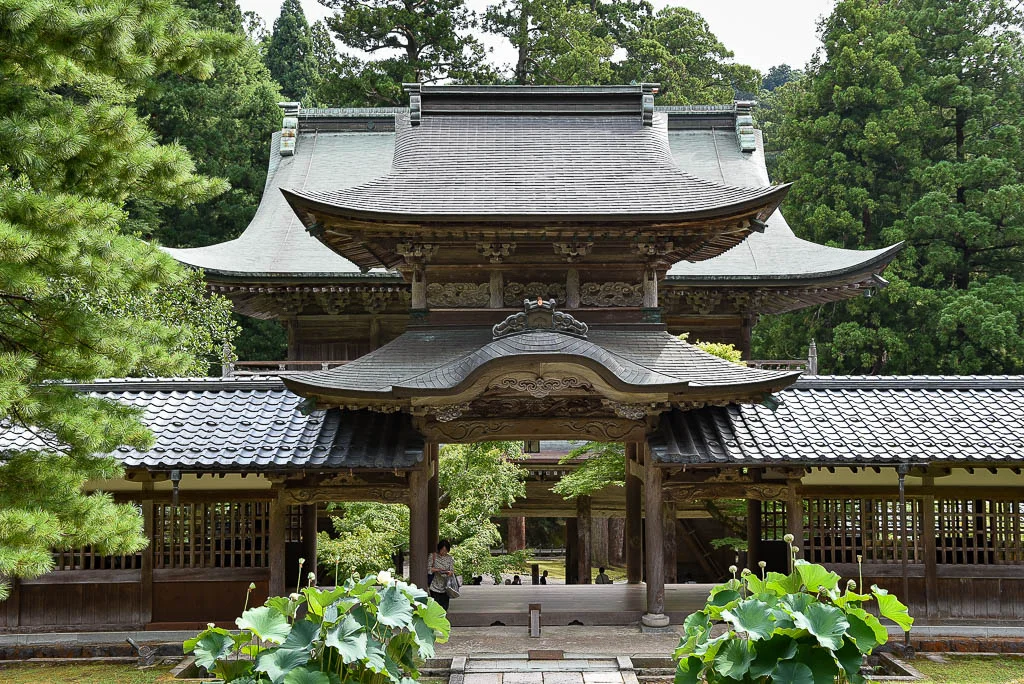
In 1243, facing pressure from the powerful Rinzai establishment of nearby Tōfuku-ji (東福寺), Dōgen accepted an invitation from the Hatano family of the Echizen province (modern Fukui Prefecture ) to establish a new temple. There he founded Eihei-ji (永平寺, "Temple of Eternal Peace"), modelled on Chinese monastic forms and emphasising disciplined meditation, ritual, and ethical conduct. In his writings from this period, including the Fukan zazengi (普勧坐禅儀, "Universal Guide to Zazen") and the Bendōwa (弁道話, "On the Endeavour of the Way"), he declared that Zazen itself was enlightenment — the practice and the goal were inseparable (shushō ittō 修証一等). His magnum opus, the Shōbōgenzō (正法眼蔵, "Treasury of the True Dharma Eye"), articulated his philosophy of immediate awakening through everyday practice.
Dōgen's later years were marked by illness and teaching. Before he died in 1253, he entrusted the temple's affairs to Ejō, who compiled and edited his master's writings. Ejō's leadership continued Dōgen's austere and straightforward path, but after his retirement, controversy arose. Tettsū Gikai, one of the few Sōtō priests who had studied in China, sought to expand Eihei-ji and incorporate elements of esoteric and devotional Buddhism to attract local support. This met resistance from Gien and Jakuen (寂円, Chinese: Jìyuán, 1207–1299), both of whom were devoted to preserving Dōgen's original purity. Their conflict — the sandai sōron (三代相論, "third-generation dispute") — split the early Sōtō community.
Ultimately, Gikai and his followers left Eihei-ji for Kaga Province (modern Ishikawa Prefecture), where they converted the Shingon temple Daijō-ji (大乗寺) into a Sōtō monastery. Jakuen founded Hōkyō-ji (宝慶寺) in Echizen, where some of Dōgen's manuscripts and relics were preserved. Eihei-ji itself fell into neglect, losing its patrons, and contact between the Eihei-ji and Daijō-ji lineages ceased for over two centuries.
The revitalisation of Sōtō came with Keizan Jōkin (瑩山紹瑾, 1268–1325), Gikai's disciple and regarded as the second great patriarch after Dōgen. Keizan founded Sōji-ji (総持寺) in 1321, which became the second daihonzan (大本山, "head temple") of the sect alongside Eihei-ji. He broadened the school's appeal, reaching beyond the cloister to farmers, local samurai , and commoners. While Dōgen had emphasised strict monastic training and the unity of practice and enlightenment, Keizan softened these edges, integrating familiar folk elements such as mountain worship (e.g. Hakusan, 白山), rituals for worldly benefits (genze riyaku 現世利益), and funerary rites. He also absorbed some mikkyō influences from Shingon and Tendai, reflecting a pragmatic approach to spreading the faith. Under his leadership, Sōtō flourished across Japan, from Kyūshū to the Kantō region , becoming one of the largest Buddhist communities in the country.
During the Muromachi and Edo periods, Sōtō temples became deeply woven into local communities. Many served both as centres of meditation and as providers of mortuary services. By the Tokugawa era, the Sōtō school had grown into a vast religious network. Sōji-ji managed more than sixteen thousand branch temples, while Eihei-ji maintained about thirteen hundred. Eihei-ji continued to be honoured as the spiritual centre of the tradition, but it was Sōji-ji that took on the role of its main seat of administration and organisation.
At the heart of Sōtō teaching lies the belief that every being inherently possesses Buddha-nature and that practice and enlightenment are not separate but the same. Its central discipline, shikantaza—"just sitting"—is a quiet meditation in which one sits without chasing goals or clinging to thoughts, letting them come and go naturally. Dōgen's teachings also articulated the concept of hishiryō (非思量), "beyond thinking," a state of mind neither suppressing nor clinging to thought. In his view, meditation itself was the direct expression of Buddha-nature.
In the modern age, the Sōtō school counts approximately 14,700 temples and some eight million adherents, making it Japan's largest Zen sect. It continues to train monks in ango (安居) — 90-day retreats — and maintains both head temples as centres of practice and study.
From the mid-20th century onwards, Sōtō Zen spread widely in the West. In 1959, Shunryū Suzuki (鈴木俊隆, 1905–1971) arrived in California to lead the Soko-ji temple in San Francisco. His approachable teaching of shikantaza inspired the creation of the San Francisco Zen Centre (SFZC), which later established Tassajara Monastery, the first Zen training monastery outside Asia. His book Zen Mind, Beginner's Mind became a seminal text in Western Zen.
In Europe, the tradition was carried by Taisen Deshimaru (弟子丸泰仙, 1914–1982), a disciple of Kōdō Sawaki (澤木興道, 1880–1965), who founded the Association Zen Internationale (AZI) in 1970 and built La Gendronnière, the first Zen temple in France. Kōdō Sawaki's lineage continued through teachers such as Kōshō Uchiyama (内山興正, 1912–1998), Gudō Wafu Nishijima (西嶌愚道和夫, 1919–2014), and later Shōhaku Okumura (奥村正博, b. 1948) and Muhō Nölke (無方, b. 1968), the first non-Japanese abbot of Antai-ji (安泰寺).
In 1970, the British-born nun Hōun Jiyu-Kennett (法雲慈祐ケネット, 1924–1996), the first Western woman ordained in the Sōtō tradition, founded Shasta Abbey in California, further broadening the school's reach. Today, Sōtō Zen continues to evolve as a global tradition. In 1996, North American priests formed the Soto Zen Buddhist Association, which collaborates with the headquarters in Japan. It now formally recognises both male and female ancestral teachers stretching back to India and China, reaffirming the school's inclusivity.
Portrait of Dōgen
Links:
- Kenninji | The Oldest Zen Temple Kenninji
- The Brief history of TOFUKU-JI Temple | "Tofukuji" -This temple is the oldest and largest in Japan.
References:
- Bodiford, William M. Sōtō Zen in Medieval Japan. University of Hawaii Press, 1993.
- Harvey, Peter. An Introduction to Buddhism: Teachings, History, and Practices. Cambridge University Press, 1990.
- Nussbaum, Louis-Frédéric. Japan Encyclopedia. Harvard University Press, 2005.
- Whitney, John. The Cambridge History of Japan. Cambridge University Press, 1988.

