

Bugyō (奉行) was a title given to officials and administrators in pre-modern Japan. The term is commonly translated as "commissioner", "magistrate" or "governor", although the precise meaning varied considerably depending on period, institution and office. In practice, bugyō were officials entrusted with carrying out specific administrative, judicial, financial or military duties on behalf of the court, the shogunate, or a daimyō government.
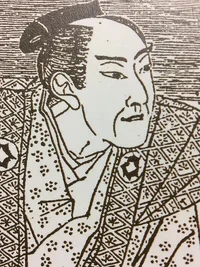
Portrait of Ōoka Tadasuke (大岡忠相, 1677–1752), the celebrated Edo machi-bugyō (江戸町奉行) and one of the best-known magistrates of the Tokugawa period. Serving as South Magistrate of Edo from 1717 to 1736 under Shōgun Tokugawa Yoshimune , Ōoka became renowned for his administrative reforms, judicial decisions and efforts to improve urban governance. Although later popular culture embellished his reputation as an infallible judge, he remains an enduring symbol of the bugyō system and Tokugawa justice.
The earliest recorded use of the title bugyō dates to the Heian period (794–1185). At first, it referred to court nobles and officials temporarily appointed to oversee specific ceremonies, public affairs or palace events. These appointments were generally ad hoc. Once the assigned task had been completed, the official ceased to hold the title. In later centuries, however, the title gradually acquired a more permanent character.
During the Kamakura period (1185–1333), the newly established shogunate institutionalised a growing number of bugyō offices. What had once been temporary assignments evolved into standing administrative posts. By the end of the Kamakura period , the shogunal bureaucracy included thirty-six bugyō offices. Similar positions also appeared in the administrations of provincial military governors (shugo) and local warrior families. Within the Kamakura bakufu , bugyō often functioned as middle-ranking administrators or senior bureaucrats. Among local lords and kokujin families, however, a bugyō might serve as a chief retainer, senior councillor or household manager overseeing the lord's entire estate administration.
The Muromachi shogunate continued this practice. After the death of Ashikaga Yoshimitsu (足利義満, 1358–1408), a corps of civil officials known as the Bugyōshū (奉行衆) emerged. Drawn from hereditary bureaucratic families dating back to the Kamakura shogunate and from long-serving retainers of the Ashikaga house, this group supplied many of the shogunate's administrative officials. In 1434, Ashikaga Yoshinori (足利義教, 1394–1441) established the Tōsen-bugyō (唐船奉行), an office responsible for regulating overseas trade and foreign relations.
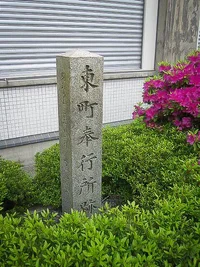
Stone monument marking the site of the East Osaka Town Magistrate's Office (東町奉行所跡, Higashi Machi-bugyōsho Ato). Together with the West Town Magistrate's Office, it formed the administrative and judicial centre of Tokugawa Osaka. The Osaka machi-bugyō exercised wide-ranging authority over the city, combining judicial, police and municipal functions on behalf of the shogunate.
The office reached its greatest development during the Edo period (1603–1868). As the Tokugawa shogunate expanded, its administration grew in a pragmatic and often improvised fashion, creating new offices whenever circumstances demanded. Consequently, a large number of bugyō posts emerged, each responsible for a specific sphere of government.
Among the most important were the Jisha-bugyō (寺社奉行), who supervised temples and shrines; the Kanjō-bugyō (勘定奉行), responsible for finance, taxation and judicial matters relating to shogunal lands; and the Machi-bugyō (町奉行), who served as urban magistrates in major shogunal cities such as Edo, Kyoto , Osaka and Nagasaki. The office of machi-bugyō combined functions that, in modern states, would be divided among mayors, judges, police chiefs, and public prosecutors.
Many other specialised offices existed. The Sakuji-bugyō (作事奉行) oversaw construction projects, while the Fushin-bugyō (普請奉行) supervised public works and infrastructure. The Kinzan-bugyō (金山奉行) administered mines, and the Sado-bugyō (佐渡奉行) governed Sado Island and its important gold mines. Port administrations were entrusted to officials such as the Nagasaki-bugyō (長崎奉行), the Hakodate-bugyō (箱館奉行), and the Kanagawa-bugyō (神奈川奉行). In response to growing foreign pressure in the late Edo period, the shogunate established new offices, including the Gaikoku-bugyō (外国奉行), responsible for diplomacy and foreign trade after 1858, and the Gunkan-bugyō (軍艦奉行), charged with naval affairs.
The military administration also fell under the bugyō system. The Gusoku-bugyō (具足奉行), established in 1641, supervised equipment for the shogunal armies. In 1863, this office was replaced by the Bugu-bugyō (武具奉行), which oversaw military weapons and supplies. Other officials managed prisons, construction materials, and provisions for the shogun's household, as well as numerous specialised functions.
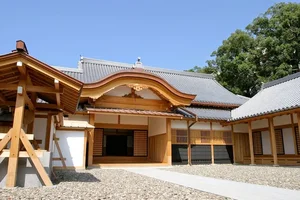
Reconstruction of the Nagasaki Bugyōsho (長崎奉行所), the office of the Nagasaki bugyō (長崎奉行), the shogunate's chief administrators in Japan's principal port for foreign trade during the Edo period. In addition to governing the city, the Nagasaki bugyō supervised commerce with the Dutch and Chinese, monitored foreign residents, and managed diplomatic and security affairs, making the office one of the Tokugawa shogunate's most important regional administrations.
Although the word bugyō often evokes images of powerful senior officials, the title itself merely indicated responsibility for a particular task. Not all bugyō were high-ranking figures. Relatively low-ranking samurai held some offices. Among the Akō rōnin (赤穂浪士), for example, several participants in the famous vendetta held bugyō posts despite receiving stipends of only twenty koku.
Following the Meiji Restoration of 1868, the new government initially retained many Tokugawa institutions while broader reforms were being implemented. As a result, the title bugyō continued to appear in some early Meiji offices. The commander-in-chief of artillery, for instance, was known as the Hōhei-bugyō (砲兵奉行). As the modern state apparatus took shape, however, the term gradually disappeared from official usage.
Today, bugyō survives chiefly in figurative and ceremonial contexts. At shrine festivals, residents or parishioners may be assigned duties under titles containing the word. In everyday Japanese, the expression nabe-bugyō (鍋奉行), literally "hot-pot magistrate", humorously refers to the person who takes charge of preparing and serving a communal hot-pot meal. In politics, influential members of a faction are sometimes collectively dubbed "bugyō", as in references to the "Five Bugyō" or "Seven Bugyō" of a political group. However, such usages are purely metaphorical and do not denote formal office.
Kabuki actor print depicting a scene from the popular Ōoka Seidan (大岡政談, "The Judgements of Ōoka") cycle, a body of stories centred on the Edo magistrate Ōoka Tadasuke (大岡忠相, 1677–1752), better known as Ōoka Echizen. Although such dramatic portrayals often took considerable artistic licence, they helped shape the popular image of the machi-bugyō as a wise and incorruptible judge. Prints and stage adaptations of famous cases enjoyed enormous popularity during the late Edo and Meiji periods, reflecting enduring public fascination with Tokugawa justice and administration.
Major Bugyō Offices of the Edo Period
The Tokugawa shogunate maintained numerous specialised bugyō offices. The following were among the most important:- Edo Machi-bugyō (江戸町奉行) – Magistrates and municipal administrators of Edo. The office was divided between the North Magistrate (北町奉行 Kita-machi-bugyō) and South Magistrate (南町奉行 Minami-machi-bugyō).
- Kyōto Machi-bugyō (京都町奉行) – Urban magistrates responsible for the administration and policing of Kyoto.
- Ōsaka Machi-bugyō (大阪町奉行) – Magistrates responsible for the administration of Osaka.
- Nagasaki Bugyō (長崎奉行) – Governors of Nagasaki, overseeing trade, diplomacy and foreign contacts.
- Jisha-bugyō (寺社奉行) – Commissioners responsible for temples, shrines and religious affairs throughout the realm.
- Kanjō-bugyō (勘定奉行) – Senior financial administrators responsible for shogunal revenues, taxation and fiscal policy.
- Fushin-bugyō (普請奉行) – Commissioners supervising public works, civil engineering and infrastructure projects.
- Sakuji-bugyō (作事奉行) – Officials responsible for the construction and maintenance of shogunal buildings and castles.
- Kinzan-bugyō (金山奉行) – Commissioners charged with supervising mines and mineral production.
- Sado Bugyō (佐渡奉行) – Administrators of Sado Island, particularly its important gold and silver mines.
- Hakodate Bugyō (箱館奉行) – Officials overseeing Hakodate and the surrounding territories in Ezo (Hokkaidō ).
- Kanagawa Bugyō (神奈川奉行) – Commissioners responsible for Kanagawa after the opening of the treaty ports in 1859.
- Gaikoku-bugyō (外国奉行) – Commissioners in charge of diplomacy and relations with foreign powers after 1858.
- Gunkan-bugyō (軍艦奉行) – Officials responsible for naval affairs and the shogunate's warships.
- Rōya-bugyō (牢屋奉行) – Commissioners responsible for the shogunal prison system.
- Uraga Bugyō (浦賀奉行) – Officials overseeing the strategically important port of Uraga and coastal defences near Edo.
- Yamada Bugyō (山田奉行) – Shogunal representatives stationed at Ise, responsible for the area surrounding the Ise Grand Shrine .
- Zaimoku-ishi Bugyō (材木石奉行) – Officials responsible for procuring and managing timber and stone for shogunal construction projects.
- Zen Bugyō (膳奉行) – Officials responsible for provisions and meals served to the shogun.
Although these offices varied greatly in prestige and authority, together they formed the backbone of Tokugawa administration. New bugyō posts were frequently created in response to changing political, military or economic circumstances, particularly during the final decades of the shogunate.
References:
- Bugyō (奉行). From Japanese Wikipedia.
- Hall, John Whitney, ed., The Cambridge History of Japan, Volume 4: Early Modern Japan, Cambridge: Cambridge University Press, 1991.
- Totman, Conrad, Politics in the Tokugawa Bakufu, 1600–1843, Cambridge, MA: Harvard University Press, 1967.
- Totman, Conrad, Early Modern Japan, Berkeley: University of California Press, 1993.

