

Ashikaga Ujimitsu (足利氏満, 1359-1398) was the second Kamakura Kubō (鎌倉公方), succeeding his father Ashikaga Motouji (足利基氏, 1340-1367), the first Kubō, after Motouji died in 1367. His mother was a daughter of Hatakeyama Ienori (畠山家国). At the time of his succession, Ujimitsu was only eight years old, and his youth made it necessary for senior retainers to govern on his behalf. Sasaki Dōyo (佐々木道誉, 1296-1373), a veteran courtier and warrior, travelled from Kyōto to Kamakura to oversee the transfer of power. Uesugi Noriaki (上杉憲顕, 1332-1368), who held the crucial post of Kantō Kanrei (関東管領), also continued to guide the youth until his death in September 1368.
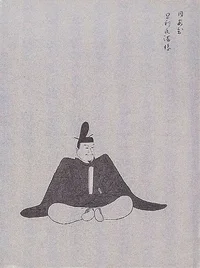
Drawing of Ashikaga Ujimitsu, from Kantō kubō Ashikaga-shi yondai: Motouji, Ujimitsu, Mitsukane, Mochiuji (関東公方足利氏四代: 基氏・氏満・満兼・持氏)
Ujimitsu underwent his coming-of-age ceremony (genpuku) on 21 January 1369, when he was ten years old. On this occasion, he received a character from the name of his cousin Ashikaga Yoshimitsu (足利義満, 1358-1408), the third Muromachi shōgun , and formally took the name Ujimitsu.
As he grew older, Ujimitsu began to display ambition that unsettled his retainers. In the late 1370s, while Yoshimitsu was tightening his hold on central Japan, Ujimitsu entertained the idea of seizing power in Kyōto for himself, even dreaming of being appointed shōgun. During the Kyōryaku Incident (康暦の政変) of 1379, he considered raising arms against Yoshimitsu. Uesugi Noriharu, horrified by the recklessness of such a scheme, tried in vain to dissuade him and, when persuasion failed, committed suicide as a form of protest and admonition. This shocking act forced Ujimitsu to reconsider, and he abandoned the plot. Historians such as Satō Shin'ichi have later suggested that the Shiba clan (斯波氏), long antagonistic to Yoshimitsu, had deliberately incited Ujimitsu's ambitions.
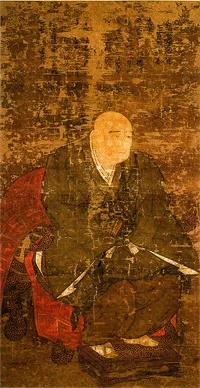
Sasaki Dōyo (佐々木道誉, 1296-1373)
Frustrated in his ambitions in Kyōto, Ujimitsu turned his energy to strengthening his position in the Kantō. He led campaigns against families that supported the Southern Court (南朝), including the Nitta (新田氏), Oyama (小山氏), Oda (小田氏) and Tamura (田村庄司氏). The defeat and death of Oyama Yoshimasa (小山義政) in 1382, who had stirred unrest in Shimotsuke, effectively destroyed one of the oldest and most prestigious houses of northern Kantō. This victory bolstered Ujimitsu's prestige and reminded even his Uesugi allies that the Kamakura Kubō was the dominant force in the region.
By the early 1390s, the fragile balance between Kamakura and Kyōto remained tense. In 1391, when Yoshimitsu clashed with the Yamana clan (山名氏) in the bloody Meitoku Rebellion (明徳の乱), Ujimitsu prepared to march in support of his cousin. The campaign, however, ended before he could participate. The following year, in 1392, Yoshimitsu extended Ujimitsu's jurisdiction by granting him authority over the distant provinces of Mutsu and Dewa. This decision was partly pragmatic: the Ōshū Kanrei (奥州管領) had failed to control powerful northern families such as the Date (伊達氏) and Shirakawa Yūki (白河結城氏), and Yoshimitsu, still shaken by the turbulence of the Meitoku Rebellion, feared that the Kamakura government might drift into opposition. By enlarging Ujimitsu's sphere of authority, the shōgun sought to bind him more closely to Kyōto. Yet this measure did little to heal the rift. Instead, the antagonism between the Kamakura Kubō and the shogunate deepened, passing on to Ujimitsu's heirs, his son Ashikaga Mitsukane (足利満兼, 1378-1402) and grandson Ashikaga Mochiuji (足利持氏, 1398-1439), who would later transform the rivalry into open conflict.
In December 1398, Ujimitsu fell ill and died at the age of forty. Although he lived only four decades, he had ruled as Kamakura Kubō for thirty-one years, from 1367 until his death, a tenure longer than any of his successors. His reign left a dual legacy: on one hand, he consolidated Ashikaga authority in the east and asserted the military might of the Kubō; on the other, his ambitions and uneasy relations with Kyōto laid the foundations for the deep divisions that would destabilise the Muromachi polity in the fifteenth century.
References:
- Ashikaga Ujimitsu. From Japanese Wikipedia
- Hall, John Whitney, Toyoda Takeshi. Japan in the Muromachi Age. Cornell East Asia Series 2001.
- Mason Richard H.P., Caiger John Godwin, A History of Japan, Revised Edition, Tuttle Publishing, 1997
- Nussbaum, Louis-Frédéric. Japan Encyclopedia. Harvard University Press, 2005.
- Papinot, Edmonde; Historical and Geographical Dictionary of Japan, Tuttle, 1972
- Sansom, George. A History of Japan 1334-1615. Stanford University Press, 1961.
- Totman, Conrad; A History of Japan, Wiley-Blackwell; second edition 2005.
- Turnbull, Stephen, Samurai Sourcebook, London 1998
- Turnbull, Stephen, War in Japan: 1467-1615, Oxford 2002

