Nature The Japanese brown and black bear thread

Amid a sharp rise in bear attacks across Akita Prefecture, Governor Kenta Suzuki said he planned to seek help from the Self-Defence Forces to manage what he called a worsening and unmanageable crisis. :oops:

In a message posted on Instagram on 26 October, he described the situation as extremely serious, noting that incidents had been reported across many parts of the prefecture. He wrote that the strain on local authorities was becoming unbearable and said that he was preparing to visit the Defence Ministry to submit a formal request for assistance.

As of 24 October, Akita had reported 47 bear-related injuries and two fatalities since April. More than 60% of those encounters occurred in October alone. To raise public awareness, the prefecture designated September and October as a heightened bear safety period, urging residents to carry noise-making items to deter the animals, keep storage doors closed and share sightings within their communities. Nationwide, bear encounters are also on the rise. 172 people were injured or killed by bears between 1 April and 22 October, with more than 60 percent of those incidents occurring in residential or urban areas.

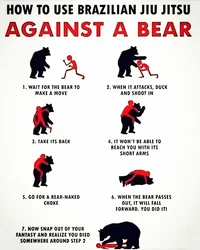
 
jitsu.webp
I'll stick to running away.
 
Convenience store chain Lawson announced plans to begin selling bear repellent spray at selected outlets across the Tohoku and northern Kanto regions. The company is considering providing bear-repellent bells to employees working in areas where bear encounters have recently increased.

Lawson said on 31 October that it planned to supply bear-repellent spray to about 100 stores in regions where bear sightings had been reported, including parts of Tōhoku and northern Kantō. The decision followed a rise in bear encounters nationwide and was accompanied by the introduction of a company-wide safety policy. The plan called for more frequent cleaning of outdoor waste areas that emit food smells and for stores to follow local government guidance, including reduced hours or temporary closures when bears are seen nearby. The company also discussed with experts the possibility of equipping staff in higher-risk areas with bear bells.

 
A small firm in Tokushima Prefecture has created a new bear-repellent spray, a rarity in Japan where most similar products are imported. The manufacturer, Biosiense, a veterinary pharmaceutical company based in Anan, released the spray—named Kuma Ichimokusan ("Bears Running Off")—in May, following about three years of development. The company described the product's aim as promoting coexistence between humans and bears rather than focusing solely on driving them away. The spray uses capsaicin, the active compound found in chilli peppers.


According to Yo Okutani, 40, who heads planning and sales at the firm's Tokyo branch and led the project, the market offers many types of repellents, but the goal was to produce one that genuinely works. An outdoor enthusiast himself, Okutani said he began developing the spray out of concern over rising bear encounters. Drawing on the company's background in chilli-based formulations, he conducted multiple tests with capsaicin and collaborated with a university to verify the results.

Field experiments confirmed that brown bears sprayed with the formula fled immediately, wiping their faces and sniffling — a reaction comparable to that seen with established foreign brands. The spray has a maximum range of about 10 meters and retails for ¥9,900 ($64) including tax, or ¥14,080 with a carrying holster — notably cheaper than many imported competitors, which can sell for as much as ¥20,000. A capsaicin-free version intended for practice is also available for ¥3,850.

Okutani recommends standing upwind and spraying in a broad S-shaped motion to create a "smokescreen" if a bear charges, or aiming directly at its face from about 5 meters away if it approaches slowly. Rather than harming the animals, the goal is to drive bears back into the mountains and maintain a safe distance between them and humans.


Link:

 
In other bear news:

Gifu Prefecture plans to start using drones that play barking-dog and fireworks sounds to keep bears away from towns and villages. The effort, set to begin later this month, will cover Takayama, Shirakawa, and other parts of the prefecture where bear encounters have recently taken place. Earlier in the month, a Spanish tourist in Shirakawa was attacked by a bear cub and suffered a minor injury. Governor Esaki Yoshihide told reporters that the prefecture wants to take early, preventive measures to address bear sightings and attacks so that residents can feel safe in their communities. The government said it would work with local hunting associations to determine how many drones would be used and the routes they would follow.

 
That might be a good retirement gig for... someone I know. I could, ...uh, that person I know could fly FPV drones around Gifu or Iwate from the comfort of home.

Good cross training for war preparedness, too!
 
I'm not sure our doggies would be very fond of barking drones around the house.
 
Definitely cheaper than spray, but is it really efficient?

At the end of October, the government advised that children carry empty plastic bottles as a precaution against bear encounters, explaining that the noise made when the bottles are crumpled tends to scare the animals away. The education and environment ministries issued the recommendation as part of new safety guidelines sent to schools across the country to help protect pupils on their way to and from school. They drew on existing bear-prevention measures already in use in northern regions such as Hokkaido and Tōhoku.

 
Who's going to have presence of mind to crumple a plastic bottle when faced with a bear?
 
Apologies if this was already posted:


Very interesting! So it's all about bear density and Siberian tigers.


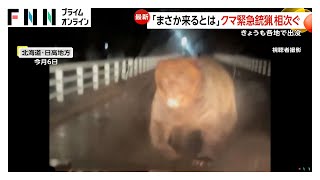
Talking about aggression. Some bears even hunt down cars:


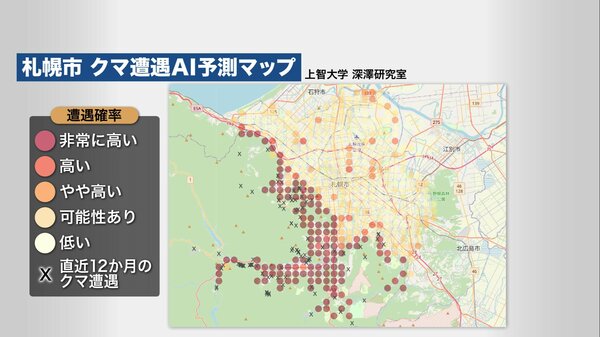
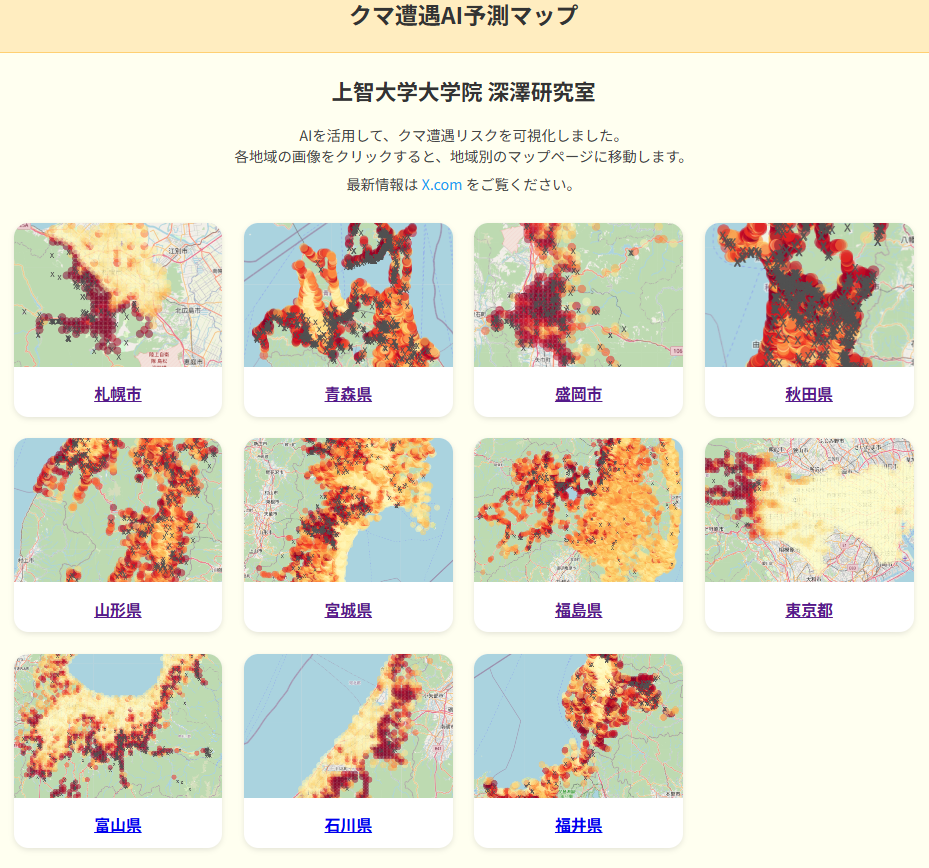
クマ遭遇予測マップ

Sophia University developed an AI-based program that predicts the likelihood of bear encounters by prefecture (クマ遭遇予測マップ).


It would be nice if the maps the Sophia/Jochi prof and his lab did were interactive, instead of more or less saying, 'there are bears everywhere'.

Eg, the X symbol for actual bear sightings (last three months) gets lost in the 'noise' of all those colored circles. It'd be better to be able to toggle the predictive circles off (however they were arrived at), so as to see only the actual bear sightings/encounters.

And then for those, why only the past three months? How about adding in the past six, 12, and 24 months of those encounters? (toggle-able on/off, of course) The user might see on their own (or not) an increase in one area or another, on one prefectural map or another.
 
It's well known in countries that don't have bears, like the UK, that if you're confronted by a bear (any sort) simply singing 'Teddy Bears Picnic' to them will pacify them immediately allowing to be befriend, stroked and even gently kicked with the point of one's boot.
The more 'plummy' one's vocal rendition, the better…like this, their absolute favourite version.
 
Here in Maine , we prefer a 44 magnum and a brain or spine shot. A wounded bear is a mean bear. Glad attacks here are very rare , some black bears reach 3 or 4 hundred pounds.

200.gif
 
It seems American bears are teddies compared to their Japanese counterparts.
 
I once heard a bear hunter/expert say that skeletalised human and grizzly hands look so similar that other than the presence of claws, they could easily be mistaken for each other.
IMG_4645.webp


You'll agree, they're almost indistinguishable 😐
 
It would be nice if the maps the Sophia/Jochi prof and his lab did were interactive, instead of more or less saying, 'there are bears everywhere'.

Eg, the X symbol for actual bear sightings (last three months) gets lost in the 'noise' of all those colored circles. It'd be better to be able to toggle the predictive circles off (however they were arrived at), so as to see only the actual bear sightings/encounters.

And then for those, why only the past three months? How about adding in the past six, 12, and 24 months of those encounters? (toggle-able on/off, of course) The user might see on their own (or not) an increase in one area or another, on one prefectural map or another.
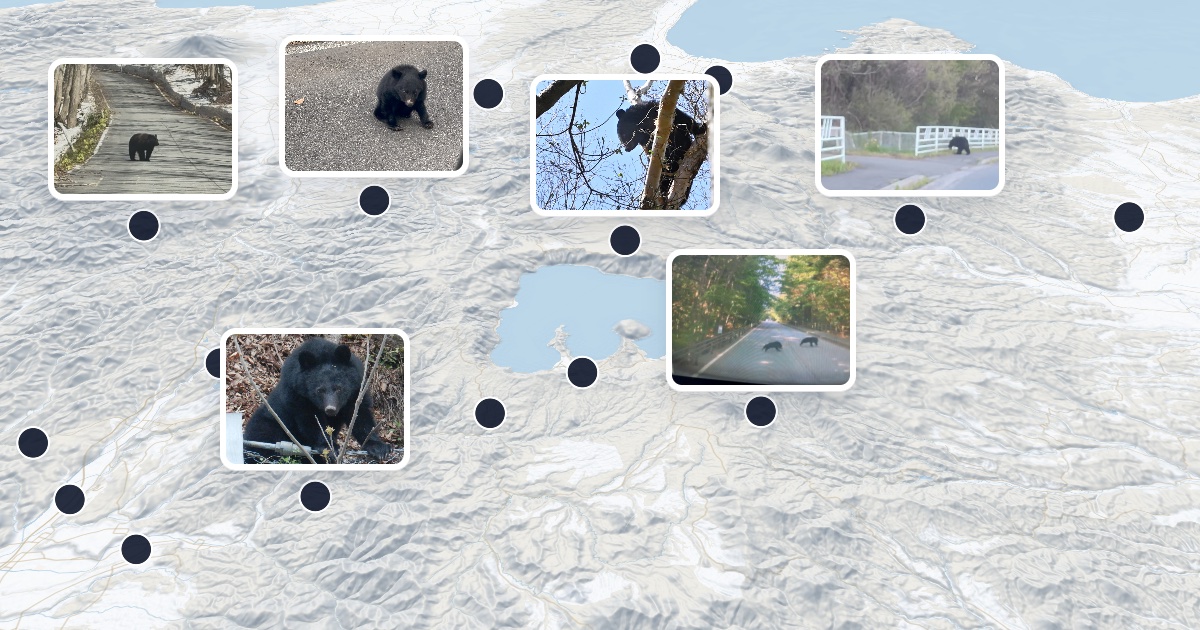
Here's a more interactive map for you, which allows you to report sightings.
 
Back
Top Bottom