So how old is the Golden Pavilion in Kyoto?

thomas

Unswerving cyclist
Admin
Joined
14 Mar 2002
Messages
21,050
Reaction score
18,903
The Cultural Tutor raised an interesting question on Twitter: The Temple of the Golden Pavilion in Kyoto was originally built 600 years ago but has been burned down and rebuilt twice. So how old is it? And is it still the same building?
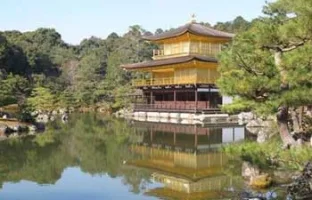
Here's what Douglas Adams, author of The Hitchhiker's Guide to the Galaxy, said about it:'I remembered once, in Japan, having been to see the Gold Pavilion Temple in Kyoto and being mildly surprised at quite how well it had weathered the passage of time since it was first built in the fourteenth century. I was told it hadn't weathered well at all, and had in fact been burnt to the ground twice in this century. "So it isn't the original building?" I had asked my Japanese guide."But yes, of course it is," he insisted, rather surprised at my question."But it's burnt down?""Yes.""Twice.""Many times.""And rebuilt.""Of course. It is an important and historic building.""With completely new materials.""But of course. It was burnt down.""So how can it be the same building?""It is always the same building."


Kinkakuji Temple

Temple  Kinkakuji Temple

Kinkaku-ji (金閣寺), the Temple of the Golden Pavilion, formally known as Rokuon-ji (鹿苑寺 “Deer Garden Temple”), is located in Kyōto’s Kita Ward and belongs to the Shōkokuji (相国寺) branch of the Rinzai sect of Zen Buddhism. Kinkakuji is built on the site of an estate of the aristocrat Saionji no...
 
I enjoyed that. I worry, though, about the view that says the original materials are merely sentimental souvenirs of the past. There has to be some value in the original materials, otherwise there isn't any value in preserving original structures at all. It leads to a kind of fatalism: "who cares if the 600-year old Kinkakuji burns down?... we'll just rebuild it". Or, "who cares if the original Mona Lisa burns up...we've got a digital copy that accurately conveys the color and composition intended by the artist".

The Grand Shrine at Ise is interesting, because it is purposefully destroyed and rebuilt every twenty years (if my memory is correct). The planned destruction (and reconstruction) itself is a concept that is foreign to us westerners. We do attach importance to original materials, which is why we mourn the loss of, say, the roof and spire of Notre Dame, or Seoul's Namdaemun gate that a crackpot burned down several years ago. They can be rebuilt, which is great, but the fact that the original structures survived for so long, is awe inspiring in itself.

So part of myself wants to rebel against the idea that the originality of a building has nothing to do with its materials. Japan has many reconstructed castles, built of concrete poured over steel frames. They are, to me, slightly sad relics of a late 20th century aesthetic of construction and commerce and tourism. Himeji castle , on the other hand, is glorious because it survives. But here, I am aware of a contradiction, because how many of Himeji Castle's planks and tiles are original? I don't know. Maybe none at all. It just went through a massive renovation a few years ago, when old plaster and wood was replaced. So is it still original? This logic loop is causing my brain to kick back one of those frustrating, inscrutable error messages, like you see in Excel.
 
This is when the asterisk gets appended.

Originally build in XXXX*

*Rebuilt the following years after having been destroyed:
XYXX - fire - nature
XYYX - fire - battle of X
YXYX - hurricane Y
YXXY - bombed during battle Y
YYYX - earthquake
 
Back
Top Bottom