Need a word or phrase translated?

Heya, so I'm trying to say something along the lines of "It's always after returning home that my jet-lag is extremely bad."
What I managed to put together was the following:
いつも帰った後に、時差ぼけが物凄く悪い

What Google Translate was suggesting as a possible alternative (I'm assuming I got it wrong) was:
いつも帰る時に、時差ぼけが物凄く悪い

Any suggestions?
 
もちろん、精霊の意志を尊重する、本物の魔装機神をね
魔装機神 is robot.
Of course, I respect the will of the spirit of the real 魔装機神(?)
 
Heya, so I'm trying to say something along the lines of "It's always after returning home that my jet-lag is extremely bad."
What I managed to put together was the following:
いつも帰った後に、時差ぼけが物凄く悪い

What Google Translate was suggesting as a possible alternative (I'm assuming I got it wrong) was:
いつも帰る時に、時差ぼけが物凄く悪い

Any suggestions?
帰国(returning from another country) / 帰宅(returning from a region of another time zone in the same country)したとき、いつも時差ボケがひどい。

もちろん、精霊の意志を尊重する、本物の魔装機神をね
魔装機神 is robot.
Of course, I respect the will of the spirit of the real 魔装機神(?)
I can't remember how many times we have asked you this question, but as usual "context?"
 
まさか。魔装機神は狙って造れるようなちゃちなものじゃないわよ。
高位の精霊との契約なんて、そう簡単にできる事じゃないんだから。
。。。いつかは挑戦してみたいだけどね

まさき:さらっと怖い事言うな

怖いって、何がよ?

まさき:お前にゃデュラクシールって前科が。。。
おっと!!わ、わるい。。。
前科なんて言い方はよくねえな。。。

気にしなくていいわよ。
あたしだって、デュラクシールの件は
忘れた事なんてないんだから。
だけど、失敗したからって、それで
引き下がってちゃ前に進めないでしょ。
あたしだって魔装機設計者の端くれよ。
いつかは魔装機神を造り上げたいと思うのは
当然よ。
もちろん、精霊の意志を尊重する、本物の魔装機神をね。
 
精霊の意志を尊重する modifies 本物の魔装機神.
The subject of 尊重する is 魔装機神, not the speaker.
を is attached to 魔装機神, thus, 魔装機神 is the object. If it's an inversion and 精霊 refers to 魔装機神's 精霊 as in your translation, the particle that is put after 魔装機神 must be の. See the difference.

いつかは魔装機神造り上げたいと思うのは当然よ。もちろん、精霊の意志を尊重する、本物の魔装機神ね。 = 精霊の意志を尊重する、本物の魔装機神を、いつかは造り上げたいと思うのは当然よ。

もちろん、精霊の意志を尊重する、本物の魔装機神ね。 = もちろん、本物の魔装機神精霊の意志を尊重する。
 
I'm a bit confused with ギャグに走る part in the following sentence. Is に here used in the meaning close to として, ギャグとして走る? Or maybe ギャグ is used as an adjective here?

「本当に、もぉ! ギャグに走るのはまだいいけど、周りの人に迷惑かけないの! わかった?」
 
Hey there folks,

I'd like a small confirmation on the meaning of 遠回りして in the phrase below:

俺達は遠回りして、お互いを誤解し、時には憎みあってきた。。。だが、同じだったんだ。

The 俺達 refers to the speaker and a friend of his. They used to be on the same team, had a falling out, tried to kill each other and are now coming back together via some mutual understanding.
Several dictionaries define 遠回りする as "taking a detour, going at a roundabout way" but how does that fit in this sentence? Is it being used akin to "lose one's way"?

Many thanks.
 
They took a roundabout way(= misunderstood and hated each other) to get a fact that they are the same.
 
I can't understand what exactly 多少 modifies in the following sentences. Is it 理由のない変な夢(not sure if includes 理由のない) or 見る?

……まぁ、夢の出来事に理由を求めても、あまり意味がない。
特にあんな異常な体験をしたばかりなのだから、多少理由のない変な夢を見るのも仕方がないかもしれない。
 
An adverb 多少 basically modifies the affirmative form of verbs/adjectives. It can be used with negative forms only when it expresses an extend "somewhat", as in 多少足りない or 多少届かない. Thus, 多少 can modify 変な, 見る or 仕方がない, but can't modify 理由のない in your sentence.

理由のない多少変な夢を見るのも仕方がない
or
理由のない変な夢を多少見るのも仕方がない
or
理由のない変な夢を見るのも多少仕方がない

多少変な夢 seems to be most suitable to the context, just in my impression.
 
Thank you.
But it differs for 少し right? if I replace 多少in this sentence with it, can we use 少し to modify 理由のない?
 
Last edited:
Hi, could anyone please help me translate "Willpower" to Japanese (kanji)? I would like to get it as a tattoo, but when I google it, I get several different symbols. I would hate to tattoo the wrong symbols on my body and have it say something like "chicken" or w/e. I got a link (1) that has several symbols meaning the same thing, which of these is correct?

(1) English to Kanji translation : "Willpower" (Free Kanji translation)

Thanks in advance,
Regards
Pat
 
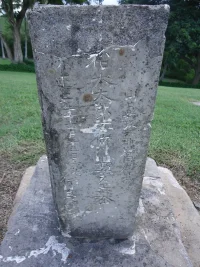
cemetery marker with writing on several sides, there or 4 or 5 different stones. i would appreciate help translating so i can add/update findagrave.com
 

Attachments

  • smaller.webp
    smaller.webp
    267.8 KB · Views: 138
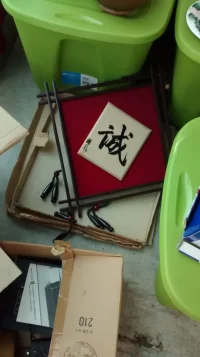
(I think I am in the right place, many apologies if I am not) Good morning, I am new to the group (I just joined today). My grandmother recently passed and she was full Japanese, born in Osaka. I found a sign hanging in her house and I was wondering what it means. I would appreciate some assistance. Thank You very much.
 

Attachments

  • Sign.webp
    Sign.webp
    167.5 KB · Views: 136
cemetery marker with writing on several sides, there or 4 or 5 different stones. i would appreciate help translating so i can add/update findagrave.com
山口縣玖珂郡岩国麻里布村
?木太郎右衛門長女スヱ墓
大正二年四月十三日死亡 行年?(十?)
Marifu Village, Iwakuni, Kuga District, Yamaguchi Prefecture
(present Marifu Town, Iwakuni City, Yamaguchi Prefecture)
Tomb of ?ki Tarōemon's eldest daughter Sue (The first kanji is illegible.)
Died on April 13, 1913
?
(could be 10) years old

(I think I am in the right place, many apologies if I am not) Good morning, I am new to the group (I just joined today). My grandmother recently passed and she was full Japanese, born in Osaka. I found a sign hanging in her house and I was wondering what it means. I would appreciate some assistance. Thank You very much.

makoto
sincerity/faithfulness/truth
 
山口県玖珂郡岩国麻里布村
?木太郎右衛門長女スヱ墓
大正二年四月十三日死亡 行年?(十?)
Marifu Village, Iwakuni, Kuga District, Yamaguchi Prefecture
(present Marifu Town, Iwakuni City, Yamaguchi Prefecture)
Tomb of ?ki Tarōemon's eldest daughter Sue (The first kanji is illegible.)
Died on April 13, 1913
?
(could be 10) years old


makoto
sincerity/faithfulness/truth

山口県玖珂郡岩国麻里布村
?木太郎右衛門長女スヱ墓
大正二年四月十三日死亡 行年?(十?)
Marifu Village, Iwakuni, Kuga District, Yamaguchi Prefecture
(present Marifu Town, Iwakuni City, Yamaguchi Prefecture)
Tomb of ?ki Tarōemon's eldest daughter Sue (The first kanji is illegible.)
Died on April 13, 1913
?
(could be 10) years old


makoto
sincerity/faithfulness/truth

sincerity/faithfulness/truth
Thank You
 
so would the deceaseds given name be Sue/Susan and her father is Taroemon and the surname is something that ends with ki? thank you for your help, i have a couple other stones needing translation some in worse shape than this one.
 
Not really. Her name is a Japanese given name スヱ "Sue"(the pronunciation is "su" + "e"), not a nickname for Susan "Sue".

I recommend making a new thread if you post other pictures.
 
I hope this is the right place to ask if anyone can help with this... if not, my apologies. Can anyone help with understanding what it on this dogtag?
Dogtag scan.webp
 
216
127
No.5


It's just a troop's/unit's/person's number, and hard to identify them.
 
Back
Top Bottom