Need a word or phrase translated?

たいていロシアにいたときよく仕事をしましたか

So. My Japanese is extremely limited. And I believe specifically (ロシアにいたとき is incorrect. Though I could be wrong)

It just looks. Wrong to me. Thanks in advance and sorry to everyone who is just about ready to release the hounds on me.
 
ロシアにいたとき/ころ is correct. The problem is in the translation of "how often". The literal translation is どれくらいの頻度で, but I would use 週に何日くらい "how many days per week" or 一日何時間くらい "how many hours per day" instead.
 
ロシアにいたとき週に何日くらい仕事をしていましたか

~ている form is used here since it's a habit.
 
Hi, I have a small translation request - 「頑張らなきゃ、彼の好きになれるように」. I guess this is the case of 倒置法 and the normal sentence would be 「彼の好きになれるように頑張らなければならない。」. Anyway, I'm wondering about the 彼の好きになれる part. I don't know what that's supposed to mean, specifically who is liking who? Is it "He (guy) can come to like (me)", "(I) can come to like the guy" doesn't make sense to me in this case, but I think that both interpretations are generally possible? I guess the の/が subject marker (for relative clauses) is messing with me here. Would the whole thing mean "I must do my best so he can come to like me?" ?

Thank you in advance.
 
Pot shot, which might make sense depending on context: is it possible this is 好き being used in a similar way to 好み - e.g. shorthand for 彼の好きなタイプ?
 
Pot shot, which might make sense depending on context: is it possible this is 好き being used in a similar way to 好み - e.g. shorthand for 彼の好きなタイプ?

That would be my take on it. She must try hard to become the sort of girl he likes.

Personally, I doubt he's worth it....
 
I third that. If so, since that's not a common usage of 好き, the same 好き would be mentioned / used previously in the story, I think.
 
Could someone please help me with translating this sentence -「僕個人の利益と、街の利益を比較して、街を選ぶというわけですか?」I'm pretty confused in 街を選ぶ part. If I'm understanding correctly, 先生 is telling to 「僕」 that he is choosing not to kill him, and that's is why the town is in danger, so why it is written that 先生 choose 街? I already asked this question before, and the following translation was given to me - "So, weighing my personal interest against the interest of the town, I'm supposed to choose the town? I can't believe this.", which is flows well with context. However I'm not sure if it is correct.

Translation attempt: Comparing my own profit and the profit of a town you are choosing town?

1.webp
 
The translation you were given is correct. If you didn't understand it, you might try asking the person who gave it to you for an explanation before being an ingrate and going behind his back seeking something different elsewhere. It was perfect.
 
Could someone please help me with translating this sentence -「僕個人の利益と、街の利益を比較して、街を選ぶというわけですか?」I'm pretty confused in 街を選ぶ part. If I'm understanding correctly, 先生 is telling to 「僕」 that he is choosing not to kill him, and that's is why the town is in danger, so why it is written that 先生 choose 街? I already asked this question before, and the following translation was given to me - "So, weighing my personal interest against the interest of the town, I'm supposed to choose the town? I can't believe this.", which is flows well with context. However I'm not sure if it is correct.

Translation attempt: Comparing my own profit and the profit of a town you are choosing town?

Context: http://i.piccy.info/i9/b1a0e16de1a074a02d8664ca83d696f7/1410105577/90530/782693/1.jpg
Do you understand the meaning of what 神父 said right before it: "我々は文明人です。話し合いで解決したいと考えています。"? 話し合いで解決する does not mean only "神父/先生 is choosing not to kill him".
 
The translation you were given is correct. If you didn't understand it, you might try asking the person who gave it to you for an explanation before being an ingrate and going behind his back seeking something different elsewhere. It was perfect.
Thank you very much for your reply.
I did understand it, and actually I think that the translation he gave me was the best one. However there were two more people on another resource who translated it the same way as I did. Also, he himself told me that 'the confirmation from a native speaker would be nice'. So, I'm not trying to be ingrate or something.

Do you understand the meaning of what 神父 said right before it: "我々は文明人です。話し合いで解決したいと考えています。"? 話し合いで解決する does not mean only "神父/先生 is choosing not to kill him".
Yes, I understand it.
 
Then you must be able to understand why the town is NOT in danger while 神父/先生 is choosing not to kill 僕.
 
It seems that I actually didn't. Thank you very much for pointing it out.
Now, as far as I can understand - 疑問のあるところを解きほぐして、納得のいくようにすること。また、納得のいくようになること
He is telling that they will deal with this problem in a way where everyone should safe.
 
Yeah, actually, 神父/先生 uses indirect/roundabout expressions. He denies "僕を消去する", and he says 話し合いで解決したい instead. I.e., he makes an offer to 僕, for instance "get out of this town with your own will"(actually it's "forced", though). 僕 wants to stay in the town, right? Nevertheless, 神父/先生 chooses the town's benefit, not 僕's.
 
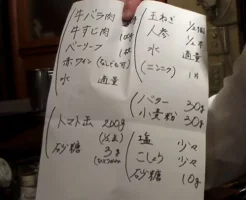
Ingredients translation help please

There's this recipe that I really want to make, but I don't know what it says. I would appreciate it if you guys can help me. Thanks so much.
Demi Glace.webp
 
There's this recipe that I really want to make, but I don't know what it says. I would appreciate it if you guys can help me. Thanks so much.

That's just a list of the ingredients....
 
left part
?g --- beef flank
100g --- beef fibrous
1 leaf --- bay leaf
red wine(not necessary if you don't have)
proper quantity of water

200g(1/2 can) --- canned tomato
3g(a handful) --- sugar

right part
1/2 piece --- onion
1/2 piece --- carrot
proper quantity of water
1 piece --- garlic

30g --- butter
30g --- flour

a pinch of salt
a pinch of pepper
10g --- sugar
 
left part
?g --- beef flank
100g --- beef fibrous
1 leaf --- bay leaf
red wine(not necessary if you don't have)
proper quantity of water

200g(1/2 can) --- canned tomato
3g(a handful) --- sugar

right part
1/2 piece --- onion
1/2 piece --- carrot
proper quantity of water
1 piece --- garlic

30g --- butter
30g --- flour

a pinch of salt
a pinch of pepper
10g --- sugar

Thank you so much, Toritoribe! You guys are the best! 👍
 
I think that should be a "pinch" of sugar rather than a handful. Three grams, anyway.

What is the dish? I am guessing it must be something rather simple since there are no directions for combining things or how to prepare them.
 
I think that should be a "pinch" of sugar rather than a handful. Three grams, anyway.
Yeah, I, too, thought so initially, but what is written there is ひとつかみ, not ひとつみ. It could be a typo, of course.

What is the dish?
The title of the attached image says the answer; "demi-glace (sauce)". ;-)
 
I think that should be a "pinch" of sugar rather than a handful. Three grams, anyway.

What is the dish? I am guessing it must be something rather simple since there are no directions for combining things or how to prepare them.

It's actually a long, tedious process just to make the sauce, surprisingly. Total of 8 hours, but I'm sure it'll be well worth the effort. I found this on youtube from a Japanese chef in Japan, and he couldn't have tempted the viewers any more than with his amazing cooking skills.
 
Back
Top Bottom